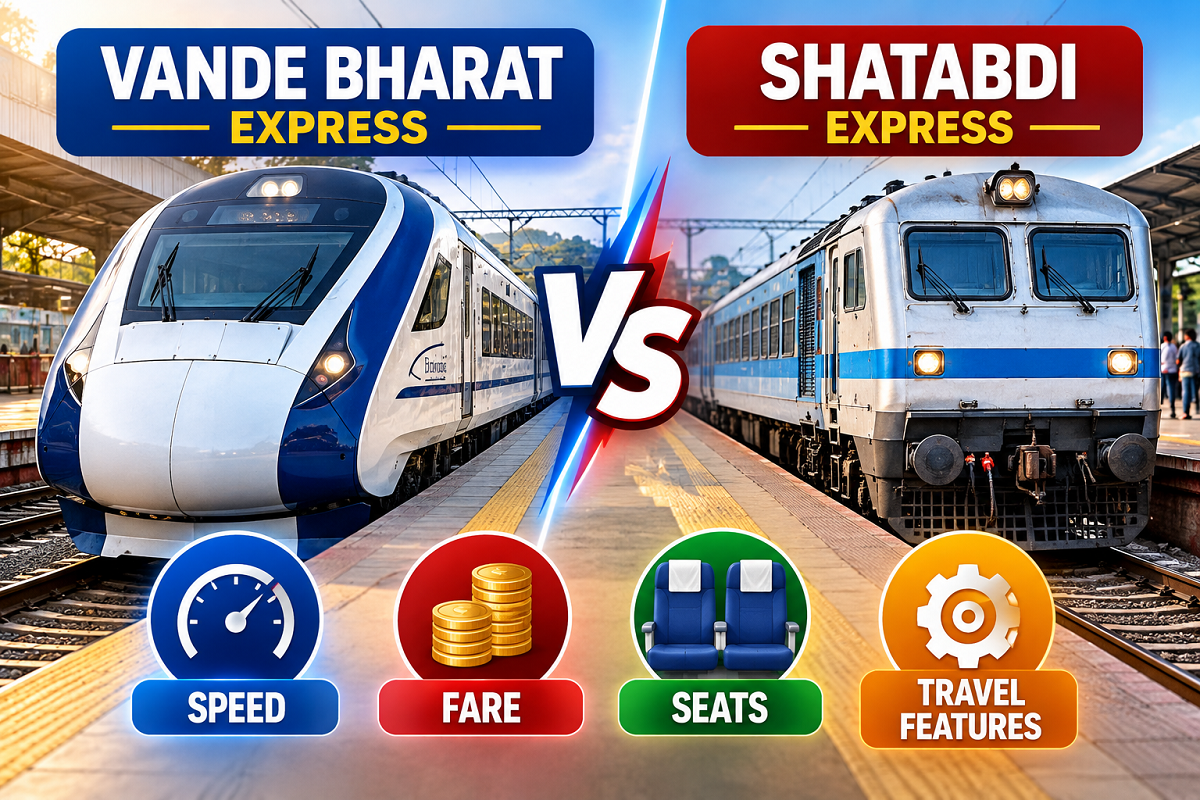
Indian Railways has changed significantly over the years, and two trains often associated with fast daytime intercity travel are the Shatabdi Express and Vande Bharat Express. While Shatabdi established itself as a premium option on important routes decades ago, Vande Bharat represents a newer generation of semi-high-speed train technology.
For passengers, however, the choice between the two is not simply about which train is newer. Travel time, ticket price, seating, onboard facilities, stoppages and route availability can all influence which service is more suitable for a particular journey.
Both are primarily designed for comfortable intercity travel, but their technology and passenger experience can differ. Here's a closer look at the major differences between Vande Bharat and Shatabdi Express.
Vande Bharat vs Shatabdi: What Is the Basic Difference?
Shatabdi Express services have been operating in India since 1988 and became known for connecting major cities with comparatively fast daytime journeys. The trains traditionally use a locomotive to haul a rake of passenger coaches.
Vande Bharat follows a different engineering approach. It is a self-propelled electric multiple unit trainset, meaning traction equipment is distributed across the train rather than relying on a conventional locomotive at one end.
This design can improve acceleration and deceleration, which can be useful on routes where trains have multiple scheduled stops.
Which Train Is Faster?
Vande Bharat trainsets are designed for higher-speed operation than conventional Shatabdi rakes, but the maximum design capability should not be confused with the speed passengers will experience throughout a journey.
Actual operating speed depends on the route, track conditions, signalling, permitted sectional speeds, congestion and other operational restrictions.
Therefore, the difference in journey time between a Vande Bharat and a Shatabdi can vary substantially from one route to another.
For passengers comparing the two, the scheduled departure and arrival times on their specific route are more useful than simply comparing headline maximum speeds.
Seating and Passenger Comfort
Both services are largely aimed at passengers making daytime journeys and offer chair-car style seating.
Shatabdi trains generally provide AC Chair Car and Executive Chair Car accommodation.
Vande Bharat services also commonly offer AC Chair Car and Executive Chair Car categories. The newer trainsets, however, have a more contemporary cabin design and several modern passenger-focused features.
Depending on the train configuration, Vande Bharat can include features such as improved seating, modern lighting, automatic doors and updated passenger information systems.
Executive-class coaches on some Vande Bharat trains also feature rotating seats, adding to the premium travel experience.
Vande Bharat Offers a More Modern Trainset Design
One of the biggest differences is the underlying technology.
Vande Bharat was developed as an integrated trainset rather than a traditional locomotive-and-coach combination. Its distributed traction system allows the train to accelerate more efficiently compared with many conventional locomotive-hauled services.
Passengers may also notice features such as automatic doors, GPS-based passenger information displays, improved onboard systems and modern interiors.
Shatabdi trains continue to offer an established premium intercity service, but their basic operating architecture belongs to an earlier generation of Indian Railways rolling stock.
What About Ticket Fares?
There is no single nationwide fare that can be used to compare every Vande Bharat with every Shatabdi.
Ticket prices depend on the route, travel class, distance and applicable railway fare structure. Catering arrangements and other charges can also affect the final ticket price.
On routes where both services are available, passengers should check the current fare for the same origin, destination and class before booking.
A newer train does not automatically mean that the fare difference will be identical on every route.
Food and Catering Facilities
Catering is another factor passengers may consider when comparing premium daytime trains.
Food arrangements can vary according to the particular service, journey and ticket conditions. Passengers should check whether catering charges are included or optional while making a reservation.
Rather than assuming that every Vande Bharat or Shatabdi ticket comes with exactly the same food arrangement, travellers should review the catering details shown during booking.
Stoppages Can Change the Overall Journey Time
A train's maximum speed alone does not determine how quickly passengers reach their destination.
The number of intermediate stops, duration of each halt, route congestion and permissible speeds across individual track sections can have a major impact on total journey time.
Vande Bharat's faster acceleration can provide an operational advantage, particularly on routes with multiple stops, but actual schedules remain route-specific.
That is why passengers should compare the complete timetable instead of choosing solely on the basis of the train category.
Vande Bharat vs Shatabdi: Key Differences
| Feature | Vande Bharat Express | Shatabdi Express |
|---|---|---|
| Train Type | Self-propelled electric trainset | Conventionally locomotive-hauled service |
| Primary Use | Premium intercity travel | Premium daytime intercity travel |
| Common Classes | AC Chair Car, Executive Chair Car | AC Chair Car, Executive Chair Car |
| Doors | Automatic doors are a key trainset feature | Depends on coach configuration |
| Interior Design | New-generation cabin and passenger systems | Conventional premium railway coaches |
| Acceleration | Faster due to distributed traction | Depends on locomotive and operating conditions |
| Fare | Varies by route and class | Varies by route and class |
| Journey Time | Route and timetable dependent | Route and timetable dependent |
| Catering | Depends on service and booking conditions | Depends on service and booking conditions |
Which Details Should Passengers Compare Before Booking?
Instead of judging the trains only by speed or appearance, passengers can compare practical factors for their specific journey.
Check the scheduled travel time, departure and arrival timings, number of stops, ticket fare, seat availability and catering conditions. It is also worth checking which train operates on the preferred travel date, since schedules and frequencies can differ by route.
For someone prioritising newer onboard technology and a modern trainset experience, Vande Bharat offers several distinctive features. Shatabdi, meanwhile, remains an established premium intercity service on routes where it operates.
Ultimately, the experience depends heavily on the particular route and service. Checking the latest timetable and fare on official Indian Railways booking channels before purchasing a ticket will provide a more accurate comparison than relying only on general specifications.
Note: Train schedules, fares, coach configurations, catering arrangements, operating speeds and stoppages can change. Passengers should verify current details through official Indian Railways or IRCTC channels before booking.