Business
HDFC Bank Loan Rates Rise in November 2026: MCLR Increased by Up to 15 BPS, Check EMI Impact
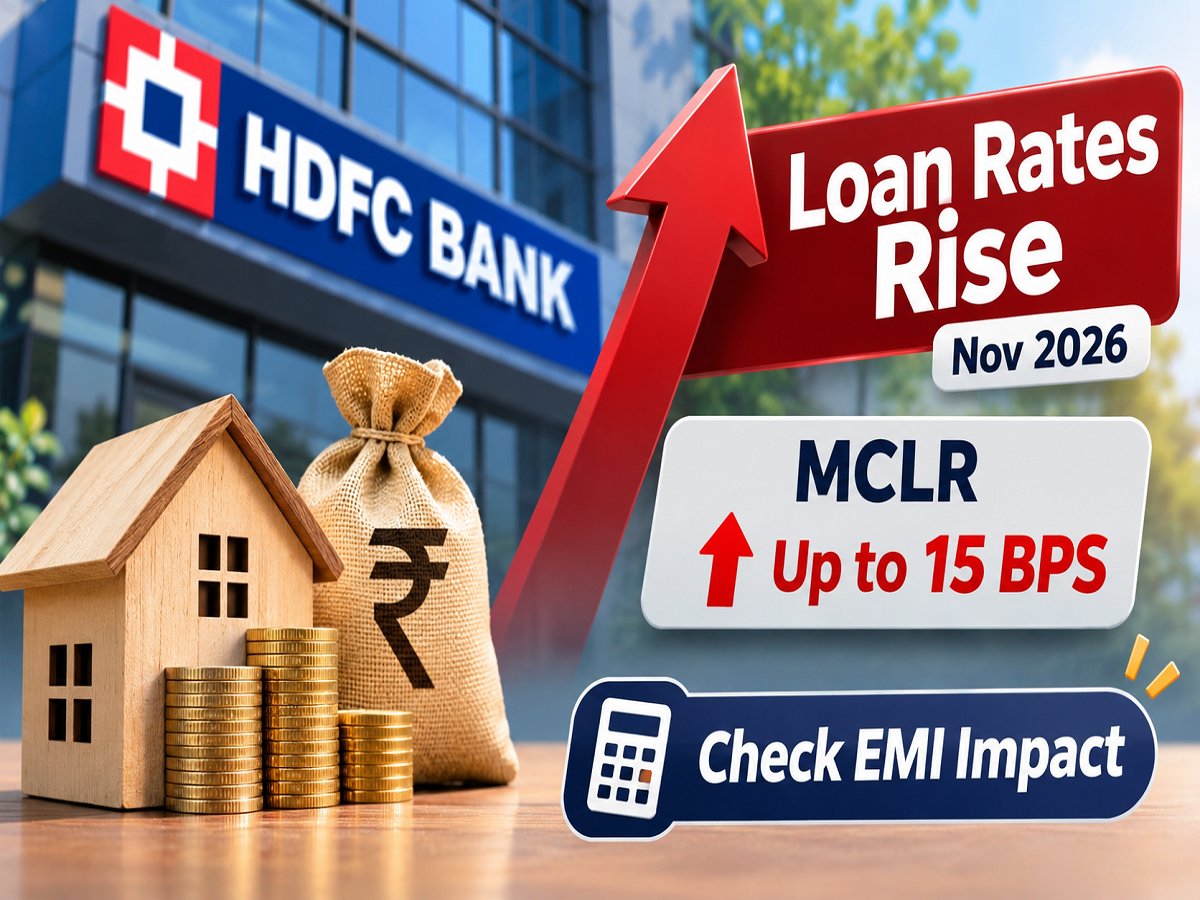
HDFC Bank MCLR Rate Hike 2026: Borrowers with loans linked to HDFC Bank's Marginal Cost of Funds-Based Lending Rate (MCLR) may face higher borrowing costs following the bank's latest interest rate revision. The private sector lender has increased its MCLR across all seven tenures by 5 to 15 basis points, with the revised rates becoming effective from November 7, 2026.
The adjustment could affect customers holding certain home loans, personal loans, vehicle loans and other floating-rate credit facilities linked to the MCLR benchmark.
Following the revision, HDFC Bank's reported MCLR range has moved to 7.85%–8.70%, compared with the earlier range of 7.75%–8.55%.
However, not every borrower will experience an immediate increase in monthly loan repayments. The actual impact depends on the interest rate benchmark, loan agreement, applicable spread and scheduled interest rate reset date.
HDFC Bank Revises MCLR Across All Loan Tenures
According to the November 11 report, HDFC Bank has increased its lending benchmark rates across seven maturity periods.
The largest increases have been introduced for loans linked to the six-month, one-year, two-year and three-year MCLR benchmarks.
Each of these tenures has experienced a rise of 15 basis points, equivalent to 0.15 percentage points.
Shorter-duration benchmarks have also been revised upward, although their increases range between 5 and 10 basis points.
A basis point is equal to 0.01 percentage points. Therefore, a 10-basis-point increase means a rise of 0.10 percentage points in the applicable interest rate.
HDFC Bank MCLR Rates: Old vs New Rates From November 7, 2026
The following table shows the reported changes in HDFC Bank's MCLR rates.
| Loan Benchmark Tenure | Previous MCLR | Revised MCLR | Increase |
|---|---|---|---|
| Overnight | 7.80% | 7.85% | 5 bps |
| 1 Month | 7.75% | 7.85% | 10 bps |
| 3 Months | 7.95% | 8.05% | 10 bps |
| 6 Months | 8.15% | 8.30% | 15 bps |
| 1 Year | 8.30% | 8.45% | 15 bps |
| 2 Years | 8.40% | 8.55% | 15 bps |
| 3 Years | 8.55% | 8.70% | 15 bps |
The figures show that longer-tenure benchmarks have recorded larger increases.
Borrowers whose loan agreements are linked to these benchmarks could see higher interest costs when their next rate reset takes place.
Which HDFC Bank Customers Could Be Affected?
The revised MCLR rates are primarily relevant to customers whose floating-rate loans are linked to the bank's MCLR system.
These may include borrowers with certain older home loans, personal loans, auto loans and other eligible credit products.
However, customers should understand that HDFC Bank offers loans linked to different interest rate benchmarks.
For example, some loans may be connected to an external benchmark, such as the Reserve Bank of India's repo rate, rather than MCLR.
An increase in MCLR does not automatically change the interest rate on loans linked to other benchmarks.
Similarly, fixed-rate loans generally remain unaffected during their agreed fixed-rate period.
Therefore, borrowers should first identify the benchmark mentioned in their loan agreement before calculating any potential increase in borrowing costs.
How Does an MCLR Increase Affect Home Loan EMIs?
When a floating-rate loan is linked to MCLR, the applicable lending rate generally consists of the relevant benchmark plus a spread determined under the loan agreement.
If the benchmark increases and the spread remains unchanged, the borrower's interest rate may rise by the same number of basis points at the next scheduled reset.
For example, suppose a borrower has a home loan linked to the six-month MCLR.
The benchmark has increased from 8.15% to 8.30%.
If the loan's applicable spread remains unchanged, the borrower's interest rate could rise by 0.15 percentage points when the next reset becomes effective.
However, the change may not appear immediately in the monthly EMI because MCLR-linked loans generally follow predetermined reset schedules.
EMI Calculator: How Much More Could Borrowers Pay?
To understand the possible financial impact, consider a hypothetical borrower whose annual home loan interest rate increases from 8.50% to 8.65%.
The following calculations assume that the outstanding loan balance and remaining repayment period stay unchanged.
| Outstanding Loan | Remaining Tenure | Old EMI | New EMI | Monthly Increase |
|---|---|---|---|---|
| ₹20 lakh | 20 years | ₹17,356 | ₹17,547 | ₹190 |
| ₹30 lakh | 20 years | ₹26,035 | ₹26,320 | ₹286 |
| ₹50 lakh | 20 years | ₹43,391 | ₹43,867 | ₹476 |
| ₹50 lakh | 15 years | ₹49,237 | ₹49,678 | ₹441 |
Illustrative calculations rounded to the nearest rupee. Actual EMIs depend on outstanding principal, applicable rates, repayment schedules and bank policies.
These examples demonstrate that even a relatively small increase in the lending benchmark can affect monthly household budgets.
For borrowers with larger outstanding loan balances, the financial impact may be more noticeable.
Calculate Your Possible EMI Increase
Outstanding loan amount
₹30,00,000
Remaining loan tenure
20 years
Current interest rate
8.50%
Interest rate increase
5 bps
10 bps
15 bps
Current EMI
₹26,035
Revised EMI
₹26,320
Estimated extra monthly payment
+₹286
New annual interest rate: 8.65%. Assumes the EMI changes while the remaining tenure stays fixed.
Will HDFC Bank Increase EMIs or Extend Loan Tenure?
A higher lending rate does not necessarily mean that the bank will increase the monthly EMI for every borrower.
Depending on the loan agreement and repayment arrangements, the bank may adjust either the monthly instalment or the remaining repayment period.
If the EMI increases while the repayment tenure remains unchanged, borrowers will need to allocate more money toward monthly loan payments.
Alternatively, if the EMI remains unchanged, the bank may extend the repayment period, subject to applicable limits and regulatory requirements.
An extended repayment period can increase the total interest paid over the life of the loan.
Borrowers should therefore review both the monthly EMI and the overall repayment cost whenever their interest rate changes.
What Is MCLR and Why Does It Matter?
The Marginal Cost of Funds-Based Lending Rate is an internal lending benchmark used by banks to determine interest rates for certain loans.
Introduced by the Reserve Bank of India in April 2016, the MCLR framework was designed to improve the transmission of changes in funding costs to lending rates.
Banks calculate MCLR using factors such as the marginal cost of funds, operating costs, negative carry on cash reserve requirements and the tenure premium.
When these underlying costs change, banks may revise their MCLR rates.
However, MCLR is not necessarily the final interest rate charged to a borrower. Banks may apply an additional spread based on the loan product, credit profile and contractual terms.
What Should Existing HDFC Bank Borrowers Do?
Customers who already have MCLR-linked loans should check their loan statements or agreements to understand the impact of the latest revision.
The most important details include the applicable MCLR tenure, current lending rate, spread, outstanding principal and next interest rate reset date.
Borrowers may also contact HDFC Bank to understand whether the revised benchmark will result in a higher EMI or a longer repayment period.
Customers who have sufficient savings may consider whether partial loan prepayment would help reduce their overall interest burden. However, this decision should account for emergency savings, other financial obligations and applicable loan terms.
HDFC Bank Share Price Gains on November 11
Despite the reported increase in lending benchmark rates, HDFC Bank shares were trading higher during Wednesday's session.
According to the original market report, the bank's stock was trading at ₹812.65 around 1 PM on November 11, 2026, representing a gain of approximately 1.82%.
However, the movement in the bank's share price should not be interpreted as a direct consequence of the MCLR revision. Stock prices are influenced by multiple market and company-specific factors.
Final Takeaway
HDFC Bank's decision to increase MCLR by 5 to 15 basis points, effective November 7, 2026, could raise borrowing costs for customers with eligible MCLR-linked floating-rate loans.
The revised benchmark range of 7.85% to 8.70% represents an increase across all seven tenures, with the largest adjustments affecting longer-duration rates.
Nevertheless, borrowers should not assume that their EMIs will rise immediately. The actual impact depends on the loan benchmark, applicable spread and contractual reset schedule.
Customers should review their loan agreements and upcoming repayment statements to understand how the revised rates may affect their monthly finances.
Disclaimer: This article is for informational purposes only. The reported MCLR rates are based on the supplied November 11, 2026 news report and have not been independently verified against the bank's latest official rate sheet. EMI calculations are illustrative. Borrowers should confirm their applicable lending rates with HDFC Bank.