Business
Gold Investment 2026: What Will ₹1 Lakh Be Worth in 2036? Check 10-Year Returns in 5 Scenarios
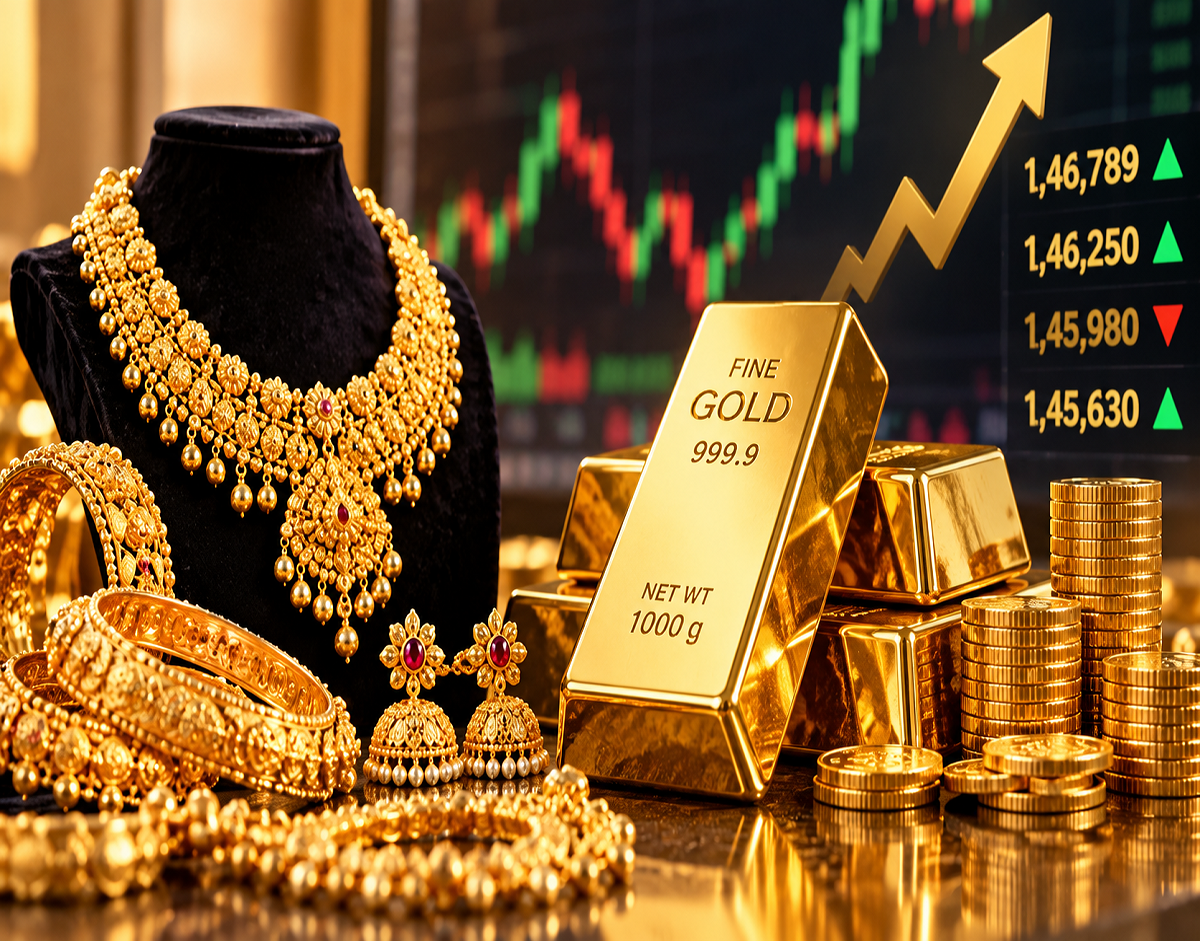
Gold Investment Returns 2036: Gold has traditionally been one of the most preferred investment options among Indian households. Whether purchased as jewellery, coins or investment products, the precious metal is often considered a way to preserve wealth during uncertain economic conditions. With gold prices witnessing substantial growth over the past decade, many investors are now wondering how much an investment of ₹1 lakh made in November 2026 could be worth by 2036.
Historical price trends indicate that gold has delivered impressive returns over certain long-term periods. However, future performance will depend on several factors, including global inflation, interest rates, currency fluctuations and international demand.
Based on different annual growth assumptions, an investment of ₹1 lakh could potentially grow to anywhere between approximately ₹1.66 lakh and ₹5.51 lakh over the next 10 years. These figures are mathematical illustrations rather than guaranteed investment outcomes.
Gold Price History: How Much Has Gold Gained Since 2016?
Gold prices in India have experienced significant appreciation over the past decade.
According to the historical figures cited in the original report, the average price of 24-carat gold in 2016 was approximately ₹28,623 per 10 grams.
By 2026, the reported price had reached around ₹1,53,250 per 10 grams.
This represents an increase of approximately 5.35 times over 10 years.
Here is a comparison of the reported prices:
| Particulars | Gold Price |
|---|---|
| Gold price in 2016 | ₹28,623 per 10 grams |
| Reported gold price in 2026 | ₹1,53,250 per 10 grams |
| Price growth over 10 years | Approximately 5.35 times |
| Approximate annualised growth | 18.3% |
The original report described the historical compound annual growth rate (CAGR) as approximately 18.6%. Using the two rounded prices above produces an annualised rate closer to 18.3%, so the exact result depends on the dates and price series used.
The report also attributed a return exceeding 60% during 2025 to World Gold Council data.
While these historical figures demonstrate the potential for strong appreciation, investors should remember that past returns do not guarantee similar performance in the future.
Gold Investment Calculator: ₹1 Lakh Value After 10 Years
The future value of a gold investment can be estimated using the compound annual growth formula:
\[ FV=P(1+r)^n \]
Where:
- \(FV\) = Future investment value
- \(P\) = Initial investment of ₹1,00,000
- \(r\) = Assumed annual growth rate
- \(n\) = Investment period of 10 years
The following table compares five possible outcomes for an investment made in 2026 and held until 2036.
| Annual Growth Assumption | Value in 2036 | Estimated Profit |
|---|---|---|
| 5.2% | ₹1,65,990 | ₹65,990 |
| 8% | ₹2,15,892 | ₹1,15,892 |
| 10% | ₹2,59,374 | ₹1,59,374 |
| 12% | ₹3,10,585 | ₹2,10,585 |
| 18.6% | ₹5,51,051 | ₹4,51,051 |
Illustrative nominal values before taxes, transaction charges, management fees and inflation. The rates are hypothetical scenarios, not assured forecasts.
Five Possible Gold Investment Outcomes by 2036
Projected value of ₹1 lakh after 10 years
Estimated investment value under five annual growth assumptions.
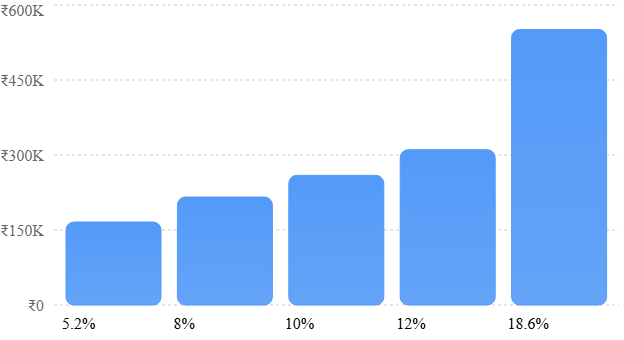
Scenario 1: Conservative Growth at 5.2% Annually
The original report refers to the World Gold Council's Gold Long-Term Expected Return framework, citing an estimated average annual return of 5.2% for the period from 2025 to 2040.
If gold appreciates by 5.2% annually over the next decade, an investment of ₹1 lakh would grow to approximately ₹1,65,990 by 2036.
The estimated gain would be around ₹65,990 before expenses and taxes.
This scenario represents a relatively moderate growth assumption compared with the strong appreciation seen during the previous decade.
Scenario 2: Gold Delivers 8% Annual Growth
Under an 8% annual growth assumption, ₹1 lakh invested in gold would increase to approximately ₹2,15,892 after 10 years.
This would generate an estimated profit of ₹1,15,892.
Such an outcome illustrates how steady long-term appreciation can potentially increase investment value even without exceptionally high annual returns.
Scenario 3: Annual Returns Average 10%
If gold prices rise by an average of 10% annually between 2026 and 2036, the investment could reach approximately ₹2,59,374.
The estimated profit would be ₹1,59,374.
However, gold does not generate a fixed annual interest payment like a bank deposit. Its returns come primarily from changes in market prices, which may rise or fall during the investment period.
Scenario 4: Gold Grows at 12% Every Year
A stronger growth scenario assumes that gold appreciates by 12% annually.
Under this assumption, ₹1 lakh would grow to approximately ₹3,10,585 over 10 years.
The investment would generate a hypothetical profit of ₹2,10,585.
Achieving this outcome would require sustained price appreciation over the investment period, which cannot be predicted with certainty.
Scenario 5: Gold Repeats Its Historical 18.6% Growth Rate
The most optimistic scenario assumes that gold repeats the 18.6% annual growth rate cited in the original report.
If this happens, ₹1 lakh could become approximately ₹5,51,051 by 2036.
The estimated profit would exceed ₹4.51 lakh.
However, this scenario should not be treated as a realistic baseline or guaranteed target. Sustaining such high annual growth for another decade would require exceptionally strong performance.
What Factors Could Influence Gold Prices Until 2036?
Gold prices are affected by several international and domestic developments.
US Federal Reserve interest rates: Changes in American interest rates can influence investor demand for gold. Lower interest rates may improve the relative attractiveness of non-interest-bearing assets, although the relationship is not always consistent.
Inflation and currency movements: Gold is often purchased as a potential hedge against inflation. Movements in the US dollar and Indian rupee also affect domestic gold prices.
Geopolitical uncertainty: International conflicts, economic instability and financial market volatility can increase demand for assets perceived as safe havens.
Central bank purchases: Gold purchases by central banks can influence global demand and market sentiment.
Indian jewellery and investment demand: Festivals, weddings and investment activity can affect domestic buying patterns, although international prices remain a major influence.
Physical Gold vs Gold ETFs: Which Is Better for Long-Term Investment?
Investors planning to hold gold for 10 years should consider the different ways of gaining exposure to the metal.
| Investment Option | Main Advantages | Important Limitations |
|---|---|---|
| Gold jewellery | Can be worn and used for personal purposes | Making charges, GST and resale deductions |
| Gold coins or bars | Direct ownership of physical gold | Storage, security and dealer spreads |
| Gold ETFs | Exchange-traded exposure without physical storage | Expense ratio, brokerage and market-related risks |
| Gold mutual funds | Convenient investment through mutual funds | Fund expenses and tracking differences |
Physical gold purchases can involve GST, making charges and other expenses that reduce the effective investment return.
For example, if an investor spends ₹1 lakh on jewellery, the entire amount may not represent the underlying value of gold because part of the purchase price covers taxes and manufacturing costs.
Gold ETFs and gold mutual funds may offer a more convenient alternative for investment-focused buyers, although these products also involve expenses and market risks.
Should You Invest ₹1 Lakh in Gold for 10 Years?
Gold can play a role in a diversified investment portfolio, particularly for individuals seeking exposure to an asset that may behave differently from equities and bonds during certain market conditions.
However, investing all available savings in gold may create concentration risk.
Unlike fixed deposits, gold does not offer guaranteed returns or regular interest income. Its market value can fluctuate substantially, including over long periods.
Investors should consider their financial goals, risk tolerance, liquidity needs and overall asset allocation before deciding how much money to invest.
It is also important to account for inflation. Even if an investment doubles in nominal value, its actual purchasing power may grow by a smaller amount.
Final Takeaway: Can ₹1 Lakh Become ₹5 Lakh by 2036?
A ₹1 lakh gold investment made in 2026 could potentially grow substantially by 2036, but the outcome will depend entirely on future market performance.
Under a moderate annual growth assumption of 5.2%, the investment could reach approximately ₹1.66 lakh. At 10% annual growth, it could increase to around ₹2.59 lakh.
If gold were to repeat an exceptionally strong annual return of 18.6%, the estimated value could exceed ₹5.5 lakh.
Nevertheless, these calculations are scenarios rather than price predictions. Gold can also deliver low or negative returns over certain periods.
Investors should focus on long-term financial planning and diversification rather than assuming that the exceptional returns of the past decade will continue unchanged.
Disclaimer: This article is for educational and informational purposes only. The calculations are hypothetical and do not guarantee future returns. Gold investments are subject to market fluctuations, taxation and transaction expenses. Consult a qualified financial adviser before making investment decisions.