
Business
GST Rule Changes From December 1, 2026: Five Major Updates on Registration, Refunds and Business Compliance
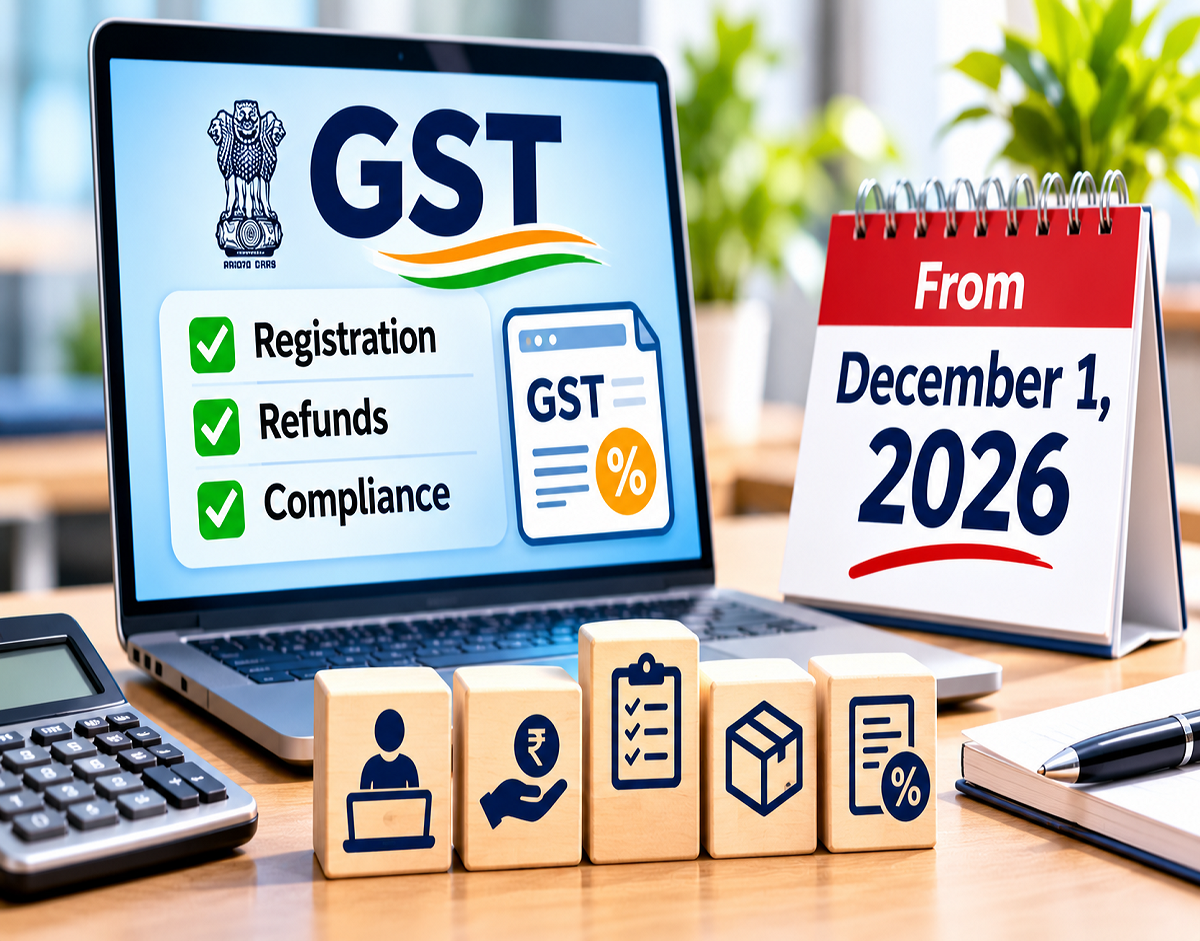
GST New Rules December 2026: Businesses registered under the Goods and Services Tax (GST) system are expected to witness several important procedural changes from December 1, 2026. The revised framework aims to simplify registration cancellation, facilitate business address modifications and improve the processing of GST refund applications.
The upcoming changes are designed to increase automation, reduce administrative delays and minimise the need for eligible taxpayers to visit tax department offices.
However, businesses will still be required to maintain accurate financial records, submit returns on time and comply with applicable tax regulations. Authorities will continue taking action against fraudulent registrations, fake invoices and irregular Input Tax Credit (ITC) claims.
Additionally, further changes related to electronic invoicing and GST returns are reportedly scheduled to take effect from January 1, 2027.
Here are five major GST updates that business owners should understand.
1. Automatic GST Registration Cancellation for Eligible Businesses
Businesses planning to discontinue operations or surrender their GST registration could benefit from a simplified online cancellation mechanism.
Under the revised framework, eligible taxpayers who have fulfilled their outstanding compliance obligations may have their registration cancellation applications processed automatically through the GST portal.
This could reduce the waiting period associated with obtaining approval from tax officials.
Businesses seeking automated cancellation must reportedly fulfil the following conditions:
- File all outstanding GST returns.
- Clear pending tax liabilities.
- Pay applicable interest and late fees.
- Settle outstanding penalties.
- Complete other prescribed compliance requirements.
Applications that do not satisfy the required conditions may be forwarded to the concerned GST officer for further examination.
Business owners should remember that cancellation of GST registration does not eliminate outstanding tax liabilities relating to earlier periods.
2. Revised GST REG-16 Form to Include Additional ITC Information
The application form used for voluntary cancellation of GST registration, Form GST REG-16, has also reportedly been revised.
The updated form will allow taxpayers to provide more comprehensive information regarding Input Tax Credit reversal and available business inventory.
Businesses may need to disclose details concerning raw materials, semi-finished products, finished goods and capital goods for which ITC reversal or payment is applicable.
The revised application will also accommodate relevant NIL return declarations for the period between the last filed return and the effective date of registration cancellation.
Information Required Under the Revised GST REG-16
| Particulars | Information Required |
|---|---|
| Raw material inventory | Applicable ITC reversal details |
| Semi-finished goods | Stock and tax credit information |
| Finished products | Relevant inventory and ITC details |
| Capital goods | Applicable ITC reversal or payment |
| Outstanding returns | Filing and compliance status |
| Pending liabilities | Tax, interest, fees and penalties |
| NIL return declaration | Details for the applicable period |
Businesses should reconcile their inventory records and electronic credit ledger before submitting a cancellation application.
3. Online Business Address Modification for Small Taxpayers
Small businesses registered under the simplified GST registration framework covered by Rule 14A are expected to receive additional flexibility when changing their principal place of business.
Eligible taxpayers will reportedly be able to initiate address modification requests through an online process.
This development could benefit small traders, retailers, service providers and entrepreneurs who frequently face administrative challenges while updating their business registration details.
However, applicants must provide accurate information about their new business premises and submit valid supporting documents wherever required.
Depending on the nature of the premises, these documents may include ownership records, rental agreements, electricity bills or other prescribed address proofs.
The facility does not remove the requirement to conduct genuine business activities from the declared premises.
4. New GST Refund Application Form From December 1
Businesses seeking GST refunds will reportedly be required to use a revised version of Form GST RFD-01 from December 1, 2026.
The updated application is expected to collect more detailed information regarding invoices, transactions, tax payments and supporting documentation.
Two additional refund categories have also reportedly been introduced:
- Refunds relating to specified supplies made to merchant exporters.
- Refunds of additional Integrated GST (IGST) paid following an upward revision in the price of goods after export.
The revised form is intended to provide tax authorities with more structured information while examining refund applications.
According to MS Mani, Partner at Deloitte India, as cited in the original report, improved documentation could reduce the need for authorities to request additional information during subsequent verification.
Businesses Must Check Pending Refund Applications
Taxpayers who have prepared refund applications but have not received an Application Reference Number (ARN) before December 1 may reportedly need to submit their applications again using the revised form.
Before applying for a GST refund, businesses should reconcile invoice details, HSN codes, Input Tax Credit records, export documents and applicable tax payments.
Incomplete or inconsistent information could result in processing delays or additional verification requirements.
5. Strict Monitoring of Fake GST Registrations and Fraudulent Invoices
Although the revised GST framework focuses on simplifying procedures, tax authorities will retain their powers to investigate suspicious business activities.
Businesses operating with fraudulent registrations, incorrect addresses or invoices issued without genuine supplies of goods or services may face regulatory action.
According to the source report, Mihir Deshmukh, Partner at Shardul Amarchand Mangaldas & Co., explained that certain technical grounds for registration cancellation have been removed, but enforcement against fraudulent activities will continue.
Businesses must ensure that their registered addresses are accurate, transactions are genuine and supporting documents are properly maintained.
Changes to applicable registration particulars should generally be reported within the prescribed 15-day period.
GST Changes From December 2026: Quick Overview
| GST Update | Expected Impact |
|---|---|
| Automated registration cancellation | Faster processing for eligible taxpayers |
| Revised GST REG-16 | Additional inventory and ITC disclosures |
| Online business address modification | Simplified procedures for eligible small businesses |
| Revised GST RFD-01 | More detailed refund documentation |
| Fraudulent registration monitoring | Continued enforcement against fake invoices and registrations |
| E-invoicing changes | Further compliance updates expected from January 1, 2027 |
Additional GST and E-Invoicing Changes Expected From January 2027
Businesses should also prepare for another set of GST-related changes reportedly scheduled for January 1, 2027.
These amendments are expected to involve electronic invoicing and GST return procedures.
Companies using automated billing platforms, accounting software and Enterprise Resource Planning (ERP) systems may need to review their existing configurations once the detailed technical requirements are available.
Businesses should coordinate with their accounting teams, GST consultants and software service providers to minimise potential disruptions.
What Should Business Owners Do Before December 1?
GST-registered businesses can prepare for the upcoming changes by completing the following compliance checks:
- Submit all outstanding GST returns.
- Clear pending tax payments, interest and penalties.
- Reconcile purchase and sales invoices.
- Verify Input Tax Credit records.
- Review pending refund applications and ARN status.
- Update registered business information wherever necessary.
- Prepare supporting documents for registration cancellation or refund claims.
- Review billing and accounting software for upcoming compliance changes.
The revised GST framework could make several routine tax procedures faster and more accessible, particularly for small businesses. However, accurate documentation, timely return filing and genuine business transactions will remain essential for maintaining compliance.
Taxpayers can visit the official GST Portal and the Central Board of Indirect Taxes and Customs (CBIC) website for official notifications and procedural updates.
Disclaimer: The reported implementation dates, revised forms and eligibility conditions have not been independently verified against the latest official GST notifications. Businesses should consult their chartered accountant or GST practitioner before taking compliance-related action.