Business
Gold and Silver Rates Today, October 23, 2026: 24K Gold at ₹1,41,448, Silver Near ₹1.95 Lakh per Kg
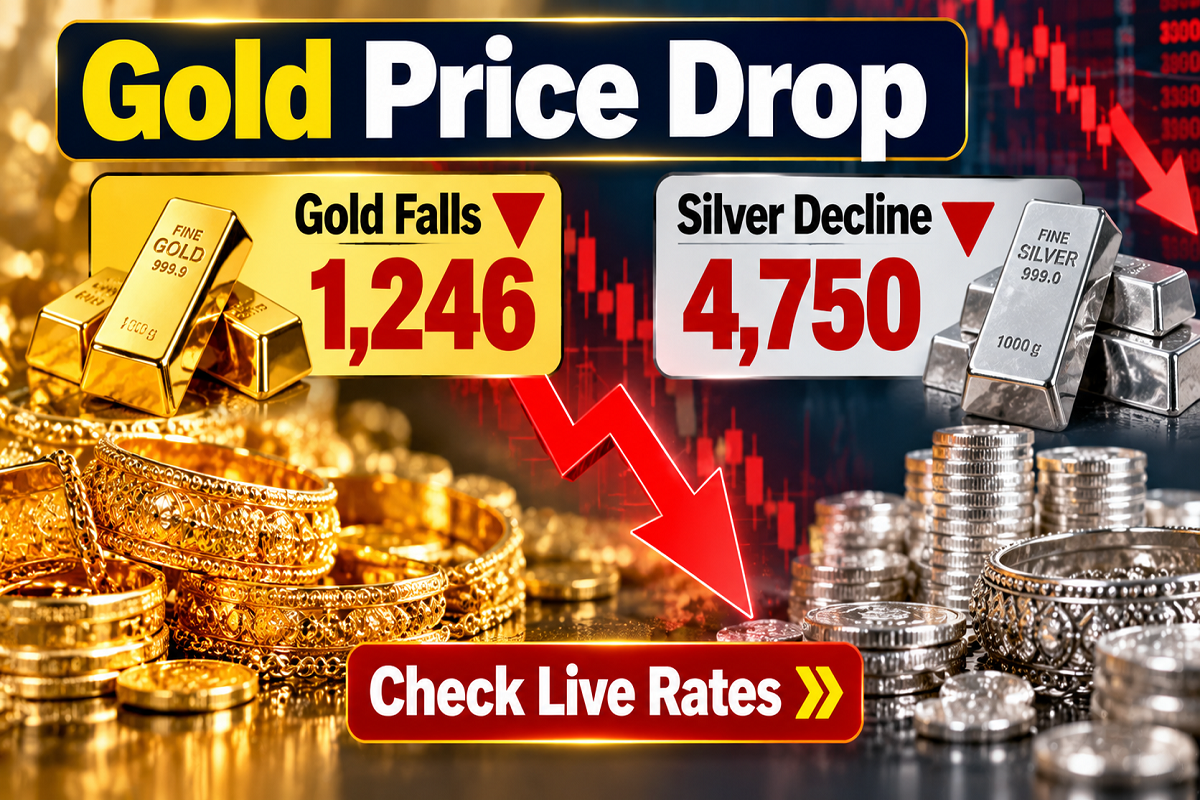
Gold Price Today, October 23, 2026: Precious metal prices came under fresh pressure on Friday, with gold and silver recording another decline in the domestic bullion market. According to the latest rates cited from the India Bullion and Jewellers Association (IBJA), 24-carat gold was quoted at ₹1,41,448 per 10 grams, while silver stood at ₹1,95,027 per kilogram.
The reported correction comes amid weakness in international gold prices, where the yellow metal slipped to its lowest level in more than two weeks. The development is attracting attention from jewellery buyers, investors and families planning purchases during the festive and wedding seasons.
The source report indicates that gold declined by approximately ₹1,246, while silver became cheaper by around ₹4,750. However, the comparison period for these declines is not specified clearly, so the figures should be treated as reported changes rather than independently verified daily movements.
Gold Price Today: Latest Rates for 24K, 23K, 22K, 18K and 14K
Gold prices vary according to purity, with 24-carat gold generally commanding a higher price than jewellery-grade gold.
The following rates were reported for October 23, 2026.
| Gold Purity | Price per 10 Grams |
|---|---|
| 24-carat gold | ₹1,41,448 |
| 23-carat gold | ₹1,40,882 |
| 22-carat gold | ₹1,29,566 |
| 18-carat gold | ₹1,06,086 |
| 14-carat gold | ₹82,747 |
Source: IBJA rates as cited in the supplied October 23 report. These figures have not been independently checked against the association's latest bulletin.
These are indicative bullion rates and should not be confused with the final amount charged by jewellery retailers.
The actual purchase price may include GST, making charges and other applicable costs.
Silver Price Today: White Metal Falls to ₹1,95,027 per Kg
Silver also witnessed selling pressure in the domestic market.
According to the supplied report, silver was quoted at ₹1,95,027 per kilogram on October 23.
The article describes a decline of ₹4,750, although it does not specify the exact earlier reference price or comparison period.
Based on the reported current rate, the indicative price works out to approximately ₹195.03 per gram before applicable taxes and retail charges.
| Silver Quantity | Indicative Value |
|---|---|
| 1 gram | ₹195.03 |
| 10 grams | ₹1,950.27 |
| 100 grams | ₹19,502.70 |
| 1 kilogram | ₹1,95,027 |
These calculations are based on the reported kilogram rate and do not include GST or dealer premiums.
Silver is widely purchased for jewellery, coins, utensils and investment purposes. Its prices can also be influenced by industrial demand, making its market behaviour different from gold in certain circumstances.
Why Are Gold Prices Falling?
The latest decline has been linked to weakness in international bullion markets.
According to the source report, spot gold fell by approximately 2.2% to $4,051.55 per troy ounce late Thursday.
US gold futures for December delivery reportedly declined by around 2%.
The report also connects the pressure on bullion to inflation concerns associated with rising crude oil prices.
However, the relationship between inflation and gold prices is complex.
Gold is often considered a potential hedge against inflation, but it can weaken when investors expect higher interest rates, rising bond yields or a stronger US dollar.
Consequently, inflation concerns do not always result in higher gold prices.
Major Factors Influencing Gold and Silver Prices
Several domestic and international developments can affect bullion prices.
- US dollar movements: A stronger dollar can make dollar-denominated gold more expensive for buyers using other currencies.
- Interest-rate expectations: Higher yields on interest-bearing assets can reduce the relative appeal of non-yielding gold.
- Crude oil prices: Changes in energy costs can influence inflation expectations and financial-market sentiment.
- International demand: Investment flows, central-bank purchases and jewellery consumption can affect gold prices.
- Rupee-dollar exchange rate: Currency movements influence the domestic cost of imported precious metals.
- Industrial demand: Silver prices can also respond to activity in manufacturing, electronics and solar-energy industries.
No single factor determines daily bullion movements, and the relative importance of these influences can change over time.
Gold Prices Decline Ahead of Festive and Wedding Purchases
Gold buying traditionally attracts considerable attention in India during major festivals and the wedding season.
The latest correction may encourage some consumers to compare prices before making purchases.
However, a fall in bullion rates does not necessarily mean that every jewellery item will become cheaper by the same amount.
Retailers may apply different making charges depending on design, craftsmanship and the type of ornament.
The purity of gold also affects the final price.
For example, 22-carat gold is commonly used for jewellery because it contains alloy metals that improve durability compared with pure gold.
Meanwhile, 18-carat and 14-carat gold are also used in jewellery, particularly in designs that require greater strength.
How Much GST Is Added to Gold Prices?
The rates cited from IBJA generally exclude GST.
For a simple illustration, consider the reported 24-carat gold price of ₹1,41,448 per 10 grams.
Applying 3% GST to that bullion value gives the following calculation:
| Particulars | Amount |
|---|---|
| Gold value for 10 grams | ₹1,41,448.00 |
| GST at 3% | ₹4,243.44 |
| Total including 3% GST | ₹1,45,691.44 |
This is only a basic bullion-value illustration.
For jewellery purchases, making charges and the applicable GST treatment of the complete transaction can affect the final invoice.
Consumers should ask the retailer for an itemised bill rather than estimating the entire purchase cost from the published bullion rate alone.
What Would 10 Grams of 22-Carat Gold Cost?
The reported 22-carat gold rate stands at ₹1,29,566 per 10 grams.
If 3% GST is applied to this base amount, the calculation would be:
- Gold value: ₹1,29,566
- GST at 3%: ₹3,886.98
- Total: ₹1,33,452.98
The example excludes making charges and other retailer-specific costs.
The final price of a necklace, ring, bracelet or other ornament can therefore be higher than this illustrative figure.
Difference Between 24K, 22K, 18K and 14K Gold
Gold purity is an important consideration when comparing jewellery prices.
| Gold Category | Approximate Gold Content | Common Uses |
|---|---|---|
| 24K | 99.9% | Coins, bars and investment products |
| 22K | 91.6% | Traditional gold jewellery |
| 18K | 75% | Jewellery, including gemstone settings |
| 14K | 58.5% | Durable jewellery designs |
Higher purity generally means a greater proportion of gold in the product.
However, buyers should consider design, durability, hallmarking and resale terms rather than choosing jewellery solely on the basis of purity.
Should Consumers Buy Gold After the Price Drop?
A decline in prices may provide an opportunity for buyers who already have a planned jewellery requirement.
However, short-term price movements are difficult to predict.
Gold can recover or decline further depending on global market conditions.
Consumers purchasing jewellery for personal use may benefit from comparing prices and making charges across authorised retailers.
Investors, meanwhile, should consider their financial goals, risk tolerance and investment horizon.
A single day's correction should not be treated as proof that prices have reached their lowest level.
Important Checks Before Buying Gold Jewellery
Consumers should verify the purity and hallmarking details of the jewellery they intend to purchase.
Where applicable, BIS hallmarking and the Hallmark Unique Identification number can help buyers check product details through official facilities.
It is also advisable to request a proper invoice showing the weight, purity, gold value, making charges and applicable taxes.
Customers should clarify the retailer's exchange and buyback conditions before completing the purchase.
The price of gold jewellery can differ from the IBJA benchmark because retail rates and charges vary.
Will Gold and Silver Prices Fall Further?
The latest market correction has increased interest in the future direction of bullion prices.
However, the information available in the supplied report does not establish whether gold or silver will continue declining.
International interest-rate expectations, currency movements, inflation data and investor demand may influence the next phase of price movements.
Silver could also experience additional volatility because of changes in industrial consumption and investment demand.
Buyers should therefore avoid relying on short-term price predictions when making substantial purchases.
Final Takeaway
Gold and silver prices were reported lower on October 23, 2026, with 24-carat gold quoted at ₹1,41,448 per 10 grams and silver at ₹1,95,027 per kilogram.
The reported rates for 22-carat and 18-carat gold stood at ₹1,29,566 and ₹1,06,086 per 10 grams, respectively.
Weakness in international bullion markets has contributed to the latest pressure on precious metals, while domestic buyers are monitoring the correction ahead of festive and wedding purchases.
Consumers should remember that published bullion prices exclude GST and jewellery-making charges, meaning the final retail price can be significantly higher.
Disclaimer: This article is independently rewritten from the supplied October 23, 2026, report. The quoted IBJA rates and market movements have not been independently verified in real time. Precious metal prices fluctuate throughout the trading day and may differ by city and retailer.