Business
8th Pay Commission Salary Calculator 2026: How ₹18,000 Basic Pay Could Rise to ₹69,000 Under Union Demands
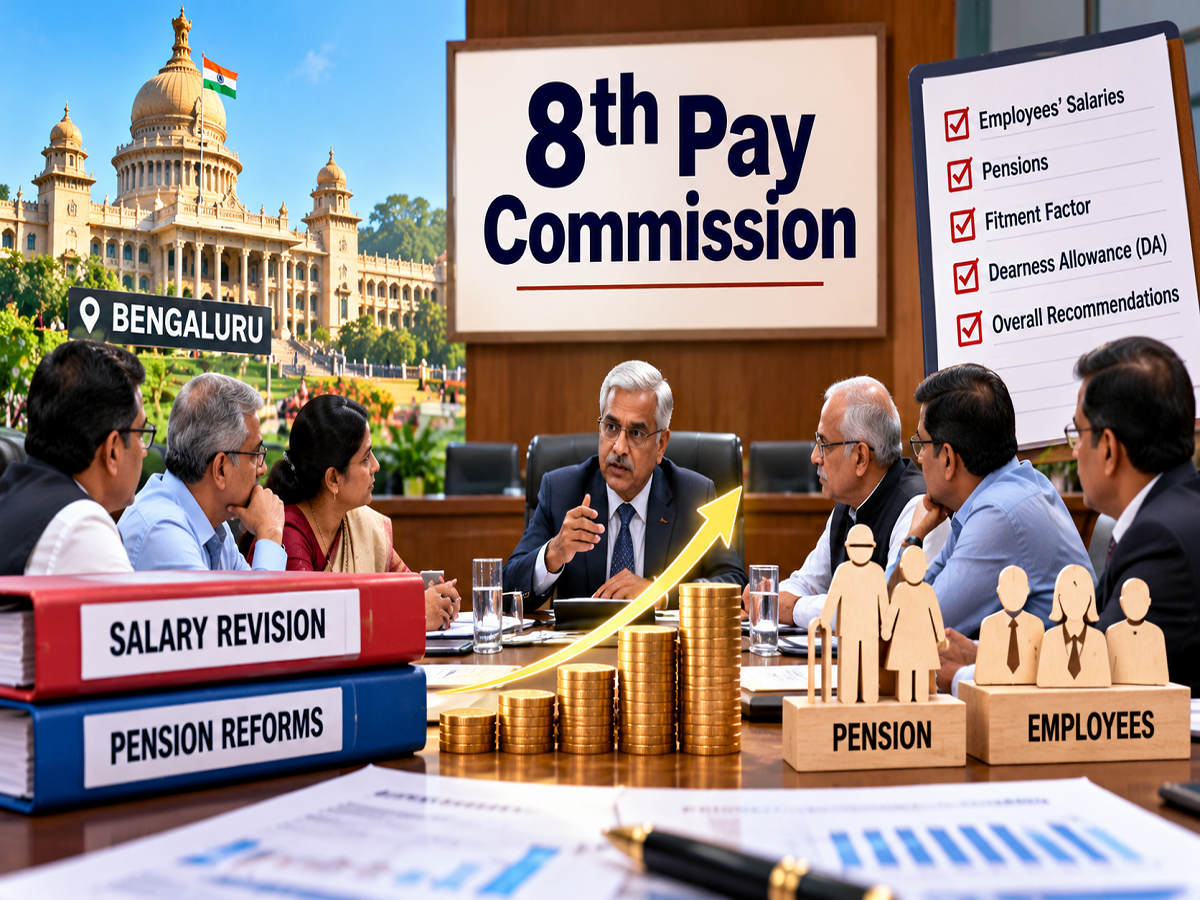
8th Pay Commission Latest News: Central government employees and pensioners are closely following discussions surrounding the proposed revision of salaries, pensions and allowances under the 8th Central Pay Commission. One of the biggest issues is the fitment factor, which could play an important role in determining revised basic salaries.
Employee representatives have reportedly demanded a minimum basic salary of approximately ₹69,000 and a fitment factor of around 3.83. However, neither the proposed fitment factor nor the revised minimum salary has received final government approval.
As the commission continues consultations with employee organisations, understanding the existing salary structure is essential. Terms such as basic pay, pay level, pay matrix and fitment factor help explain how a revised salary may be calculated.
The 8th Pay Commission is also expected to examine matters relating to pensions, allowances and other service conditions before submitting its recommendations.
8th Pay Commission: What Are Employees Demanding?
Employee organisations have been seeking substantial improvements in the existing salary and pension structure.
According to the supplied report, representatives associated with the National Council of the Joint Consultative Machinery have proposed a minimum basic salary of ₹69,000.
A fitment factor of approximately 3.83 has also been discussed.
The demands reflect employee representatives' expectations for higher basic pay under the next salary revision.
However, a demand submitted by an employee organisation is not equivalent to an approved government decision.
The final outcome will depend on the commission's recommendations and the central government's subsequent decisions.
| Particulars | Existing Structure / Reported Demand |
|---|---|
| Current minimum basic pay under 7th CPC | ₹18,000 |
| Reported minimum basic pay demand | ₹69,000 |
| Fitment factor under 7th CPC | 2.57 |
| Fitment factor proposed by unions | Approximately 3.83 |
| Government approval of proposed factor | Not announced |
| Commission report timeline | Reportedly expected around May–June 2027 |
What Is a Fitment Factor and How Does It Work?
A fitment factor is a multiplier used in pay revision calculations.
In a simplified illustration, the employee's existing basic salary is multiplied by the specified factor to estimate a revised basic salary.
The calculation is:
\[ \text{Illustrative revised basic pay}=\text{Existing basic pay}\times\text{Fitment factor} \]
For example, an employee receiving ₹18,000 as basic pay would have an illustrative revised amount of ₹46,260 if a multiplier of 2.57 were applied directly.
Under the 7th Pay Commission, the fitment factor of 2.57 was used in the transition to the revised pay structure, subject to applicable pay-fixation rules.
For the proposed 8th Pay Commission, unions are reportedly seeking a significantly higher multiplier.
However, the eventual pay-fixation method may include rounding, pay-matrix placement and other government-approved conditions.
What Happens If the Fitment Factor Becomes 3.83?
If a multiplier of 3.83 were applied directly to the current minimum basic pay of ₹18,000, the result would be ₹68,940.
That amount is close to the reported union demand of ₹69,000.
The calculation is:
\[ ₹18,000\times3.83=₹68,940 \]
If the proposed factor were 3.833 instead, the result would be:
\[ ₹18,000\times3.833=₹68,994 \]
This explains why a minimum salary of approximately ₹69,000 is being discussed.
However, these figures are mathematical illustrations, not officially approved salaries.
8th Pay Commission Salary Calculation at Different Fitment Factors
The following table shows how existing basic salaries would change under different hypothetical multipliers.
| Current Basic Pay | At 2.57 | At 3.00 | At 3.83 |
|---|---|---|---|
| ₹18,000 | ₹46,260 | ₹54,000 | ₹68,940 |
| ₹25,500 | ₹65,535 | ₹76,500 | ₹97,665 |
| ₹35,400 | ₹90,978 | ₹1,06,200 | ₹1,35,582 |
| ₹44,900 | ₹1,15,393 | ₹1,34,700 | ₹1,71,967 |
| ₹56,100 | ₹1,44,177 | ₹1,68,300 | ₹2,14,863 |
| ₹67,700 | ₹1,73,989 | ₹2,03,100 | ₹2,59,291 |
Note: All figures are direct multiplication examples. They do not represent approved 8th Pay Commission pay scales or final pay-matrix values.
Calculate Your Possible Basic Salary
Use the calculator below to compare hypothetical fitment factors. It shows only revised basic pay, not gross salary or take-home pay.
Current monthly basic pay (₹)
Hypothetical fitment factor
3.83
2.00
4.00
Illustrative revised monthly basic pay
₹68,940.00
Illustrative increase over current basic: ₹50,940.00
For illustration only. The government has not approved a final 8th CPC fitment factor.
What Is Basic Pay in a Government Salary?
Basic pay is the core component of an employee's salary.
It is the amount assigned according to the applicable pay level and position in the pay matrix.
Allowances such as Dearness Allowance (DA), House Rent Allowance (HRA) and Transport Allowance are generally calculated or determined separately under the relevant rules.
Basic pay is important because several salary-related benefits and calculations are linked to it.
For example, DA is generally calculated as a percentage of basic pay.
HRA rates depend on the applicable city classification, but the HRA amount is also calculated as a percentage of basic pay. Therefore, it would be incorrect to say that HRA is completely independent of basic salary.
An increase in basic pay can consequently influence multiple components of gross salary, depending on the allowance rules introduced with the revised pay structure.
Understanding Pay Levels Under the 7th Pay Commission
The 7th Central Pay Commission introduced a pay matrix that replaced the earlier pay-band and grade-pay structure for covered central government employees.
The matrix contains 18 pay levels.
Each level has a series of pay cells representing basic pay amounts at different stages of progression.
An employee's applicable pay level depends on the post and relevant service rules.
For example, the minimum basic pay in Level 1 is ₹18,000, while the starting basic pay in Level 7 is ₹44,900.
Selected Starting Salaries Under the Existing Pay Matrix
| Pay Level | Starting Basic Pay |
|---|---|
| Level 1 | ₹18,000 |
| Level 2 | ₹19,900 |
| Level 3 | ₹21,700 |
| Level 4 | ₹25,500 |
| Level 5 | ₹29,200 |
| Level 6 | ₹35,400 |
| Level 7 | ₹44,900 |
| Level 8 | ₹47,600 |
| Level 9 | ₹53,100 |
| Level 10 | ₹56,100 |
The actual basic salary of an employee may be higher than the starting amount because of increments, promotions and other applicable pay-fixation provisions.
What Happened to Grade Pay?
Before the 7th Pay Commission, central government salary structures commonly used pay bands and grade pay.
Grade pay helped distinguish the relative position of posts within the earlier system.
Under the 7th Pay Commission, the pay matrix replaced that structure for covered employees.
The new system uses pay levels and cells instead of separately adding grade pay to the pay band.
This distinction is important because the 8th Pay Commission's eventual recommendations will be evaluated against the existing pay framework.
Employees should therefore use their current basic pay and pay level when examining possible salary scenarios rather than relying on outdated grade-pay calculations.
Will a Higher Fitment Factor Mean the Same Increase in Take-Home Salary?
Not necessarily.
The fitment factor is used to understand possible basic-pay revision, but an employee's monthly take-home salary involves several other components.
Gross salary may include basic pay, DA, HRA, transport-related benefits and other applicable allowances.
Take-home pay is calculated after deductions such as applicable pension contributions, taxes and other recoveries.
When a new pay commission is implemented, allowance rates and their calculation methods may also be revised.
For this reason, an increase in basic pay does not translate into an identical percentage increase in take-home salary.
A multiplier of 3.83 should not be interpreted as a guaranteed 283% increase in the employee's total monthly earnings.
What About Dearness Allowance Under the 8th Pay Commission?
Dearness Allowance compensates eligible employees for changes in the cost of living.
It is calculated according to government-approved rules and revised periodically.
When a new pay commission's recommendations are implemented, the treatment of accumulated DA and the calculation of future DA may change.
The final outcome will depend on the recommendations accepted by the government.
Therefore, salary projections that simply add the existing DA percentage to a hypothetical revised basic pay may produce misleading results.
Employees should wait for official pay-fixation and allowance rules before estimating their future gross salaries.
Could Pensioners Also Benefit From the 8th Pay Commission?
The 8th Pay Commission discussions are important for pensioners as well as serving employees.
Employee and pensioner organisations have raised demands concerning pension revision and related benefits.
However, the final method for revising pensions has not been established in the supplied report.
Any approved changes would depend on the commission's recommendations and subsequent government decisions.
Pensioners should avoid assuming that a proposed salary fitment factor will automatically apply to all pension categories in the same manner.
Mumbai Consultation on October 23
The supplied report states that the 8th Pay Commission was scheduled to hold consultations in Mumbai on October 23, 2026.
It also refers to an earlier meeting in Bengaluru on October 8.
Such consultations provide opportunities for employee representatives and other stakeholders to submit their views on salary structures, allowances, pensions and service conditions.
The report further states that the commission was constituted on November 3, 2025, with an 18-month period to prepare its recommendations.
Based on that reported timeline, its report could be expected around May–June 2027.
However, the date of submitting recommendations should not be confused with the date on which revised salaries will actually become payable.
Implementation requires separate government decisions.
Has the Government Approved the 3.83 Fitment Factor?
No approval for the proposed 3.83 or 3.833 multiplier is established in the supplied report.
The figure represents a demand attributed to employee representatives.
The commission may examine different proposals before preparing its recommendations.
The government will subsequently decide which recommendations to accept and how they should be implemented.
Until then, salary tables based on a 3.83 multiplier should be treated as hypothetical calculations rather than confirmed pay revisions.
Final Takeaway
The 8th Pay Commission has generated considerable interest because employee organisations are reportedly seeking a minimum basic salary of approximately ₹69,000 and a fitment factor of around 3.83.
A direct calculation shows that multiplying the existing ₹18,000 minimum basic pay by 3.833 produces ₹68,994, explaining the approximate ₹69,000 demand.
However, the actual revised salary structure will depend on the final fitment factor, pay matrix, allowance rules and government approval.
Central government employees should understand their existing basic pay, pay level and the fitment-factor calculation, but should not treat union demands as officially approved salary increases.
Disclaimer: This article is based on the supplied October 23, 2026, report. The reported union demands, consultation schedule and commission timeline have not been independently verified against official notifications. All salary projections are illustrative and do not represent approved government pay scales.