Business
FD Calculator 2026: How Much Will ₹10, ₹20 and ₹30 Lakh Earn in 5 Years? Compare These Banks
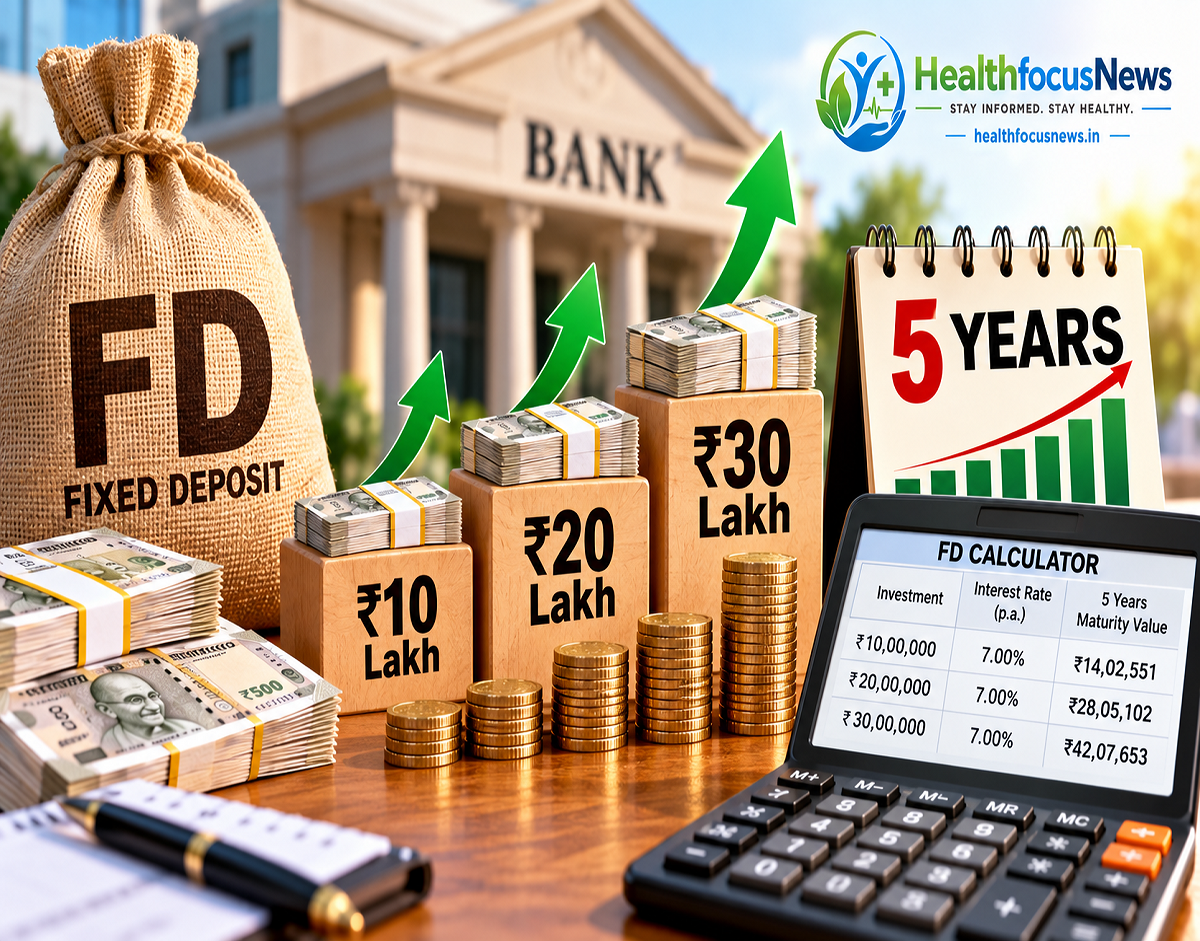
Fixed Deposit Interest Rates 2026: Fixed deposits remain a popular investment choice among Indian savers who prefer predictable returns and want to avoid the daily fluctuations of the stock market. With some small finance banks offering attractive interest rates, investors are increasingly comparing how much their savings could grow over five years.
If you are planning to invest ₹10 lakh, ₹20 lakh or ₹30 lakh in a bank FD, the interest rate can make a significant difference to your final maturity amount.
Two banks highlighted in an October 2026 report are Suryoday Small Finance Bank and Jana Small Finance Bank.
According to the report, Suryoday Small Finance Bank was offering an annual interest rate of up to 8.25% on an eligible five-year FD, while Jana Small Finance Bank was offering up to 7.77%.
At these rates, a ₹30 lakh cumulative fixed deposit could potentially grow to more than ₹44 lakh over five years, depending on the applicable compounding method.
However, before investing such a large amount, it is important to understand deposit insurance limits, taxation, premature withdrawal rules and the actual terms offered by the bank.
Here is a detailed comparison of the potential returns.
Why Are Fixed Deposits Attracting Attention in 2026?
Bank fixed deposits provide an agreed interest rate for a specified investment period.
Unlike equity investments, a conventional fixed-rate FD generally allows investors to estimate the maturity amount in advance.
This makes fixed deposits useful for people planning expenses such as education, retirement requirements or other future financial commitments.
The supplied report also refers to an increase in the Reserve Bank of India's repo rate from 5.25% to 5.50% in October 2026.
Changes in monetary policy can influence bank deposit rates, although individual banks decide their FD interest rates based on funding requirements and other factors.
Therefore, a higher repo rate does not automatically mean that every bank will increase FD returns.
Suryoday Small Finance Bank: Five-Year FD at 8.25%
Suryoday Small Finance Bank is among the institutions highlighted for its reported fixed deposit interest rate.
According to the supplied October 2026 figures, the bank offered an annual interest rate of up to 8.25% for eligible five-year deposits.
At this rate, the potential maturity amount can be calculated using the cumulative FD method.
₹10 Lakh, ₹20 Lakh and ₹30 Lakh FD Returns at 8.25%
| Initial Deposit | Annual Interest Rate | Approximate Interest Earned | Approximate Maturity Amount |
|---|---|---|---|
| ₹10,00,000 | 8.25% | ₹5,04,264 | ₹15,04,264 |
| ₹20,00,000 | 8.25% | ₹10,08,528 | ₹30,08,528 |
| ₹30,00,000 | 8.25% | ₹15,12,792 | ₹45,12,792 |
Note: Figures reproduce the illustrative calculations in the supplied report. Actual bank maturity values may vary slightly based on compounding conventions, deposit dates and applicable terms. Amounts are before tax.
The table demonstrates how larger deposits can generate higher absolute interest income when the rate and tenure remain unchanged.
For example, an investor depositing ₹10 lakh could earn approximately ₹5.04 lakh in interest over five years.
Similarly, a ₹30 lakh deposit could generate approximately ₹15.13 lakh in interest, taking the total maturity value to around ₹45.13 lakh.
These figures assume the quoted interest rate remains applicable for the full deposit period.
Jana Small Finance Bank: Five-Year FD at 7.77%
Jana Small Finance Bank is another institution mentioned in the report.
According to the supplied information, the bank offered an annual interest rate of up to 7.77% on eligible five-year fixed deposits.
Although this rate is lower than the quoted 8.25% from Suryoday Small Finance Bank, it could still generate substantial interest over five years.
₹10 Lakh, ₹20 Lakh and ₹30 Lakh FD Returns at 7.77%
| Initial Deposit | Annual Interest Rate | Approximate Interest Earned | Approximate Maturity Amount |
|---|---|---|---|
| ₹10,00,000 | 7.77% | ₹4,69,048 | ₹14,69,048 |
| ₹20,00,000 | 7.77% | ₹9,38,093 | ₹29,38,093 |
| ₹30,00,000 | 7.77% | ₹14,07,142 | ₹44,07,142 |
Note: These are illustrative figures from the supplied report, before tax. Actual returns depend on the bank's applicable FD terms and calculation method.
Under this example, an investor placing ₹10 lakh in a five-year FD could receive approximately ₹14.69 lakh at maturity.
For a ₹20 lakh investment, the maturity value could be around ₹29.38 lakh.
Meanwhile, a ₹30 lakh FD could grow to approximately ₹44.07 lakh over five years.
Suryoday vs Jana Small Finance Bank: Which Offers Higher Returns?
Based on the interest rates quoted in the supplied report, Suryoday Small Finance Bank provides a higher illustrated maturity amount for all three deposit sizes.
| Deposit Amount | Suryoday SFB at 8.25% | Jana SFB at 7.77% | Difference in Maturity Value |
|---|---|---|---|
| ₹10 lakh | ₹15,04,264 | ₹14,69,048 | ₹35,216 |
| ₹20 lakh | ₹30,08,528 | ₹29,38,093 | ₹70,435 |
| ₹30 lakh | ₹45,12,792 | ₹44,07,142 | ₹1,05,650 |
For a ₹30 lakh deposit, the difference in estimated maturity value exceeds ₹1 lakh.
However, the highest interest rate should not be the only factor influencing an investment decision.
Bank deposit insurance, liquidity requirements, tax implications and financial concentration risks are equally important.
The rates in this comparison are reported figures, not independently verified live offers. Investors should confirm whether these rates apply to exactly five years, the relevant deposit amount and their customer category.
How Does Compounding Increase FD Returns?
Compounding is an important reason why cumulative fixed deposits can generate substantial returns over longer periods.
Under a cumulative FD, interest is periodically added to the deposit balance.
Future interest is then calculated on the increased amount.
For example, a ₹10 lakh FD earning 8.25% annually does not simply generate the same interest amount every year when interest is compounded.
Instead, accumulated interest contributes to the calculation of subsequent interest.
The result is a higher maturity amount than would arise from a simple-interest calculation at the same stated annual rate.
However, compounding frequency matters.
Banks may use quarterly compounding or other applicable methods depending on the deposit product.
Investors should check the bank's official FD calculator for the precise maturity amount.
Is a ₹30 Lakh Fixed Deposit Fully Insured?
One of the most important considerations for large FD investors is deposit insurance.
In India, eligible deposits with insured banks are covered by the Deposit Insurance and Credit Guarantee Corporation (DICGC).
The insurance limit is ₹5 lakh per depositor per insured bank, including principal and accrued interest, subject to applicable rules.
This means that placing ₹30 lakh in a single bank does not make the entire amount eligible for ₹30 lakh of deposit insurance.
The insurance protection is limited to the applicable ceiling.
Even if a bank offers an attractive interest rate, investors should understand this limitation before depositing a substantial amount.
Should You Split ₹10 Lakh, ₹20 Lakh or ₹30 Lakh Across Different Banks?
Distributing large deposits across different insured banks may help reduce exposure to a single institution.
For example, an investor with ₹20 lakh could consider maintaining deposits at more than one bank rather than concentrating the entire amount in one place.
However, splitting deposits requires careful planning.
DICGC coverage is calculated according to the applicable depositor, bank and ownership-capacity rules.
Multiple fixed deposits held in the same ownership capacity at different branches of the same bank generally do not create separate insurance limits.
Accrued interest also counts toward the ₹5 lakh insurance ceiling.
Therefore, someone seeking to keep balances within the insurance limit should account for interest accumulation, not just the initial principal.
Diversification may help manage bank-specific risk, but it does not eliminate every financial risk.
FD Interest Is Taxable: Understand Your Post-Tax Returns
The interest earned from bank fixed deposits is generally taxable according to the investor's applicable income tax provisions.
This is particularly important when investing ₹10 lakh, ₹20 lakh or ₹30 lakh because the accumulated interest can be substantial.
For example, the illustrated ₹30 lakh deposit at 8.25% generates more than ₹15 lakh in total interest over five years.
The actual post-tax benefit depends on the investor's tax position and the applicable rules.
Banks may deduct tax at source when relevant conditions and thresholds are met.
However, TDS and the investor's final income tax liability are not necessarily the same.
Therefore, investors should compare the expected post-tax returns before choosing an FD.
What Happens If You Withdraw Your FD Before Five Years?
Fixed deposits are designed to remain invested for the selected tenure.
If money is withdrawn before maturity, the bank may apply premature withdrawal conditions.
These may include a reduced applicable interest rate and a penalty.
The exact financial impact depends on the bank and deposit scheme.
Some special fixed deposits may have additional withdrawal restrictions.
For investors who may require money for emergencies, locking the entire amount into a five-year deposit may not be appropriate.
Maintaining a separate emergency fund can help avoid premature FD closure.
Is a Five-Year Tax-Saving FD the Same as a Regular FD?
No. A five-year tax-saving fixed deposit has specific conditions that differ from those of a regular five-year FD.
Eligible investments in qualifying tax-saving FDs may receive deductions under Section 80C of the Income-tax Act, subject to applicable conditions and the tax regime chosen.
However, these deposits generally carry a mandatory five-year lock-in period and restrictions on premature withdrawal.
The deduction is not automatically available to every taxpayer, particularly under tax regimes where Section 80C benefits do not apply.
A regular five-year FD may offer different withdrawal flexibility and may not qualify for the same deduction.
Investors should distinguish between the two products before making a deposit.
What Should You Check Before Investing a Large Amount in an FD?
Before placing ₹10 lakh or more in a fixed deposit, investors should examine the following factors:
- Interest rate: Verify the rate available for the exact deposit amount and tenure.
- Deposit insurance: Understand the ₹5 lakh DICGC coverage limit.
- Bank concentration: Consider whether keeping all savings in one institution is appropriate.
- Premature withdrawal: Review penalties and liquidity restrictions.
- Taxation: Estimate the actual return after applicable taxes.
- Compounding: Check how frequently interest is credited or compounded.
- Financial goals: Match the deposit maturity date with the time when the money will be required.
A high advertised interest rate may be attractive, but it should be evaluated alongside the overall safety and suitability of the deposit.
Frequently Asked Questions
How much will a ₹10 lakh FD become in five years at 8.25%?
Based on the supplied illustrative calculation, the maturity value would be approximately ₹15,04,264, including ₹5,04,264 in interest before taxes.
What is the estimated return on a ₹20 lakh FD at 7.77%?
The supplied calculation shows an estimated maturity amount of ₹29,38,093 after five years, including approximately ₹9,38,093 in interest.
How much can a ₹30 lakh FD earn at 8.25%?
The illustrated five-year interest income is approximately ₹15,12,792, bringing the total maturity amount to ₹45,12,792 before taxes.
Which bank offers the higher quoted five-year FD rate in this comparison?
According to the supplied October 2026 report, Suryoday Small Finance Bank's quoted 8.25% rate is higher than Jana Small Finance Bank's quoted 7.77%.
Are fixed deposits completely risk-free?
No. Fixed deposits generally offer relatively predictable returns, but bank-related risks remain. Eligible deposits receive DICGC insurance only up to the applicable limit.
Final Thoughts
A five-year fixed deposit can generate substantial interest when a large amount is invested at a competitive rate.
According to the supplied October 2026 comparison, a ₹10 lakh deposit at 8.25% could grow to approximately ₹15.04 lakh, while ₹20 lakh could become ₹30.09 lakh and ₹30 lakh could reach ₹45.13 lakh.
At the quoted 7.77% rate, the corresponding maturity amounts would be approximately ₹14.69 lakh, ₹29.38 lakh and ₹44.07 lakh.
Suryoday Small Finance Bank offers the higher illustrated return in this two-bank comparison, but investors should not select an FD based on interest rates alone.
Deposit insurance limits, taxation, bank-specific risks and liquidity needs are especially important when investing ₹10 lakh or more.
Before opening an FD, verify the latest official bank rates and calculate the expected post-tax maturity value.
Disclaimer: This article is for general informational purposes only and does not constitute investment advice. Interest rates and maturity calculations are based on the supplied October 2026 report and have not been independently verified against current bank rate schedules. Actual returns may differ according to the bank's terms, compounding method and applicable taxes. Consult your bank or a qualified financial adviser before investing.