Business
DA Hike 2026: How Much Will Salary Increase for Employees Earning ₹18,000 Basic Pay? Check Calculation
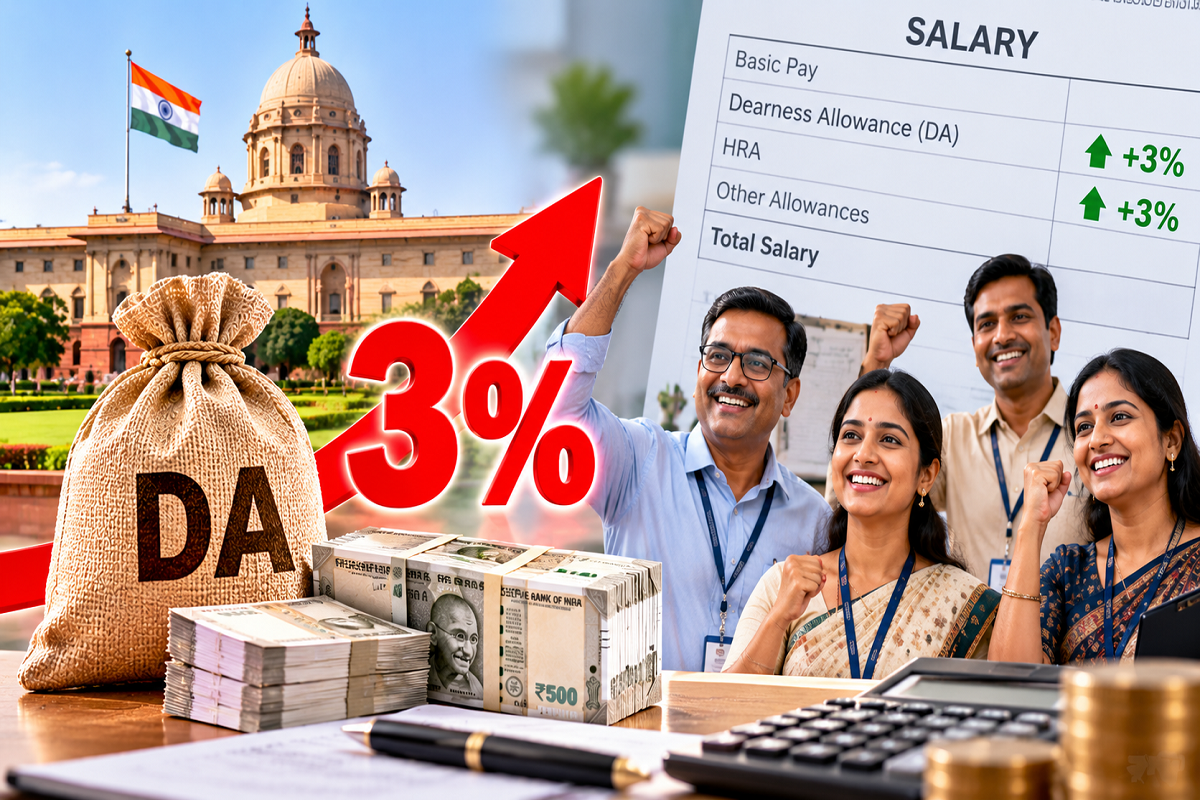
DA Hike Latest Update 2026: Central government employees are closely watching developments regarding the next Dearness Allowance (DA) revision. For employees receiving a minimum basic salary of ₹18,000 per month, even a small increase in DA can provide additional monthly income.
Dearness Allowance is an important component of government employees' salaries because it helps compensate for the rising cost of living. The allowance is generally revised twice a year, with changes linked to inflation-related indicators.
A possible increase of 3% or 4% could result in a monthly salary benefit of ₹540 or ₹720, respectively, for an employee earning ₹18,000 in basic pay. However, these figures are illustrative calculations, not confirmation of a newly approved increase.
What Is the Latest Update on the DA Hike?
The existing Dearness Allowance rate for central government employees is 60% of basic pay. The government approved the previous increase in April 2026, raising DA from 58% to 60%, effective January 1, 2026.
The July 2026 revision is still awaiting an official announcement. Recent reports suggest that DA could rise by approximately 3 percentage points, taking the rate to 63%. Some reports have also discussed the possibility of a 4-percentage-point increase.
Employees are now looking towards the expected Union Cabinet meeting on October 28. However, there is no official confirmation that the DA revision will be approved at that meeting.
₹18,000 Basic Salary: How Much Could Employees Receive?
Employees earning ₹18,000 as monthly basic pay currently receive ₹10,800 in Dearness Allowance at the 60% rate.
If the government approves a 3-percentage-point increase, their DA would become ₹11,340 per month. This would mean an additional ₹540 every month.
Here is a comparison of possible DA rates.
| DA Rate | Monthly DA | Basic Pay + DA |
|---|---|---|
| 60% (Current) | ₹10,800 | ₹28,800 |
| 61% | ₹10,980 | ₹28,980 |
| 62% | ₹11,160 | ₹29,160 |
| 63% | ₹11,340 | ₹29,340 |
| 64% | ₹11,520 | ₹29,520 |
These calculations exclude House Rent Allowance (HRA), Transport Allowance (TA), deductions and other salary components.
DA Hike Calculation for Different Basic Salaries
The financial benefit of a DA revision increases with an employee's basic salary.
The table below shows the possible monthly increase if DA rises from 60% to 63%.
| Monthly Basic Pay | Current DA (60%) | Expected DA (63%) | Monthly Increase |
|---|---|---|---|
| ₹18,000 | ₹10,800 | ₹11,340 | ₹540 |
| ₹25,000 | ₹15,000 | ₹15,750 | ₹750 |
| ₹30,000 | ₹18,000 | ₹18,900 | ₹900 |
| ₹35,400 | ₹21,240 | ₹22,302 | ₹1,062 |
| ₹44,900 | ₹26,940 | ₹28,287 | ₹1,347 |
| ₹50,000 | ₹30,000 | ₹31,500 | ₹1,500 |
| ₹56,100 | ₹33,660 | ₹35,343 | ₹1,683 |
The calculation is straightforward:
Monthly DA Increase = Basic Salary × DA Increase Percentage ÷ 100
For example, an employee with ₹30,000 basic pay would receive ₹900 more per month if DA increases by 3 percentage points.
Will Employees Receive DA Arrears From July 2026?
Apart from the regular monthly increase, employees may also become eligible for arrears if the government approves the revised DA retrospectively.
The pending revision relates to the period beginning July 1, 2026. If a 3-percentage-point increase is approved from that date, employees could receive the difference between the existing and revised allowances for eligible months.
For an employee with ₹18,000 basic pay, the estimated additional DA would be ₹540 monthly.
If four months of arrears are payable, covering July through October, the amount would be:
- Monthly additional DA: ₹540
- Four months of arrears: ₹2,160
- Additional DA over 12 months at the revised rate: ₹6,480
These are illustrative figures. The actual arrears will depend on the official implementation date, applicable pay and government notification.
How Does Dearness Allowance Help Government Employees?
Dearness Allowance is designed to protect government employees against the effects of inflation.
As the prices of food, transportation, housing-related services and other essential goods increase, the purchasing power of a fixed salary can decline.
To address this, the central government periodically revises DA using inflation data from the All-India Consumer Price Index for Industrial Workers (AICPI-IW).
The allowance is generally reviewed twice annually, for January and July.
Importantly, DA is calculated on basic pay rather than the employee's total gross salary.
Will Pensioners Also Benefit From the DA Increase?
Central government pensioners are also awaiting the corresponding Dearness Relief (DR) revision.
Dearness Relief serves a similar purpose to DA, helping eligible pensioners manage increasing living expenses.
If the government approves a 3-percentage-point increase in DR, a pensioner receiving a basic pension of ₹18,000 would receive an additional ₹540 per month.
The exact benefit will depend on the pensioner's eligible basic pension and the officially notified DR rate.
When Will the Government Announce the New DA Rate?
The government has not yet confirmed the announcement date for the pending July 2026 DA revision.
Although expectations are growing ahead of the anticipated October 28 Cabinet meeting, employees should wait for an official notification before treating the expected increase as final.
Once approved, the revised DA rate and effective date will determine the additional salary and arrears payable to eligible employees.
For now, employees with ₹18,000 basic pay can estimate an additional ₹540 per month under the widely discussed 3-percentage-point hike scenario.
The key point is that a DA increase may provide welcome financial relief, but the final benefit will be known only after the government's formal decision.
Disclaimer: The DA calculations presented above are illustrative and based on potential revisions. The July 2026 DA increase has not been officially confirmed in the sources reviewed.