Business
8th Pay Commission 2026: Three Old DA Demands Return, Will Basic Salary and Tax Rules Change?
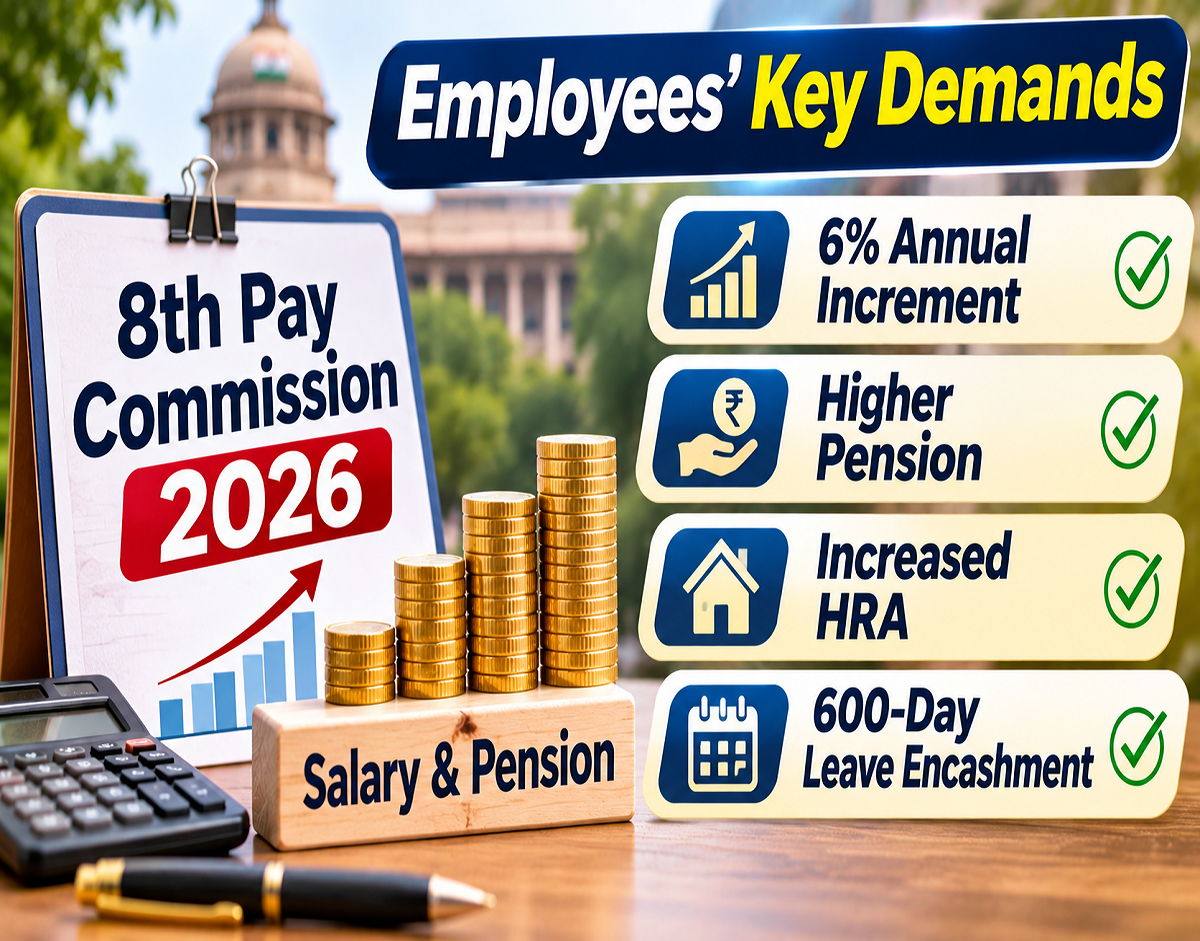
8th Pay Commission Latest News, October 30, 2026: Central government employees and pensioners are closely watching developments surrounding the 8th Central Pay Commission (CPC). Three long-standing demands related to Dearness Allowance (DA) have reportedly resurfaced as discussions about salary revisions and employee benefits continue.
According to an Aaj Tak report published on October 30, these demands have a history dating back more than two decades. Similar proposals were placed before the 6th Central Pay Commission but were not accepted.
The renewed discussion concerns how DA is treated in salary calculations, whether it should be merged with basic pay, and whether employees should receive tax relief on the allowance.
However, these are demands and proposals, not approved changes. Any revision will depend on the 8th Pay Commission's recommendations and subsequent decisions by the central government.
What Are the Three Major DA Demands?
The debate centres on the treatment of Dearness Allowance in the central government salary structure.
The principal issues being discussed are:
- Merging Dearness Allowance with basic salary.
- Giving DA greater recognition when calculating salary-linked benefits.
- Providing income-tax relief on Dearness Allowance.
These proposals reflect long-standing concerns about inflation compensation and the way employee benefits are calculated.
The exact wording and scope of the demands will matter when the commission examines representations from employee organisations.
Demand 1: Merge Dearness Allowance With Basic Pay
One of the most widely discussed demands is the merger of DA with basic salary.
Dearness Allowance is provided to eligible government employees to help offset the impact of rising living costs.
It is calculated as a percentage of basic pay.
Employee representatives have periodically argued that when DA rises substantially, part of it should be incorporated into basic salary.
A merger could affect salary calculations and certain allowances, depending on the rules adopted.
For example, if an employee has a basic salary of ₹35,400 and receives DA at 63%, the monthly DA amount is ₹22,302.
The combined amount is ₹57,702.
However, this does not mean that the employee's official basic pay automatically becomes ₹57,702. That would require a formal policy decision.
Demand 2: Review DA's Role in Salary-Linked Benefits
Another area of concern involves the treatment of DA when calculating various employee benefits.
Basic pay is an important component of government salary structures because several allowances and benefits are linked to it.
Employees have sought changes in how inflation-related compensation is recognised in such calculations.
The financial effect would depend on which benefits were included and the specific rules recommended.
Importantly, DA is already included in the calculation of certain retirement-related benefits under existing rules. Therefore, the issue should not be interpreted as a demand to introduce DA into every benefit calculation for the first time.
Any change under the 8th Pay Commission would require a detailed examination of the current rules.
Demand 3: Make Dearness Allowance Tax-Free
The third major proposal seeks income-tax exemption for DA.
The Federation of National Postal Organisations (FNPO) has argued that DA is intended to compensate employees for inflation-related expenses rather than provide additional financial gains.
The organisation has requested that DA be excluded from taxable income. It has also proposed broader tax relief for allowances such as House Rent Allowance (HRA) and Transport Allowance.
Currently, DA is generally taxable as part of salary income under applicable income-tax rules. Any exemption would require changes to the relevant tax provisions.
Demand for DA Revision Every Three Months
Another significant proposal concerns the frequency of DA revisions.
Under the existing system, central government employees' DA and pensioners' Dearness Relief (DR) are normally revised twice a year, with effect from January 1 and July 1.
Bharat Pensioners Samaj has requested quarterly revisions based on a three-month average of the relevant inflation index.
The organisation argues that more frequent adjustments would allow inflation compensation to respond faster to changing living costs.
This proposal was also considered during the 6th Pay Commission, which did not recommend changing the existing six-month revision cycle.
Why Are These Demands More Than 20 Years Old?
The debate is not new.
The 5th Central Pay Commission had recommended a mechanism involving the conversion of part of DA into Dearness Pay when the allowance reached a specified level.
Employee organisations subsequently sought changes to the threshold.
During the 6th Pay Commission, proposals involving quarterly DA revisions and the merger of DA with basic pay were examined but not accepted.
The commission also did not recommend the proposed income-tax exemption.
The 7th Pay Commission did not introduce these three changes either.
Now, employee organisations have revived the issues before the 8th Pay Commission.
What Happens Next Under the 8th Pay Commission?
The commission will examine representations, salary structures, inflation-related compensation and other matters within its mandate.
It may accept, modify or decline the proposals.
Even if the commission recommends changes, implementation would require government approval and, where necessary, amendments to existing rules.
Employees should therefore continue using the prevailing DA, salary and tax provisions until official notifications announce otherwise.
The key takeaway: Employee organisations have revived three longstanding demands: quarterly DA revisions, merging DA with basic pay once it crosses 25%, and exempting DA from income tax. None of these proposals has been approved as a new rule under the 8th Pay Commission.