Business
Want to Close a 15-Year Home Loan Early? Here’s How Higher EMIs and Prepayments Can Cut Years Off Your Loan
A home loan can make buying a house easier, but a long repayment period can also result in a substantial interest burden. Home loans are commonly taken for 15, 20 or even 25 years because a longer tenure keeps the monthly EMI relatively manageable. The trade-off is that borrowers may end up paying a significant amount of interest over the life of the loan.
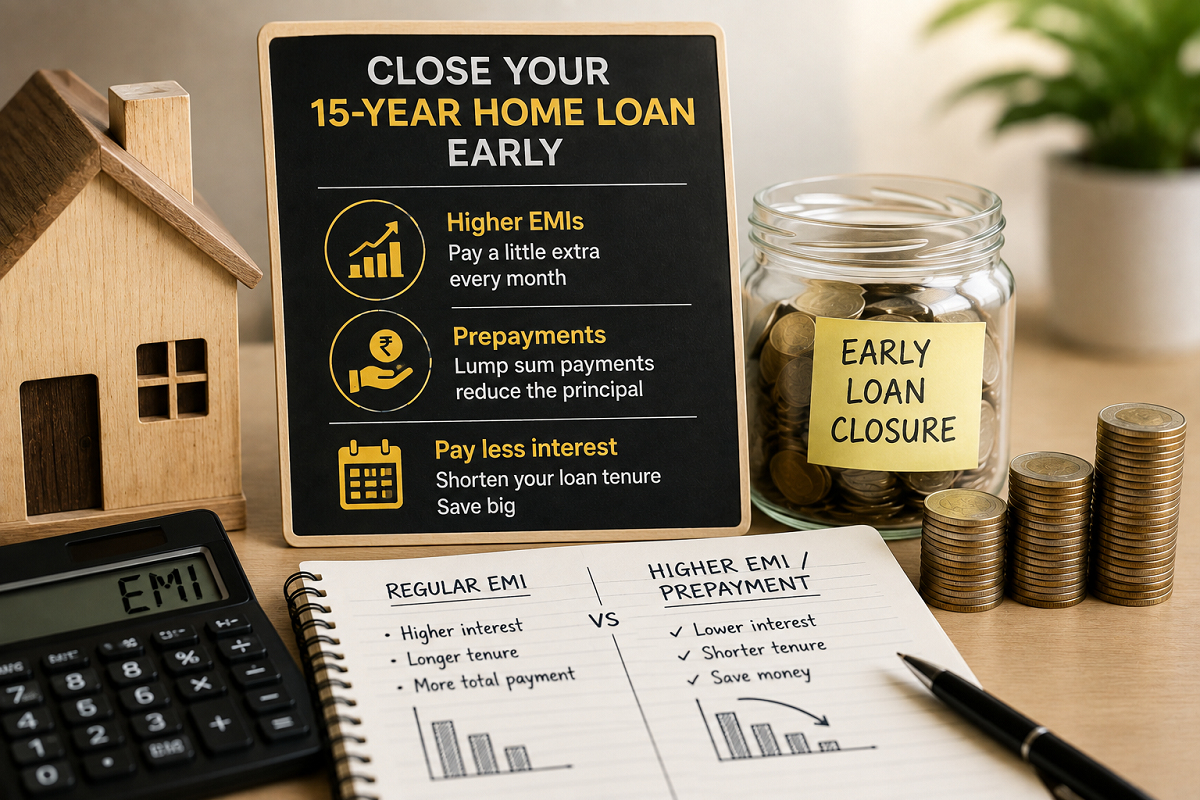
If your income increases over time, however, you do not necessarily have to continue with the original repayment schedule. By increasing your EMI and making regular part-prepayments, you may be able to reduce the tenure significantly and save on interest.
For example, someone with a ₹40 lakh home loan for 15 years could potentially aim to repay it much earlier. Bringing the tenure down to around six years would require aggressive repayment and will depend on the interest rate, original EMI, timing and size of prepayments, and how frequently the EMI is increased.
Why Early Home Loan Prepayment Can Make a Big Difference
Understanding how an EMI works is important before deciding on an early-repayment strategy.
Every EMI consists of two components: principal and interest. During the initial years of a home loan, a relatively larger portion of the EMI generally goes towards interest. As the outstanding principal gradually declines, the interest component reduces and a larger share of the EMI starts repaying principal.
This is why additional payments made during the earlier years can have a meaningful impact.
When you make a part-prepayment, the money generally reduces the outstanding principal. Since future interest is calculated on the remaining loan balance, reducing the principal can lower the interest payable over the remaining tenure.
Increase Your EMI as Your Income Grows
One practical strategy is to avoid keeping your EMI unchanged for the entire loan period.
Suppose your current home loan EMI is ₹30,000 per month. If your salary increases every year, you could consider raising the EMI by 5% to 10%, provided your household budget allows it.
Even an additional ₹2,000 or ₹3,000 per month may appear modest initially, but regular increases can accelerate principal repayment.
This approach is sometimes called a step-up repayment strategy. Instead of allowing your lifestyle expenses to absorb the entire salary increment, you direct part of the increase towards your outstanding home loan.
Over several years, this can make a considerable difference to the remaining tenure.
However, a modest annual EMI increase alone may not be sufficient to turn a 15-year loan into a six-year loan. Achieving such an aggressive target would usually require larger additional payments alongside EMI increases.
Use Bonuses for Home Loan Prepayments
Annual bonuses, performance incentives, salary arrears or other occasional income can also be used strategically.
Suppose you receive a ₹1 lakh annual bonus. Instead of spending the entire amount, you could allocate a portion towards your home loan as a lump-sum prepayment.
The advantage is not limited to reducing the outstanding balance by that amount. Once the principal falls, you also avoid paying future interest on the prepaid amount.
This can be particularly effective when prepayments are made during the earlier stages of the loan.
A borrower does not necessarily have to use the entire bonus. The amount can be divided between investments, emergency savings, personal expenses and loan repayment depending on financial priorities.
Combine EMI Increases With Regular Prepayments
Borrowers seeking a dramatic reduction in tenure can consider combining multiple repayment strategies.
For instance, instead of relying only on the scheduled EMI, a borrower could increase the EMI whenever income rises and make one or two additional lump-sum principal payments every year.
A possible strategy could look like this:
- Increase the EMI by 5% to 10% after an annual salary increment.
- Use part of annual bonuses and incentives for principal prepayment.
- Make an additional lump-sum payment whenever there is surplus cash.
- Ask the lender to reduce the loan tenure rather than the EMI after a prepayment, if shortening the repayment period is the main objective.
- Review the outstanding principal and remaining tenure at least once a year.
The exact outcome will vary from borrower to borrower.
Can a 15-Year ₹40 Lakh Loan Really Be Closed in Six Years?
It is possible to shorten a loan substantially, but there is no universal formula guaranteeing that every ₹40 lakh, 15-year loan can be closed within six years.
The numbers depend heavily on the applicable interest rate.
For illustration, a ₹40 lakh loan at an assumed interest rate of 8.5% for 15 years would have an EMI of roughly ₹39,000. If the borrower simply continues paying the scheduled EMI, repayment would run for the full tenure.
To finish the same debt in around six years, the borrower would need to repay the principal much more aggressively through significantly higher monthly payments, substantial annual prepayments, or a combination of both.
Therefore, borrowers should use their lender's loan calculator or amortisation schedule before setting a six-year target.
Don't Empty Your Emergency Fund to Repay the Loan
Paying off debt early can save interest, but borrowers should avoid putting every available rupee into their home loan.
An emergency fund is equally important. Ideally, households should retain enough liquid savings to manage several months of essential expenses and EMIs in case of a job loss, medical emergency or unexpected financial requirement.
Using all savings to prepay a home loan could create a cash-flow problem if an emergency occurs later.
Similarly, borrowers should evaluate whether money earmarked for insurance, children's education, retirement or other essential goals should be diverted towards early repayment.
Check Prepayment Rules With Your Lender
Before making a large payment, borrowers should also check the terms of their loan.
Prepayment conditions can vary depending on whether the loan carries a floating or fixed interest rate and whether the borrower is an individual or another category of customer.
Ask the lender how the additional payment will be adjusted, whether any charges apply, and whether you can choose between lowering the EMI and reducing the tenure.
For borrowers focused on becoming debt-free sooner, reducing the tenure can generally be more aligned with that objective.
The Key Is to Start Early
The earlier you begin making additional principal repayments, the greater the potential interest-saving impact can be.
A long-tenure home loan does not necessarily have to remain outstanding for its entire original term. Rising income, annual bonuses and surplus savings can all be used to accelerate repayment.
The goal, however, should not simply be to chase a specific number such as six years. The better approach is to build a repayment plan that balances faster loan closure with emergency savings, investments and other financial goals.
With disciplined EMI increases and well-timed prepayments, borrowers may be able to cut several years from their home loan tenure and potentially save a substantial amount of interest.