
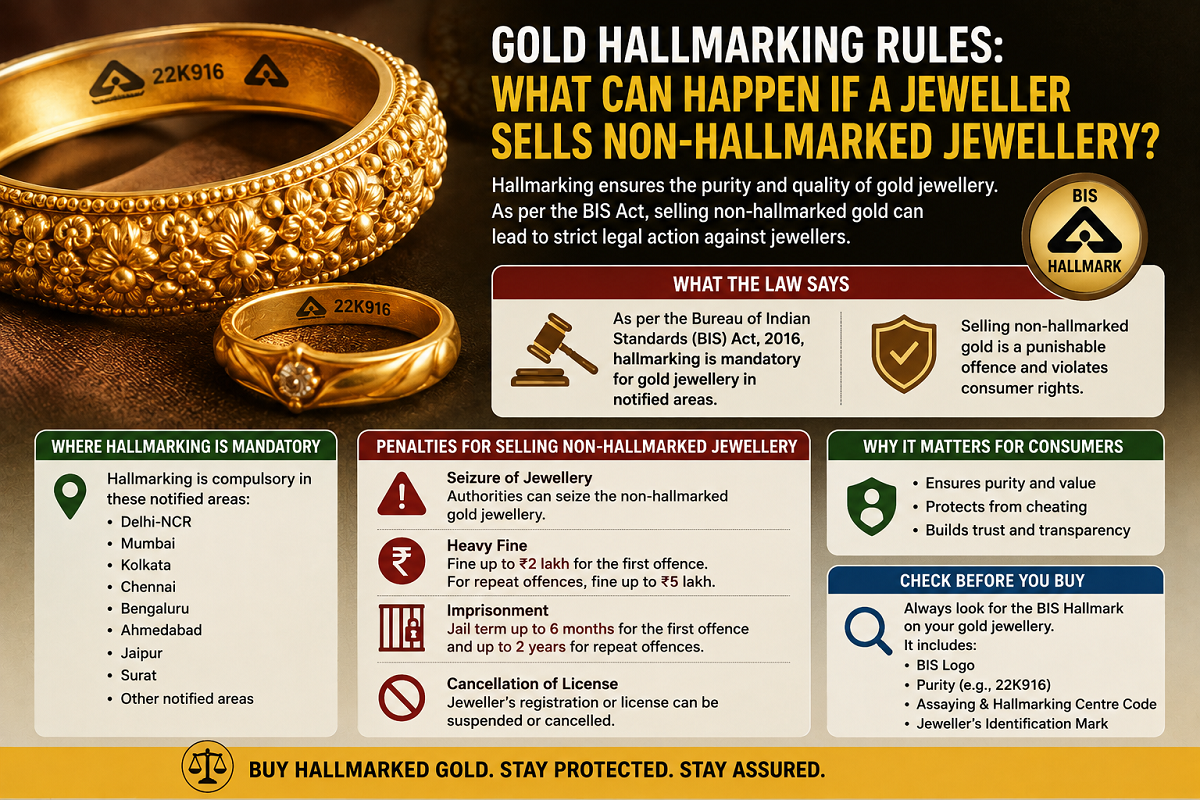
Buying gold jewellery is a major financial decision for many Indian households, whether the purchase is for a wedding, festival, investment or personal use. While buyers often compare gold rates and making charges, checking the hallmark is equally important because it helps verify the declared purity of the jewellery.
The Bureau of Indian Standards (BIS) has laid down rules governing the hallmarking of gold jewellery and artefacts in India. However, mandatory hallmarking requirements do not apply uniformly to every jeweller, every location or every category of jewellery. Certain exemptions are available under the applicable rules.
For consumers, understanding these provisions can make it easier to distinguish between legitimately exempt jewellery and cases where a seller may be violating mandatory hallmarking requirements.
What Does a Gold Hallmark Tell You?
A BIS hallmark provides important information related to the purity of a gold article. Hallmarking is intended to protect consumers by ensuring that the purity claimed by the seller conforms to prescribed standards.
For jewellery covered by mandatory hallmarking requirements, jewellers operating in notified districts must comply with BIS rules before selling applicable gold jewellery or artefacts.
Consumers should therefore check the hallmark carefully rather than relying only on verbal assurances about purity.
Is Hallmarking Compulsory for Every Jeweller?
No. Mandatory hallmarking rules include certain exemptions.
According to the applicable framework, jewellers whose annual turnover is up to ₹40 lakh are exempt from mandatory hallmarking requirements. Certain types of jewellery and articles may also qualify for exemptions under BIS provisions.
This distinction is important because the mere sale of an item without a hallmark does not automatically establish that the jeweller has broken the law.
Whether there has been a violation depends on factors such as the seller's eligibility for exemption, location, type of jewellery and whether the particular transaction falls within mandatory hallmarking requirements.
What Can Happen If a Jeweller Violates Hallmarking Rules?
A jeweller covered by mandatory hallmarking requirements cannot simply ignore the prescribed standards.
If BIS authorities suspect a violation, inspections may be conducted and samples of jewellery can be collected for testing. If the investigation establishes non-compliance, action can be taken against the jeweller under the applicable provisions.
Depending on the nature and seriousness of the violation, consequences can include financial penalties and legal proceedings. Regulatory action relating to the jeweller's BIS registration may also be possible in applicable cases.
The exact penalty is determined by the provision violated and the circumstances of the case rather than by a single uniform punishment for every hallmarking-related offence.
Can Violations Lead to Jail or a Fine?
The BIS Act provides penalties for specified offences.
Depending on the relevant violation, penalties can include imprisonment and substantial monetary fines. Certain offences may attract imprisonment of up to one year, while the minimum fine can start at ₹1 lakh and, in applicable circumstances, may extend to several times the value of the goods involved.
Other violations covered under different provisions can carry stricter consequences, potentially including imprisonment of up to two years and higher minimum financial penalties.
Consumers should remember that these are statutory penalty provisions. It does not mean that every case involving non-hallmarked gold will automatically result in the maximum fine or imprisonment. The circumstances and specific legal provision involved determine the actual action.
Is It Illegal to Keep Old Gold Jewellery Without a Hallmark?
No. Consumers do not need to worry simply because old jewellery stored at home does not carry a BIS hallmark.
Many families own jewellery purchased years or even decades before the current hallmarking framework was introduced. The absence of a hallmark on such personal jewellery does not, by itself, make the gold illegal.
BIS rules also allow consumers to sell their old non-hallmarked gold jewellery to a jeweller.
Therefore, if you have inherited jewellery or ornaments purchased before hallmarking became widespread, you are not automatically prevented from selling them simply because they do not have a hallmark.
What Is HUID and Why Should Buyers Check It?
When purchasing newly hallmarked gold jewellery, consumers should also pay attention to the Hallmark Unique Identification (HUID) number.
HUID is a unique identification associated with a hallmarked jewellery article and provides consumers with another way to verify hallmark-related information.
Buyers can use the BIS Care mobile application to check HUID details and verify information associated with the hallmarked item.
This additional verification can be useful when making expensive purchases, especially when buying gold for long-term holding.
Always Ask for a Proper Jewellery Bill
Checking the hallmark should be accompanied by another simple precaution: obtaining a proper invoice.
The purchase bill creates a record of the transaction and should clearly contain relevant details of the jewellery. It can become important if a dispute arises later regarding purity, price or other aspects of the purchase.
Consumers should review the invoice before leaving the store and retain it safely along with other important financial documents.
What Should Gold Buyers Check Before Paying?
Before finalising a gold jewellery purchase, buyers can follow a few basic precautions:
- Check whether the jewellery carries the required BIS hallmark.
- Look for the HUID on applicable hallmarked jewellery.
- Verify the HUID using the BIS Care app.
- Confirm the purity or caratage being sold.
- Ask for a detailed purchase invoice.
- Review gold price, weight and making charges separately.
- Buy from a trusted jeweller and understand whether any exemption from mandatory hallmarking applies.
These checks take only a few minutes but can provide valuable protection when purchasing an expensive item.
Non-Hallmarked Gold Is Not Always Illegal
The most important point for consumers is that there is a difference between owning old non-hallmarked gold and a jeweller violating mandatory hallmarking rules.
Old jewellery kept by consumers can legally exist without a hallmark, and customers can sell such jewellery to jewellers. At the same time, sellers covered by mandatory hallmarking requirements must comply with the BIS framework when selling jewellery that falls within its scope.
For anyone buying new gold, checking the hallmark, verifying the HUID and keeping the invoice remain some of the simplest ways to protect their purchase and ensure they have a clear record of what they paid for.