Business
VB-G RAM G Scheme 2026: Tamil Nadu Announces 150 Days of Rural Employment, 25 Extra Days for Eligible Families
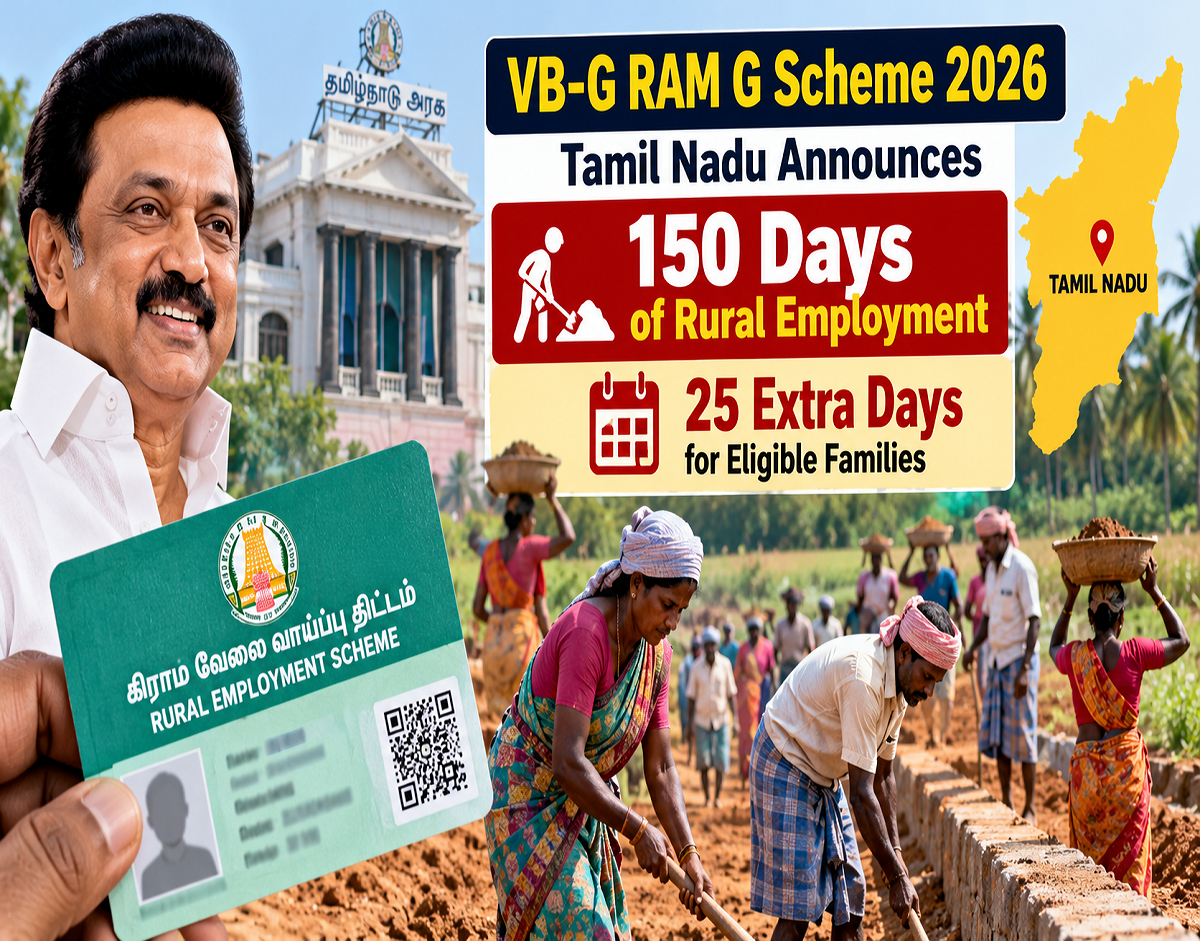
VB-G RAM G Scheme 2026: Rural workers in Tamil Nadu could receive an additional 25 days of paid employment under a new state government initiative. According to a report published on October 20, 2026, the Tamil Nadu government has announced additional employment support for eligible rural households that have already completed 125 days of work under the Viksit Bharat employment and livelihood programme.
The announcement has reportedly been made under the leadership of Tamil Nadu Chief Minister C. Joseph Vijay, popularly known as Thalapathy Vijay.
Under the proposed arrangement, qualifying rural households could receive up to 150 days of paid employment in a financial year, compared with the 125 days available under the central programme described in the report.
The additional 25 days would be funded by the Tamil Nadu government rather than the central allocation.
The initiative is intended to provide additional income opportunities to economically vulnerable rural families, particularly households headed by women, families with persons with disabilities and communities facing social or economic disadvantages.
However, the 150-day provision is a reported Tamil Nadu-specific measure, not a nationwide employment guarantee. Eligibility, implementation and payments will depend on the applicable government orders.
What Is the VB-G RAM G Scheme?
The Viksit Bharat–Guarantee for Rozgar and Ajeevika Mission (Gramin), commonly referred to as VB-G RAM G, is described in the report as a rural employment and livelihood programme introduced to replace the earlier Mahatma Gandhi National Rural Employment Guarantee Act (MGNREGA) framework.
According to the supplied article, the programme was implemented in Tamil Nadu from July 1, 2026, with a provision for 125 days of guaranteed employment.
The latest announcement concerns an additional 25 days of work for qualifying households in Tamil Nadu.
This would increase the total available employment support to 150 days for eligible beneficiaries.
Importantly, the reported additional benefit is intended for households that have completed the initial 125 days of employment and meet the state's conditions.
Tamil Nadu Rural Employment Scheme 2026: Key Details
| Particulars | Reported Details |
|---|---|
| Scheme | VB-G RAM G rural employment programme |
| State | Tamil Nadu |
| Chief Minister named in report | C. Joseph Vijay |
| Central programme employment provision | 125 days |
| Additional state-supported employment | 25 days |
| Total potential employment | 150 days annually |
| Funding for extra days | Tamil Nadu government |
| Implementing department | Rural Development and Panchayat Raj Department |
| Priority beneficiaries | Economically vulnerable rural households |
| Report date | October 20, 2026 |
The figures reflect the reported policy announcement. The exact implementation conditions should be checked against the official state government order.
How Will Rural Workers Get 150 Days of Employment?
Under the arrangement described in the report, the first 125 days of employment fall within the central rural employment programme.
Once an eligible household completes those 125 days, the state government would provide up to 25 additional days of paid work.
This means that qualifying households may have access to a combined total of 150 days of employment.
However, the additional work is not described as an automatic cash payment.
Beneficiaries would need to undertake approved employment activities under the relevant programme.
The number of days actually provided may depend on eligibility, work allocation, attendance records and implementation guidelines.
The reported benefit applies to households rather than guaranteeing 150 separate days to every adult member of a family.
Which Rural Families Will Receive Priority?
The Tamil Nadu government has identified several categories of vulnerable households for priority consideration under the additional employment programme.
These include:
- Rural households headed by women.
- Single women eligible under the programme.
- Families with members who have disabilities.
- Scheduled Caste households.
- Scheduled Tribe households.
- Eligible beneficiaries recognised under the Forest Rights Act, 2006.
These groups will receive priority for the additional 25 days of employment, subject to completion of the initial 125 days and other applicable conditions.
Being included in a priority category does not automatically mean that wages will be credited without undertaking the required work.
Tamil Nadu Government Approves ₹100 Crore for Vetri 150
A significant development is the reported allocation of ₹100 crore for the additional employment initiative.
The Tamil Nadu Rural Development and Panchayat Raj Department has granted administrative and financial sanction for the programme, designated Vetri 150.
The allocation has been made from the revised budget estimates for 2026–27.
The additional employment expenditure will be financed through state government funds.
The department's commissioner has been authorised to oversee fund distribution across the state's districts, excluding Chennai.
This financial approval is intended to support implementation of the additional 25 days of employment for qualifying rural households.
How Much Additional Income Can Workers Earn?
The actual financial benefit will depend on the applicable daily wage rate and the number of additional days worked.
For example, if a worker receives an illustrative wage of ₹300 per day, completing 25 additional days would generate ₹7,500 in wages.
| Illustrative Daily Wage | Earnings for 25 Additional Days |
|---|---|
| ₹250 | ₹6,250 |
| ₹300 | ₹7,500 |
| ₹350 | ₹8,750 |
| ₹400 | ₹10,000 |
These figures are examples only. They are not the officially notified wage rates for the programme.
Actual payments will depend on the prescribed rates, attendance and approved work records.
How Can Eligible Workers Access the Extra 25 Days?
Rural households seeking additional employment should contact their local village panchayat or the relevant rural development office.
Officials can provide information about employment records, eligibility verification and available work.
Households should ensure that their initial 125 days of employment have been properly recorded.
They may also need to verify household details, employment registration and bank account information under the applicable procedures.
The supplied announcement does not establish a separate online application portal or a universal application deadline for the additional 25 days.
Applicants should rely on instructions issued by the Tamil Nadu Rural Development and Panchayat Raj Department rather than unofficial registration links.
Is the 150-Day Employment Benefit Available Across India?
No. The additional 25-day benefit announced under Vetri 150 is specific to Tamil Nadu.
The central VB-G RAM G programme is described as providing 125 days of employment, while the Tamil Nadu government has approved additional state-funded support for selected eligible households.
Workers in other states should not assume that the same 150-day arrangement applies to them.
Any comparable extension elsewhere would depend on the relevant state government's decisions and applicable rules.
Why Is the Additional Employment Important?
For rural households dependent on seasonal or irregular work, additional paid employment can provide financial support.
An extra 25 days of work may help families meet expenses relating to food, education, healthcare and other essential needs.
The programme also places particular emphasis on vulnerable households that may face greater difficulties securing regular employment.
However, implementation will be important.
The effectiveness of the initiative will depend on whether eligible workers receive sufficient work opportunities, whether employment records are maintained accurately and whether wages are paid promptly.
VB-G RAM G Scheme 2026: Latest Update
Tamil Nadu has approved the Vetri 150 initiative to provide up to 25 additional days of paid employment to eligible vulnerable rural households that complete 125 days under the VB-G RAM G programme.
The state government has sanctioned ₹100 crore for the initiative during 2026–27, with priority for women-headed households, single women, families with persons with disabilities, SC and ST households, and eligible forest-rights beneficiaries.
The key point is that 150 days is the maximum combined employment support available to qualifying households under the reported arrangement. It is not an automatic entitlement for every rural worker or a direct cash benefit without work.
Eligible households should contact their local panchayat or rural development authorities for implementation details and employment availability.