Business
Natural Farming Scheme 2026: Farmers May Get ₹8,000 Per Acre in 2 Years, Check Eligibility and Benefits
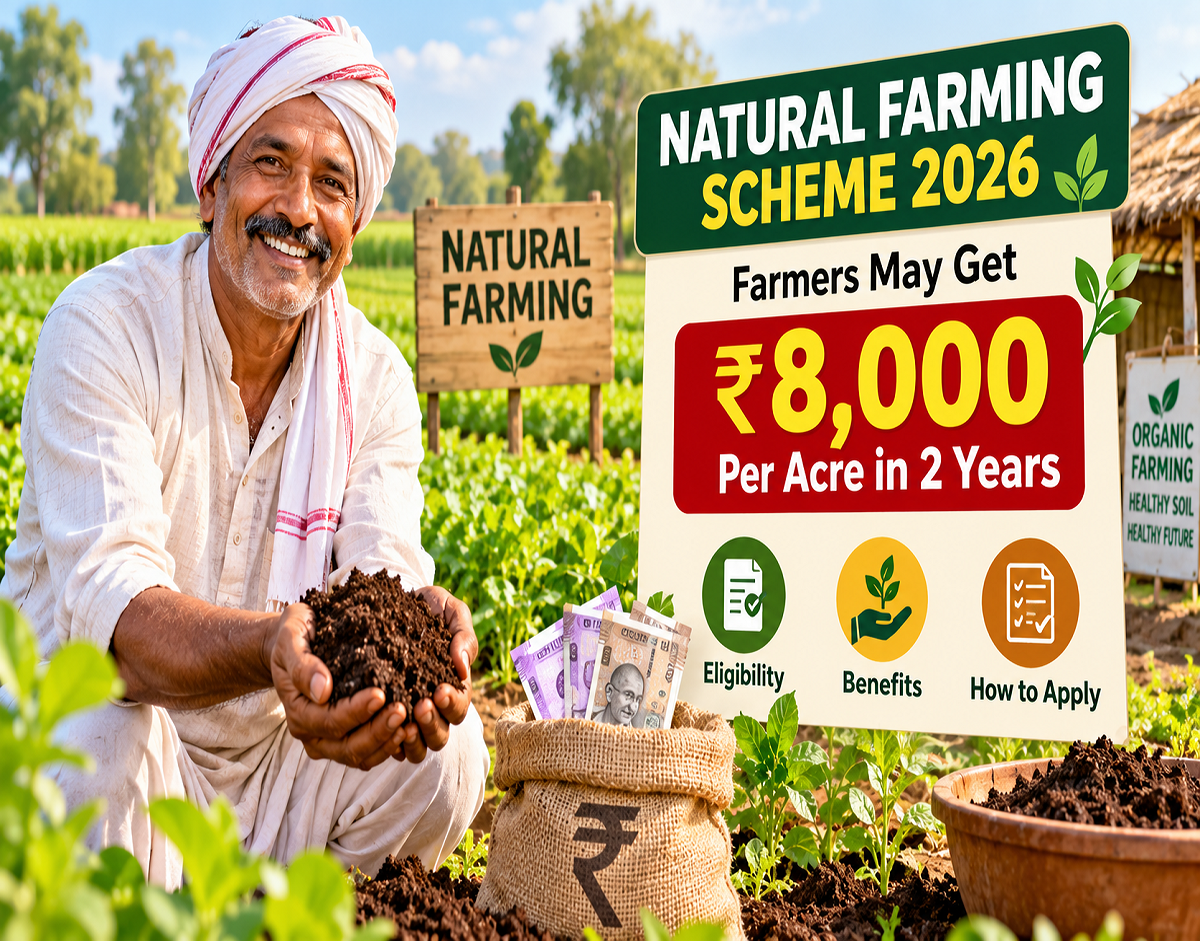
Natural Farming Scheme 2026: The government is encouraging farmers to adopt natural farming practices by offering financial assistance and technical support under the National Mission on Natural Farming (NMNF). The initiative aims to reduce cultivation expenses, improve soil health and help farmers gradually decrease their dependence on chemical fertilisers and pesticides.
According to a report published on October 20, 2026, eligible farmers participating in the programme may receive financial assistance of ₹4,000 per acre annually for two years, bringing the reported total benefit to ₹8,000 per acre.
The assistance is intended to help farmers transition towards natural cultivation methods and meet certain expenses associated with agricultural inputs.
However, farmers should understand that this is not an unconditional cash payment available to every landowner. Participation, land coverage, verification and financial assistance are subject to the mission's applicable guidelines and state-level implementation.
Here is everything farmers should know about the Natural Farming Mission, the reported financial benefits, eligibility conditions and enrolment process.
What Is the National Mission on Natural Farming?
The National Mission on Natural Farming is a government initiative designed to promote farming methods that rely more on natural agricultural processes and locally available resources.
The mission encourages farmers to reduce excessive dependence on synthetic fertilisers and chemical pesticides.
Instead, it promotes the use of natural preparations, soil-friendly cultivation methods and locally available biological resources.
The programme also focuses on training farmers, developing demonstration areas and encouraging community-based adoption of natural farming.
One of its central objectives is to make farming more economically sustainable, particularly for small and marginal farmers who face rising input costs.
The mission is implemented through designated administrative arrangements and participating states, with farmers generally organised into clusters.
Natural Farming Scheme 2026: Key Details
| Particulars | Details |
|---|---|
| Scheme | National Mission on Natural Farming |
| Main objective | Promote natural cultivation practices |
| Reported annual assistance | ₹4,000 per acre |
| Reported assistance period | Two years |
| Reported total assistance | ₹8,000 per acre |
| Main beneficiaries | Eligible participating farmers |
| Participation model | Natural farming clusters |
| Main focus | Lower input costs and improve soil health |
| Enrolment | Through authorised agriculture department channels |
Important: The ₹4,000-per-acre figure comes from the supplied report. Farmers should verify the applicable financial assistance rate, land-area limits and payment conditions with their state agriculture department. It should not be treated as a guaranteed nationwide entitlement for every acre.
How Much Money Can Farmers Receive?
According to the reported benefit structure, a participating farmer may receive assistance calculated at ₹4,000 per acre each year for two years.
Under this calculation, the total assistance would be ₹8,000 per acre over the entire period.
The amount is intended to support the adoption of natural farming practices rather than function as a general agricultural income payment.
For example, a farmer cultivating one eligible acre under the programme could potentially receive ₹4,000 in the first year and another ₹4,000 in the second year, provided all applicable conditions are met.
However, the actual assistance available may be subject to restrictions on eligible land area, approved activities and the implementation framework.
Natural Farming Financial Assistance Calculation
| Eligible Land Area | First-Year Assistance | Second-Year Assistance | Total for Two Years |
|---|---|---|---|
| 1 acre | ₹4,000 | ₹4,000 | ₹8,000 |
| 2 acres | ₹8,000 | ₹8,000 | ₹16,000 |
| 3 acres | ₹12,000 | ₹12,000 | ₹24,000 |
| 4 acres | ₹16,000 | ₹16,000 | ₹32,000 |
| 5 acres | ₹20,000 | ₹20,000 | ₹40,000 |
This table is a mathematical illustration based on the reported rate. It does not establish that assistance is approved for all five acres or that every participating farmer can claim the amounts shown.
Actual payments depend on the official scheme rules and eligible land-area limits.
Who Is Eligible for the Natural Farming Scheme?
The programme is intended for farmers who are willing to adopt natural farming practices and participate in the mission's implementation activities.
According to the supplied report, participating farmers may need to satisfy several conditions.
These include having access to eligible cultivable agricultural land and following the prescribed natural farming guidelines.
Farmers may also need to join a designated natural farming cluster.
Identity verification and bank account details can be required for enrolment and payment processing.
The final eligibility requirements depend on the applicable state and programme guidelines.
Farmers should not assume that simply owning agricultural land automatically qualifies them for financial assistance.
What Is a Natural Farming Cluster?
A natural farming cluster is a group of farmers participating in the programme within a designated geographical area.
The cluster-based approach allows agriculture departments and supporting organisations to organise training, demonstrations and technical assistance more efficiently.
Farmers within a cluster may receive guidance on natural farming practices and the preparation of locally sourced agricultural inputs.
The system can also encourage participating farmers to share experiences and learn from one another.
According to the report, joining an approved cluster is an important part of participation.
Farmers should contact their local agriculture department to find out whether a natural farming cluster operates in their village or nearby area.
What Can Farmers Use the Financial Assistance For?
The reported financial support is intended to help farmers adopt natural cultivation practices.
The programme encourages the use of locally prepared inputs rather than relying entirely on purchased chemical fertilisers and pesticides.
Depending on the applicable guidelines, assistance may support eligible activities associated with the transition to natural farming.
These can include preparing natural agricultural formulations, managing suitable input materials and adopting recommended cultivation methods.
However, the exact expenses covered by financial assistance should be confirmed with the implementing authority.
Farmers should not assume that the money can be spent without restrictions or that every agricultural purchase will qualify.
How Does Natural Farming Help Reduce Cultivation Costs?
Traditional agricultural production can involve significant expenditure on fertilisers, pesticides and other purchased inputs.
For farmers managing small holdings, these expenses can place pressure on seasonal income.
Natural farming approaches seek to reduce dependence on some externally purchased agricultural inputs by encouraging locally available resources and farm-based preparations.
If implemented successfully under suitable local conditions, this may help reduce certain cultivation expenses.
However, financial savings are not guaranteed for every crop or location.
Results depend on soil conditions, water availability, crop selection, farmer experience and the quality of implementation.
Farmers should assess their local agricultural conditions and obtain technical advice before making major changes to cultivation practices.
Can Natural Farming Improve Soil Health?
Soil health is one of the important areas addressed by the Natural Farming Mission.
The initiative encourages practices intended to support soil biological activity and reduce unnecessary chemical inputs.
Natural farming methods may include mulching, crop diversification, locally prepared formulations and other practices suited to the farming system.
These approaches can contribute to better soil management when applied appropriately.
However, the effects on crop yields, soil fertility and farm profitability can vary.
Farmers should not assume that switching to natural farming will automatically increase production.
A gradual transition supported by local agricultural experts may help farmers understand the practical requirements and risks.
How to Apply for the Natural Farming Scheme in 2026
Farmers interested in participating should first check whether the programme is being implemented in their district.
The application and selection process may differ between states.
A general enrolment process may involve the following steps:
- Contact the local agriculture department: Visit the district agriculture office, block agriculture office or another authorised agricultural extension centre.
- Ask about NMNF participation: Check whether natural farming clusters have been established in your village or nearby area.
- Confirm eligibility: Find out the requirements relating to land, identity verification and participation.
- Prepare documents: Keep the necessary identification, agricultural land and banking information available.
- Complete the prescribed enrolment process: Submit the required information through the authorised channel.
- Participate in training: Follow the natural farming practices and training requirements specified by the implementing agency.
- Check assistance eligibility: Confirm the applicable financial support, payment schedule and verification requirements.
Farmers should rely on the official process announced by their state agriculture department rather than unofficial registration links.
Documents That May Be Required
Depending on the state-level enrolment process, farmers may be asked to provide:
- Aadhaar card or another accepted identity document.
- Agricultural land records or proof of eligible cultivation.
- Bank account information.
- Mobile number for communication.
- Details of the agricultural area proposed for natural farming.
- Additional documents required by the implementing authority.
The exact documentation requirements may vary.
An Aadhaar-linked bank account may be relevant to benefit payments, but farmers should confirm the specific banking requirements rather than assuming that Aadhaar linking alone guarantees payment.
Is the Natural Farming Scheme the Same as PM-Kisan?
No. The National Mission on Natural Farming and PM-Kisan are separate government initiatives.
PM-Kisan is an income-support scheme under which eligible farmer families receive ₹6,000 annually in three instalments of ₹2,000.
The Natural Farming Mission, by contrast, focuses on encouraging the adoption of natural agricultural practices through training, implementation support and applicable financial assistance.
The eligibility conditions and administrative procedures are different.
Participation in one programme does not automatically establish eligibility for the other.
Farmers should check each scheme's requirements separately.
Will Every Farmer Receive ₹8,000 Per Acre?
Not necessarily.
The ₹8,000 figure represents the reported cumulative assistance calculated over two years at ₹4,000 per acre annually.
It should not be interpreted as an automatic payment for every acre of agricultural land.
The actual assistance depends on whether the farmer is selected or enrolled, whether the land qualifies and what limits are specified under the applicable guidelines.
State-level implementation and availability of approved clusters may also affect participation.
Before planning agricultural expenditure around the reported amount, farmers should confirm the officially applicable benefit.
Natural Farming Scheme 2026: Final Update
The National Mission on Natural Farming aims to encourage farmers to reduce cultivation costs and adopt agricultural practices that support long-term soil management.
A report dated October 20, 2026, describes financial assistance of ₹4,000 per acre annually for two years, equivalent to ₹8,000 per acre over the period.
The programme also involves farmer training, natural farming clusters and compliance with applicable implementation guidelines.
Farmers interested in receiving assistance should contact their district agriculture department, confirm whether an approved cluster is available and verify the official payment rate and land-area limits before enrolling.