Business
ESIC Funeral Benefit 2026: Financial Assistance Increased to ₹20,000, Check Eligibility and Claim Process
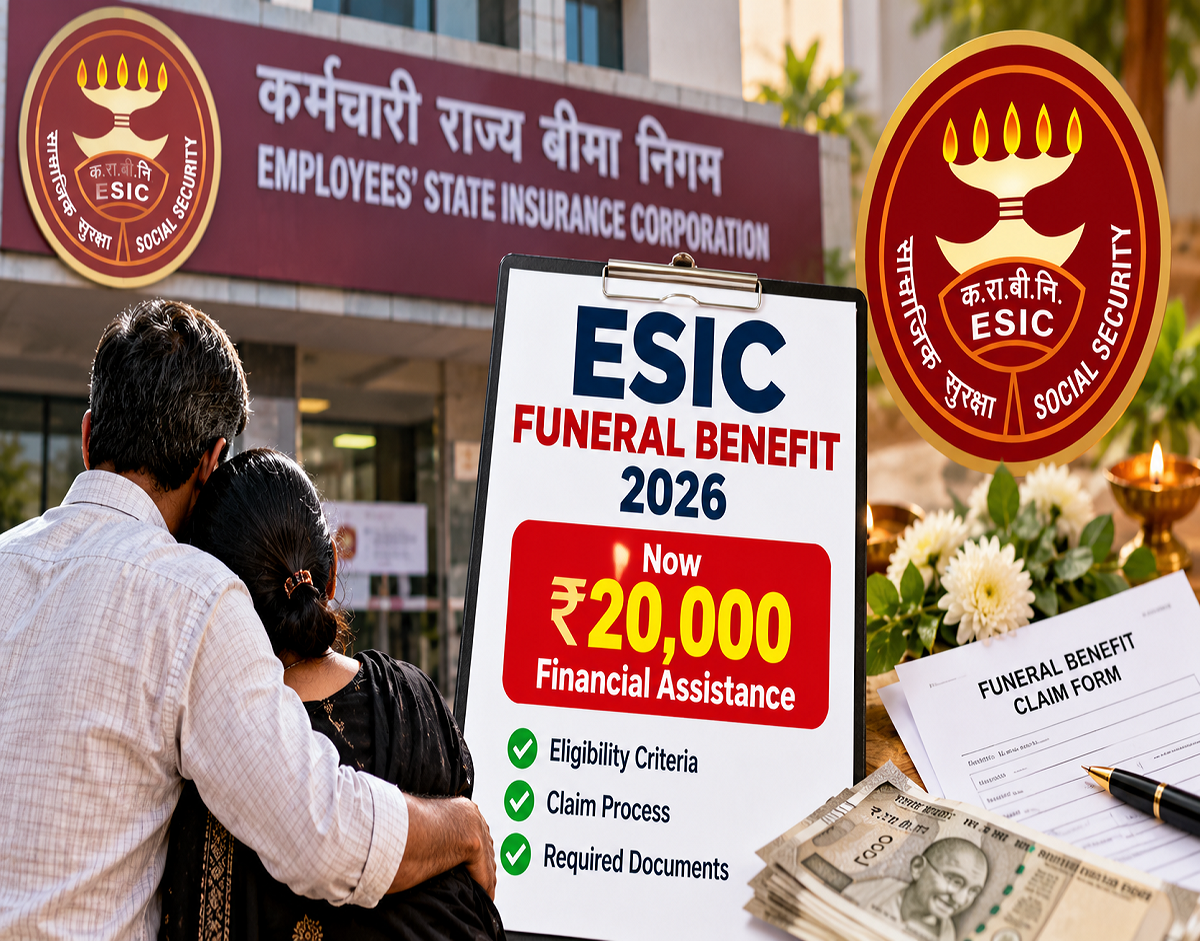
ESIC New Rules 2026: The Employees' State Insurance Corporation (ESIC) has reportedly increased the financial assistance available for funeral expenses following the death of an eligible insured employee. Under the revised provision, the funeral benefit has been raised from ₹15,000 to ₹20,000, providing additional support to families during a difficult period.
According to a report published on October 20, 2026, the revised benefit became effective on May 8, 2026, following a Government of India Gazette notification.
The increase provides an additional ₹5,000 compared with the earlier benefit amount, representing a rise of approximately 33.33%.
📢 बीमित कर्मचारियों के लिए सामाजिक सुरक्षा में बढ़ोतरी! कर्मचारी राज्य बीमा निगम (#ESIC) ने अंत्येष्टि व्यय (Funeral Expenses) की राशि को ₹15000 से बढ़ाकर ₹20,000/- कर दिया है। भारत सरकार के आधिकारिक राजपत्र के अनुसार यह आदेश 8 मई 2026 से प्रभावी माना जाएगा। ऑल इंडिया एनपीएस एम्पलाइज फेडरेशन (#AINPSEF) इस कल्याणकारी निर्णय का स्वागत करता है। सभी साथी इस जानकारी को ज़मीनी स्तर पर हर कर्मचारी तक पहुँचाना सुनिश्चित करें ताकि संकट के समय प्रभावित परिवारों को इसका लाभ मिल सके। #ManjeetSinghPatel (राष्ट्रीय अध्यक्ष, AINPSEF)
— Dr Manjeet Singh Patel (@ManjeetIMOPS) October 20, 2026
The funeral expenses benefit forms part of the social security assistance available under the Employees' State Insurance framework.
However, the payment is not automatically available to every employee's family. Eligibility depends on the insured person's coverage and the applicable rules governing funeral expense claims.
Here is a detailed explanation of the revised ESIC funeral benefit, who may qualify, the documents generally required and how eligible claimants can seek assistance.
ESIC Funeral Expenses Benefit Increased to ₹20,000
The Employees' State Insurance scheme provides social security protection to eligible employees covered under its provisions.
Its benefits include medical care and certain financial assistance arrangements connected with sickness, maternity, employment injury and other specified circumstances.
Funeral expenses assistance is one of the benefits intended to support eligible claimants following the death of an insured person.
The latest reported revision increases the amount available under this benefit.
Previously, the funeral expenses benefit was ₹15,000.
Under the revised provision described in the report, the amount has been increased to ₹20,000.
The objective is to provide greater financial support to families or other eligible claimants responsible for funeral arrangements.
ESIC Funeral Benefit 2026: Key Details
| Particulars | Details |
|---|---|
| Organisation | Employees' State Insurance Corporation |
| Benefit | Funeral Expenses Benefit |
| Earlier amount | ₹15,000 |
| Revised amount | ₹20,000 |
| Increase | ₹5,000 |
| Percentage increase | Approximately 33.33% |
| Reported effective date | May 8, 2026 |
| Eligible category | Qualifying claims relating to deceased insured persons |
| Claim authority | Relevant ESIC office |
The revised amount and effective date are based on the reported Gazette notification. Claimants should consult the applicable official notification and ESIC office to confirm the conditions governing their individual claims.
Who Can Receive the ₹20,000 ESIC Funeral Benefit?
The funeral expenses benefit is linked to the death of a person insured under the Employees' State Insurance scheme.
Under the established ESI benefit framework, the payment is generally intended for the eligible person who incurs the funeral expenses.
A qualifying family member may be entitled to receive the assistance.
Where the applicable rules permit, a person other than a family member who actually undertakes the funeral expenses may also be eligible.
This distinction is important because the benefit is not necessarily restricted to a spouse or another particular relative in every situation.
The claimant must satisfy the applicable eligibility requirements and provide the necessary supporting information.
The final determination is made under the relevant ESIC rules.
Is the Funeral Benefit Available to Every Employee?
No. The ESIC funeral expenses benefit should not be confused with a universal government payment for all deceased workers.
It is associated with coverage under the Employees' State Insurance framework.
Employees who are not covered by the applicable ESI provisions may not qualify for this specific benefit.
Similarly, simply having worked in the private sector does not automatically establish eligibility.
The deceased person's insured status and the relevant statutory conditions must be considered.
Families should verify the deceased employee's ESIC insurance details before submitting a claim.
Why Has the Funeral Expenses Amount Been Increased?
Funeral arrangements can involve several immediate expenses.
Families may need to arrange transportation, cremation or burial services, ceremonial requirements and other essential activities.
These costs can create financial pressure, particularly when the deceased person was a major source of household income.
An increase in the funeral benefit is intended to provide additional assistance at such a time.
Although ₹20,000 may not cover every expense, the higher amount can reduce part of the immediate financial burden.
The revision also reflects the broader purpose of social security benefits: providing financial support during specified periods of hardship.
ESIC Funeral Benefit: Old Amount vs New Amount
The difference between the previous and revised amounts is straightforward.
| Benefit Calculation | Amount |
|---|---|
| Previous funeral assistance | ₹15,000 |
| Revised funeral assistance | ₹20,000 |
| Additional assistance | ₹5,000 |
| Increase over previous amount | 33.33% |
For example, if a claim qualifies for the revised benefit of ₹20,000, the claimant may receive ₹5,000 more than under the earlier ₹15,000 provision.
However, the actual amount payable in a particular case will depend on the applicable rules, including the date relevant to determining eligibility.
What Is the Effective Date of the New ESIC Rule?
According to the supplied report, the revised funeral benefit became effective on May 8, 2026.
The date is important because changes to social security benefits generally operate according to the commencement provisions specified in the relevant notification.
Families should not assume that all earlier claims will automatically be recalculated or that previously settled cases will receive an additional ₹5,000.
Whether the revised amount applies to a particular claim depends on the official rules and any applicable transitional provisions.
Claimants dealing with a death or claim that predates the reported effective date should seek clarification from ESIC.
How to Claim the ESIC Funeral Expenses Benefit
A person seeking funeral expenses assistance should contact the appropriate ESIC office and follow the prescribed claim procedure.
The general process may involve the following steps:
- Confirm ESIC coverage: Verify that the deceased person was insured under the relevant ESI provisions.
- Identify the eligible claimant: Establish who is entitled to claim the funeral expenses benefit under the applicable rules.
- Obtain the prescribed claim form: Request the current funeral expenses claim form or application instructions from ESIC.
- Prepare supporting documents: Collect the necessary identification, death-related and insurance records.
- Submit the application: File the completed claim through the authorised ESIC process.
- Complete verification: Respond to any additional documentation or clarification requested by the office.
- Receive the approved benefit: Payment will be processed after the claim is accepted, subject to the applicable rules.
The exact process, prescribed form and submission requirements should be confirmed with ESIC before filing.
Documents That May Be Required
Depending on the applicable claim procedure, ESIC may require documents establishing the insured person's identity, death and the claimant's entitlement.
These may include:
- ESIC insurance number or relevant insured-person details.
- Death certificate or other accepted proof of death.
- Identification details of the claimant.
- Information establishing the claimant's relationship to the deceased, where relevant.
- Evidence or declaration concerning responsibility for funeral expenses, if required.
- Bank account details for payment.
- The prescribed ESIC claim form.
This is a general preparation checklist, not a confirmed exhaustive list of mandatory documents under the revised 2026 rules.
Claimants should follow the instructions issued by the relevant ESIC office.
Is the ₹20,000 Funeral Benefit Paid Automatically?
Families should not assume that the benefit will be credited automatically after the death of an insured employee.
The funeral expenses benefit generally involves a claim and verification process.
Eligible claimants may need to submit the prescribed application and supporting documents.
Failure to provide the required information can delay processing.
It is therefore advisable to contact ESIC promptly and confirm the applicable claim submission requirements.
Any statutory time limit or provision for accepting a delayed claim should be checked under the current rules.
Employee Organisations Welcome the Decision
According to the report, the All India NPS Employees Federation (AINPSEF) has welcomed the increase in funeral expenses assistance.
The federation described the revision as a positive welfare measure for employees and their families.
It has also reportedly encouraged employee representatives and organisations to spread awareness of the revised benefit.
Such awareness can be important because eligible families may not always know which social security benefits are available.
Providing accurate information about eligibility and the claims process can help prevent families from missing assistance to which they may be entitled.
ESIC Benefits Under India's Social Security Framework
The funeral expenses benefit forms part of the wider social security framework governing insured employees.
The supplied report also refers to the Code on Social Security, 2020, and the Social Security (Central) Rules, 2026.
The application of particular provisions depends on their legal commencement and the relevant implementing rules.
Employees and families should therefore rely on the applicable ESIC regulations and official notifications rather than assuming that every provision mentioned in the broader social security framework operates identically.
Other benefits available under the ESI system are subject to their own eligibility conditions.
The funeral expenses payment should not be confused with dependants' benefits, employment injury compensation or other financial assistance programmes.
What Should Families Do if They Need Assistance?
Families who believe they qualify for the revised benefit should contact their nearest relevant ESIC office.
They should keep the deceased insured person's ESIC details available and ask for the current claim procedure.
If the claim involves uncertainty about the effective date, entitlement or required documents, they should request clarification before submitting incomplete paperwork.
Claimants should also be cautious about unofficial agents or messages promising guaranteed payments in exchange for fees.
Applications and benefit-related enquiries should be handled through authorised channels.
ESIC Funeral Benefit 2026: Final Update
The Employees' State Insurance Corporation has reportedly raised funeral expenses assistance from ₹15,000 to ₹20,000, with the revised amount taking effect from May 8, 2026.
The change represents an additional ₹5,000 in potential financial support for eligible claimants following the death of an insured person.
Employee organisations have welcomed the measure and encouraged wider awareness of the revised benefit.
Families should verify the deceased person's ESIC coverage, confirm who is entitled to claim and follow the official application procedure. The ₹20,000 amount is subject to the applicable eligibility and claim rules, rather than being an automatic payment to every deceased employee's family.