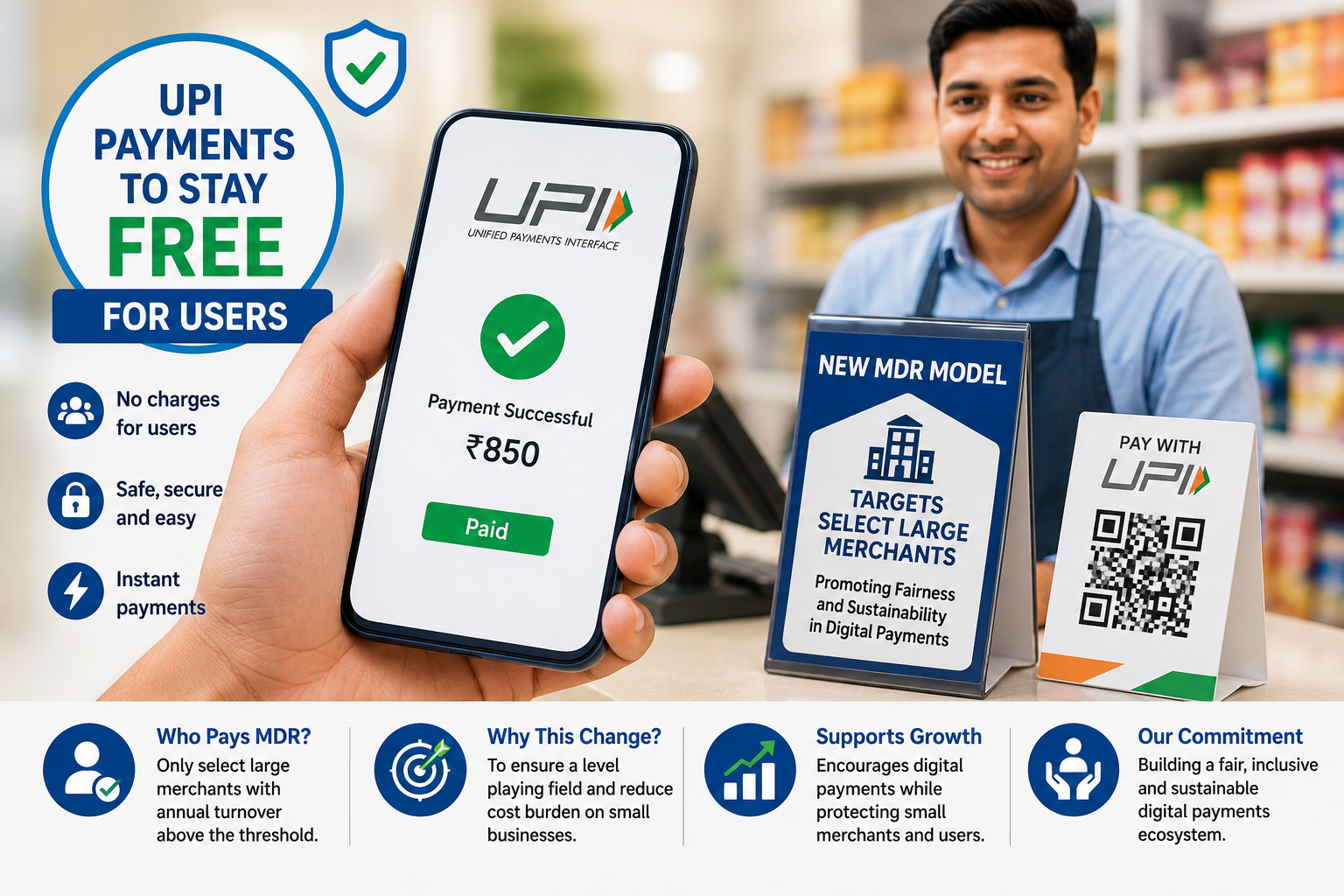
UPI Payment Charges Update: UPI users worried about having to pay an extra fee every time they scan a QR code may have some relief. The government has clarified that consumers will continue to make UPI payments without transaction charges, even as policymakers explore a new Merchant Discount Rate (MDR) framework for selected merchant transactions.
The emerging approach could take cues from the Reserve Bank of India’s earlier debit-card MDR model, where charges were structured differently according to merchant size and payment acceptance infrastructure. The broader objective is to create a sustainable source of revenue for banks and payment companies without placing the burden on ordinary consumers or small businesses.
The government has already stated that person-to-person UPI transfers will remain free, while the vast majority of merchant payments are also expected to stay outside any MDR framework. Any future charge is expected to apply only to a limited category of higher-value merchant transactions. (Public NOW)
What Is Changing in the UPI MDR System?
At present, standard bank-account-based UPI transactions operate under a zero-MDR model. This means merchants generally do not pay a transaction-processing fee for accepting ordinary UPI payments.
However, operating India's enormous digital-payment network involves significant costs. Banks, fintech companies, payment service providers and NPCI have to spend on servers, cybersecurity, fraud monitoring, dispute resolution and technological upgrades.
That has led to discussions over whether selected large merchants should begin contributing toward the cost of maintaining the UPI ecosystem.
Reports suggest that one possible model would protect ordinary consumers and small businesses while allowing a modest MDR on some higher-value transactions involving larger merchants. The exact threshold and rate have not yet been finalised. (mint)
Debit Card Rules Could Provide a Blueprint
The RBI's 2017 debit-card MDR framework provides an example of how merchants can be divided into categories.
Under that framework, merchants with annual turnover of up to ₹20 lakh were classified as small merchants. For debit-card transactions, the RBI capped MDR at:
- 0.40% for physical point-of-sale transactions, subject to a ₹200 cap per transaction.
- 0.30% for QR-based debit-card acceptance, also subject to a ₹200 cap.
For merchants with turnover above ₹20 lakh, the permitted MDR ceiling was higher—up to 0.90% for physical POS transactions and 0.80% for QR-based debit-card transactions, subject to prescribed caps.
Crucially, the RBI also instructed banks to ensure that merchants did not pass the MDR charge on to customers. (Reserve Bank of India)
A similar principle could potentially influence the future UPI framework: payment companies get a revenue stream, while customers remain protected from additional transaction charges.
Will Customers Have to Pay for UPI?
The government's position is clear on this point: UPI users will not be charged for making payments.
The Ministry of Finance said on August 8, 2026 that consumers would continue to face no transaction charge. It also confirmed that all person-to-person, or P2P, transfers would remain free. (Public NOW)
This means sending money to friends, relatives or another individual through UPI is not expected to attract MDR.
Even when a merchant payment falls into a category on which MDR may eventually be permitted, the charge is intended to form part of the merchant-payment ecosystem rather than being imposed directly on the customer.
Small Merchants Could Remain Protected
Small businesses are one of the biggest reasons UPI has become so successful in India.
From neighbourhood grocery shops and vegetable vendors to tea stalls, autorickshaw drivers and street vendors, QR-code payments have allowed even very small merchants to accept digital payments without expensive infrastructure.
The government has indicated that the vast majority of merchant transactions will remain free even after the legal framework is changed. (Public NOW)
That means smaller merchants are likely to remain protected under any eventual MDR model.
A tiered system could instead focus on larger organised retailers, high-value merchants and certain transactions above a specified threshold.
Could MDR Apply Above ₹2,000?
Several reports have suggested that the government is considering a threshold-based system under which selected UPI merchant transactions above ₹2,000 could attract MDR.
Possible rates of around 0.25% to 0.40% have been discussed in reports, but there has been no final official notification fixing these figures. (The Economic Times)
Therefore, consumers should not assume that every UPI payment above ₹2,000 has already become chargeable.
The final rate, merchant turnover threshold, transaction limit and exemptions will depend on the rules ultimately notified by the government.
Why Does UPI Need a Revenue Model?
For users, a UPI payment appears almost instant and effortless. But several institutions work behind the scenes to complete each transaction.
The customer's bank verifies and sends the money. The merchant's bank receives it. Payment apps provide the interface, while NPCI operates the UPI network connecting participating banks and service providers.
Maintaining this infrastructure requires continuous investment.
As UPI transactions grow, so do expenses related to:
- Cybersecurity
- Fraud detection
- Server capacity
- Customer support
- Transaction processing
- Network resilience
- Regulatory compliance
- Technology upgrades
The debate over MDR is therefore less about making customers pay and more about finding a long-term financial model for the payment ecosystem.
Why Was UPI Kept Free Until Now?
The zero-MDR policy played an important role in accelerating digital-payment adoption.
By making UPI inexpensive for both consumers and merchants, the government encouraged millions of small businesses to start accepting QR payments.
Government incentives have also been used to compensate participants in the payment ecosystem. Under an earlier incentive framework, small merchants could receive support for qualifying transactions while MDR remained zero. (Press Information Bureau)
However, as transaction volumes expand, policymakers have increasingly examined whether government subsidies alone should continue bearing the cost indefinitely.
Legal Change Does Not Mean Charges Have Started
A recent amendment to the Payment and Settlement Systems framework removed the blanket statutory restriction that had supported the zero-MDR regime.
But the legal change is an enabling provision. It does not mean that merchants or consumers automatically started paying UPI charges from the date of the amendment. (Tech Times)
Instead, it allows the government to create a more targeted system in which certain payment modes or transaction categories can continue receiving exemptions while charges may be permitted elsewhere.
The government has said any future merchant fee would be nominal and apply only to a limited set of transactions. (Public NOW)
Who Could Receive the MDR Revenue?
If MDR is introduced, the money would not necessarily go to one company.
A UPI transaction involves multiple participants, including the customer's bank, merchant's bank, payment service providers and NPCI.
Revenue generated through MDR could therefore be distributed across various entities involved in processing and settling the payment.
Such revenue could help payment companies invest in stronger infrastructure and reduce dependence on government incentives.
The precise revenue-sharing structure, however, will depend on the final policy.
What Does This Mean for PhonePe, Google Pay and Other Apps?
UPI apps have helped make digital payments easy for consumers, but maintaining their platforms involves substantial technology and security costs.
A merchant-funded revenue mechanism could potentially give banks and fintech companies a more sustainable economic model.
However, any future MDR rules would need to balance this requirement against the risk of discouraging merchants from accepting UPI.
That is why policymakers appear to be focusing on a limited, tiered approach rather than imposing a universal charge.
UPI Users Should Not Panic About Extra Charges
Consumers should be cautious about social-media messages claiming that every UPI payment will soon become chargeable.
The latest government clarification says otherwise.
Person-to-person transfers will remain free, consumers will not face transaction charges and most merchant payments are also expected to remain outside the MDR system. (Public NOW)
The debate currently concerns how selected larger merchants could contribute toward UPI's operating costs.
The Bottom Line
India is exploring a new UPI pricing framework that could allow a limited Merchant Discount Rate on selected commercial transactions while protecting ordinary users and small businesses.
The RBI's debit-card model offers one possible template: keep charges lower for smaller merchants, allow higher but capped fees for bigger businesses and prevent merchants from passing those fees directly to customers. (Reserve Bank of India)
For UPI users, the most important takeaway is simple—payments are expected to remain free for consumers, and P2P transfers will continue without transaction charges.
A final MDR rate, threshold and merchant eligibility framework has not yet been officially notified. Until that happens, users should avoid assuming that every payment above a particular amount will carry an extra fee.