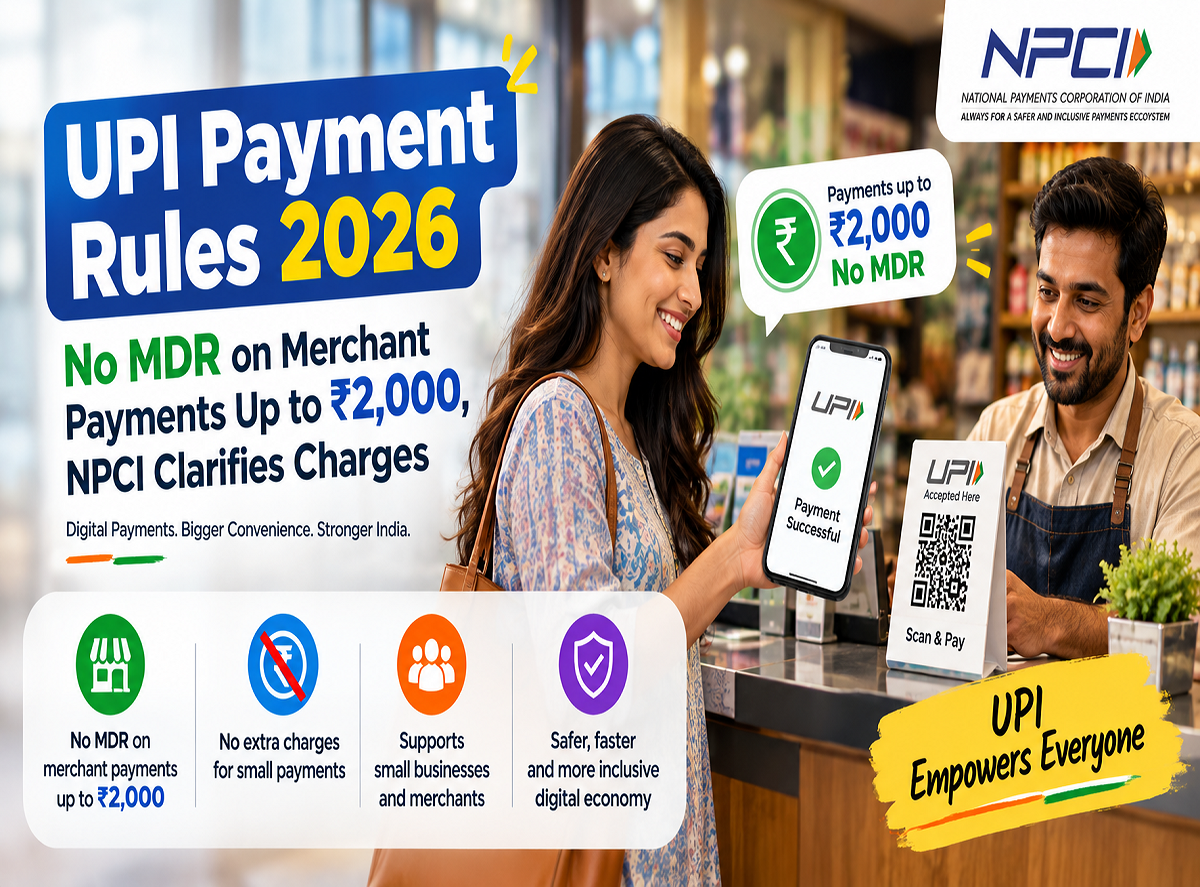
UPI MDR Charges 2026: Millions of Indians use Unified Payments Interface (UPI) every day to purchase groceries, pay at local shops, buy medicines and make other routine payments. Now, an important clarification regarding UPI transaction charges has highlighted that eligible person-to-merchant (P2M) payments of up to ₹2,000 attract zero Merchant Discount Rate (MDR).
The awareness message shared by UPI emphasises that small digital payments can continue without MDR charges under the applicable payment framework.
The clarification is particularly relevant for consumers and small businesses that depend on UPI for everyday transactions. However, it is important to understand that MDR is generally associated with merchant payment acceptance rather than a fee directly charged to customers.
NPCI Highlights Zero MDR on UPI Merchant Payments Up to ₹2,000
The National Payments Corporation of India (NPCI), which operates the UPI payment system, has highlighted the zero-MDR treatment of P2M transactions up to ₹2,000.
P2M stands for Person to Merchant, referring to payments made by individuals to businesses for goods or services.
For example, when a customer purchases groceries from a neighbourhood store and pays through a merchant's UPI QR code, the transaction is generally classified as P2M.
Similarly, payments made to registered merchants for medicines, food, household products and other purchases may fall under this category.
According to the supplied awareness message, P2M UPI transactions of up to ₹2,000 attract zero MDR.
The statement does not, by itself, announce any new charges on transactions exceeding ₹2,000.
What Is MDR and How Does It Work?
MDR, or Merchant Discount Rate, is a payment acceptance charge associated with certain digital transactions.
It is generally paid by merchants or handled under the relevant payment service arrangements.
For example, when a customer pays a retailer electronically, the payment system may involve banks, payment service providers and other participating entities.
Depending on the payment method and applicable rules, charges may arise within the payment acceptance arrangement.
However, UPI transactions covered by the zero-MDR framework do not attract this particular merchant discount charge.
Consumers should understand that MDR is different from other possible service fees or charges associated with certain payment products.
How Much MDR Applies to UPI Payments Up to ₹2,000?
The following table illustrates the zero-MDR treatment highlighted in the awareness message.
| Merchant UPI payment amount | MDR |
|---|---|
| ₹100 | ₹0 |
| ₹250 | ₹0 |
| ₹500 | ₹0 |
| ₹750 | ₹0 |
| ₹1,000 | ₹0 |
| ₹1,500 | ₹0 |
| ₹1,999 | ₹0 |
| ₹2,000 | ₹0 |
These examples relate to the P2M transaction category covered by the announcement.
The zero-MDR statement should not be interpreted as meaning that a charge automatically applies when a payment exceeds ₹2,000.
The applicable treatment of larger transactions depends on the payment instrument and prevailing rules.
What Happens When a UPI Merchant Payment Exceeds ₹2,000?
This is an important question for customers who regularly make higher-value purchases using UPI.
The supplied NPCI message specifically highlights zero MDR on P2M transactions up to ₹2,000.
However, it does not specify that ordinary bank-account-linked UPI merchant payments above ₹2,000 will attract MDR.
Under India's established framework, eligible bank-account-linked UPI merchant transactions are generally covered by zero-MDR provisions.
Different commercial arrangements can apply to certain prepaid payment instruments, including eligible wallet-based transactions.
Therefore, customers should not assume that making a ₹3,000 or ₹5,000 UPI payment will automatically result in an additional charge.
Any applicable fee should be assessed according to the payment method and current regulatory framework.
What Is the Difference Between P2P and P2M UPI Transactions?
UPI supports different payment categories, including person-to-person and person-to-merchant transfers.
P2P transactions involve transferring money directly between individuals.
Examples include sending money to parents, transferring funds to friends or sharing personal expenses.
P2M transactions involve payments made to businesses or merchants.
Examples include paying a grocery shop, restaurant, pharmacy or other registered merchant.
NPCI has separately clarified that ordinary P2P UPI transfers remain free from MDR.
The latest awareness message focuses on the zero-MDR treatment of merchant transactions up to ₹2,000.
How Does Zero MDR Help Small Businesses?
Digital payments have become increasingly important for neighbourhood shops, street vendors and other small businesses.
Customers often prefer scanning a QR code instead of carrying cash.
A zero-MDR framework can help eligible merchants accept digital payments without incurring that particular transaction charge.
For example, a small retailer receiving a ₹500 UPI payment covered by the zero-MDR framework would not incur MDR on that transaction.
This can support the adoption of digital payments among businesses that regularly handle low-value purchases.
However, merchants should separately review any fees for optional services, devices or payment products provided by their payment service providers.
Important Safety Tips for UPI Users
While UPI provides a convenient way to make everyday payments, users should remain careful about financial fraud.
Before scanning a QR code, verify that it belongs to the intended merchant.
Check the recipient's name and payment amount before approving a transaction.
Never share your UPI PIN, OTP or banking password with anyone.
Remember that a UPI PIN is used to authorise payments and is not required simply to receive money.
Customers should also avoid suspicious payment links and use trusted applications for financial transactions.
Where Can You Get Help With UPI Payments?
Customers facing failed transactions, incorrect deductions or other payment-related problems should contact their bank or UPI application provider.
NPCI also provides an official assistance platform for UPI users.
For UPI-related support, visit NPCI UPI Help Portal.
If you suspect financial cyber fraud, immediately contact your bank and report the incident through the national cybercrime helpline at 1930.
Users can also submit complaints through the official National Cyber Crime Reporting Portal.
NPCI's Message on Everyday Digital Payments
UPI has transformed how people make routine payments across India, from purchasing household essentials to paying local businesses.
The latest awareness message highlights the zero-MDR treatment of eligible merchant transactions up to ₹2,000.
This is particularly relevant for small purchases that form a significant part of everyday digital payment activity.
However, the clarification should not be misunderstood as an announcement of automatic charges on transactions above ₹2,000.
The key takeaway: Eligible P2M UPI payments up to ₹2,000 attract zero MDR. Ordinary bank-account-linked UPI merchant payments above this amount should not automatically be assumed to carry MDR, as the applicable rules depend on the payment arrangement.
Source Credit: National Payments Corporation of India (NPCI) — UPI public awareness message, “Everyday payments, zero MDR.” Additional reference: NPCI official website.