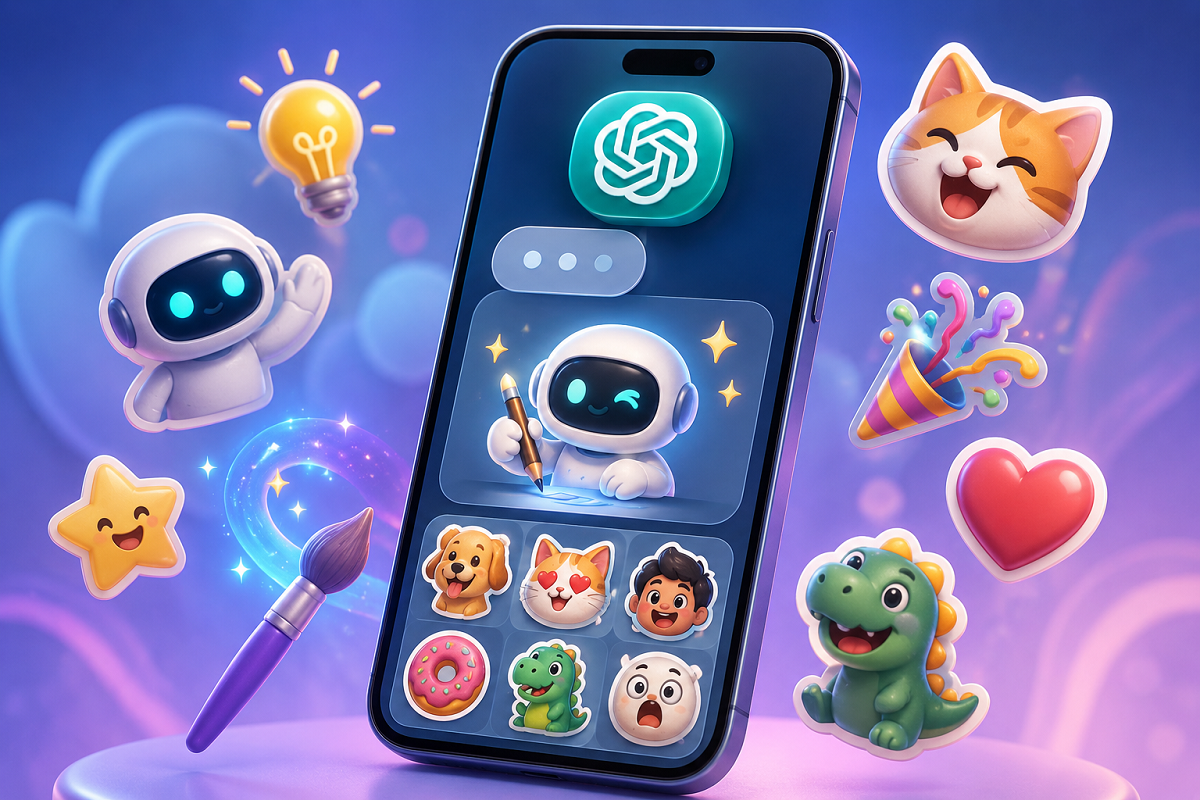
Sending the same collection of stickers repeatedly may soon become less common for ChatGPT users. OpenAI has rolled out a creative feature that enables people to generate their own AI-powered sticker collections from simple descriptions. The personalized creations can then be used in conversations on popular messaging services, including WhatsApp and Apple's iMessage.
Instead of selecting a sticker from an existing catalogue, users can describe exactly what they want to see. It could be a pet showing different emotions, a funny reaction between friends, a recurring family joke or an entirely imaginary character. ChatGPT can transform that description into a collection of original visuals.
The capability is built around OpenAI's updated ChatGPT Images 2.0 technology and is intended to make personalized visual creation accessible even to people with no graphic-design experience.
Your Personal Ideas Can Now Become Chat Reactions
Stickers have become a common way of responding to messages without typing a complete sentence. However, conventional sticker libraries generally provide the same designs to millions of users.
ChatGPT's new capability takes a different approach by allowing the individual to decide what should appear in the sticker.
Users can provide a description of a person, animal, character, emotion or situation and ask the AI to transform the concept into multiple sticker-style images. This makes it possible to build a collection around something that has personal meaning rather than depending entirely on pre-designed options.
A pet owner, for example, could create a series inspired by their cat or dog. Friends could turn a recurring joke into visual reactions, while families could develop their own collection for birthdays, celebrations and everyday conversations.
OpenAI's Updated Image Technology Works Behind the Scenes
The technology supporting the feature is ChatGPT Images 2.0, the latest development in OpenAI's image-generation system.
The upgraded model has been designed to interpret instructions more effectively and handle increasingly detailed visual requests. This means users can provide specific directions about the appearance, mood and composition they want rather than relying on a very basic description.
The model also brings improvements to visual detail and the handling of more complicated image-generation tasks.
Another notable advancement involves words appearing inside generated pictures. AI image generators have historically struggled to reproduce text correctly, particularly when designs contain several words or complicated layouts. The updated technology aims to improve accuracy when generating visuals that contain significant amounts of written content.
For sticker users, these improvements should provide greater control over the final appearance of their creations.
Creating Your Own Sticker Collection Requires Only a Prompt
Users do not need professional editing software or extensive design knowledge to get started.
The process begins by opening ChatGPT on a mobile device and entering a description of the desired sticker collection. The request can be short or detailed depending on how much control the user wants over the result.
Someone with a kitten, for instance, could request several adorable reactions inspired by their pet. Instead of stopping with a general request, the user could specify different moods or situations, such as celebrating, laughing, looking surprised or appearing sleepy.
The AI then interprets those directions and creates corresponding visuals.
The conversational nature of ChatGPT also means the creative process does not necessarily end with the first result. Users can provide follow-up instructions if they want something changed.
Don't Like the First Result? Ask ChatGPT to Modify It
Customization is an important part of the updated image experience.
If a generated image does not match the original idea, users can describe what needs to be changed. Instead of manually editing individual elements with specialist software, they can communicate the desired adjustments through additional prompts.
This could involve altering the style, modifying an expression or refining a particular part of the generated image.
The ability to repeatedly refine an image makes the feature useful beyond casual sticker creation. It also demonstrates how conversational AI is increasingly being combined with visual editing tools, allowing users to create and modify images through natural-language instructions.
Take the Finished Stickers Into Your Everyday Chats
Once users are satisfied with their creations, the personalized stickers can be shared through WhatsApp or iMessage.
This gives people an opportunity to create reactions that are closely connected to their own conversations. A unique facial expression, memorable moment or private joke could potentially become a reusable response in a family or friends' group chat.
The feature may particularly appeal to users who already depend heavily on emojis, GIFs and stickers to express emotions while messaging.
Rather than spending time searching for a reaction that roughly matches what they want to say, they can generate something specifically designed around their idea.
The AI Image Upgrade Goes Beyond Messaging Stickers
Although personalized stickers are one of the more playful applications of the technology, ChatGPT Images 2.0 has broader creative uses.
The system can generate new visuals from written descriptions and allow users to continue making adjustments through subsequent instructions. Specific areas of an image can also be refined, providing greater flexibility during the editing process.
This combination of creation and conversational modification lowers the barrier for people who want customized digital artwork but may not know how to use conventional design applications.
Global Mobile Users Can Try the Feature Without an Extra Fee
OpenAI has made the sticker-making capability available to ChatGPT mobile users worldwide without requiring an additional payment specifically for the feature.
Its wider availability could introduce AI image creation to people who may never have considered using generative tools for artwork. Creating a sticker is a relatively simple everyday activity, making it an accessible way to experiment with AI-generated visuals.
The development also highlights how generative AI is moving beyond large creative projects and becoming part of routine digital communication.
For users, the practical benefit is straightforward: an ordinary idea, pet reaction or private joke can now be transformed into a personalized visual that can become part of everyday messaging.