
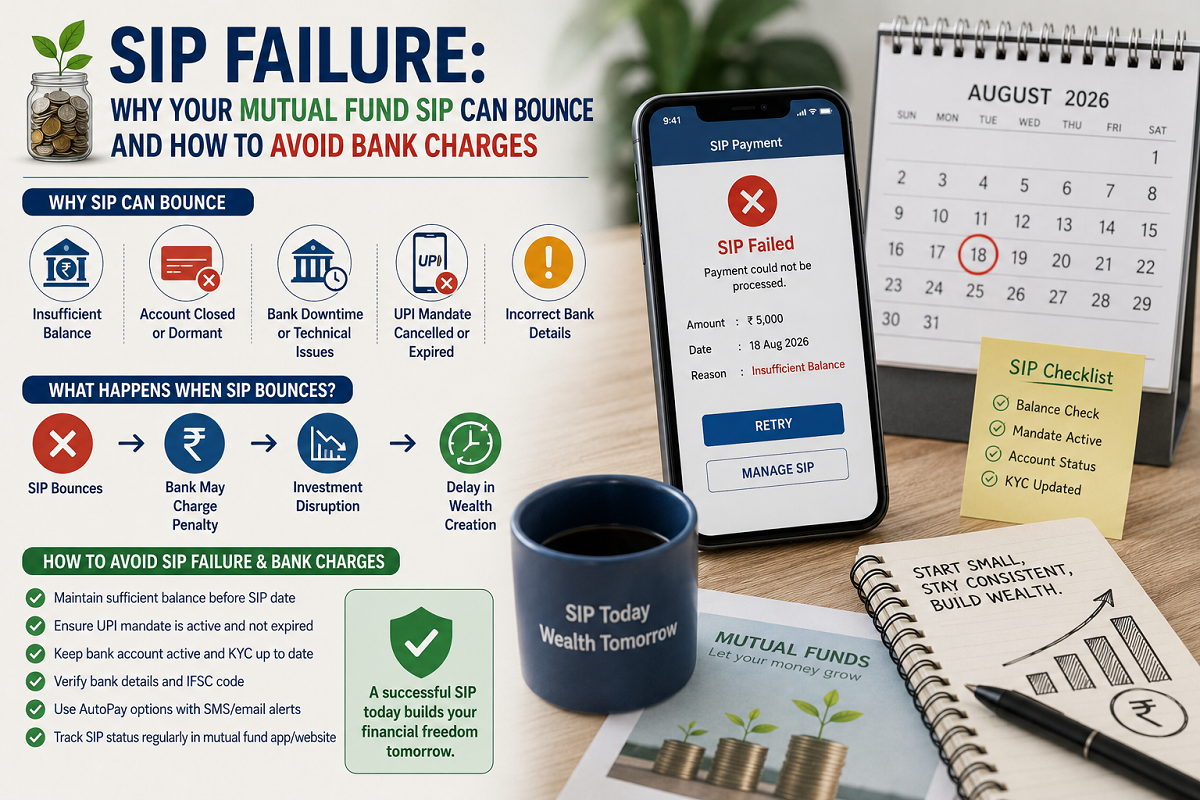
SIP Failure Reasons: A Systematic Investment Plan (SIP) is one of the simplest ways to invest regularly in mutual funds. Once an SIP is registered, a fixed amount is generally debited automatically from the investor’s linked bank account on the selected date and invested in the chosen scheme.
That automation, however, does not mean investors can completely forget about the payment process. An SIP instalment can fail because of insufficient funds, an expired or inactive mandate, bank-related issues or technical problems with the payment mechanism. Depending on the bank and mandate, a failed debit may also attract return or bounce charges.
Here is what investors should know about SIP failures and how to reduce the chances of paying avoidable charges.
Why Does a Mutual Fund SIP Fail?
A failed SIP does not necessarily mean there is something wrong with the mutual fund itself. In many cases, the problem occurs at the payment stage.
The asset management company or its payment system sends an instruction to debit the scheduled SIP amount. If the linked bank account cannot honour that instruction, the instalment may not be processed.
Possible reasons include insufficient balance, problems with the auto-debit mandate, changes to the bank account, technical failures or restrictions affecting the payment method.
Low Bank Balance Is One of the Biggest Risks
Insufficient funds are among the most straightforward reasons for an SIP debit failure.
Suppose your SIP of ₹10,000 is scheduled for the 5th of every month. If the account does not have sufficient usable balance when the debit request is processed, the transaction can be returned.
Investors sometimes assume they can deposit money into the account later on the SIP date. That can be risky because debit requests may be presented earlier in the day.
A safer approach is to ensure sufficient funds are available before the scheduled SIP date, rather than waiting for the debit notification.
Can a Failed SIP Result in a Penalty?
This is where investors need to distinguish between the mutual fund and their bank.
An AMC generally does not impose a penalty simply because an SIP instalment could not be debited. However, the investor's bank may levy mandate-return, ECS/NACH return or similar charges when an auto-debit fails, depending on its applicable schedule of charges.
The amount is not a universal fixed penalty for all SIP investors. It can differ from one bank and account type to another.
Therefore, claims suggesting that every failed SIP automatically attracts a large fixed fine can be misleading.
Multiple SIPs on the Same Date Can Increase the Risk
Imagine an investor has four SIPs:
| SIP | Monthly Amount |
|---|---|
| SIP 1 | ₹5,000 |
| SIP 2 | ₹4,000 |
| SIP 3 | ₹6,000 |
| SIP 4 | ₹5,000 |
| Total | ₹20,000 |
If all four are scheduled for the same day, the linked account needs enough available balance to meet the combined debit requirement.
A delayed salary credit or an unexpected expense could therefore cause more than one transaction to fail.
Investors with several SIPs may consider spreading their debit dates across the month if that arrangement better matches their cash flow. However, changing dates solely to improve investment returns is generally unnecessary; the objective here is payment management.
Keep an Extra ‘SIP Buffer’ in Your Account
One practical approach is to avoid maintaining exactly the amount required for your SIPs.
For example, if your total monthly SIP commitment is ₹15,000, keeping some additional money in the linked account can provide protection against unexpected debits, bank holds or other expenses.
There is no regulatory rule prescribing a specific “SIP buffer.” The appropriate amount depends on your income, expenses and banking habits.
The main idea is simple: don't run the SIP-linked account so close to zero that one unexpected payment causes the investment debit to bounce.
What Happens If One SIP Instalment Fails?
One failed instalment does not normally mean that all the money you have already invested in the mutual fund disappears.
The units purchased through previous successful investments remain in your folio and continue to be subject to the scheme's performance.
The failed instalment simply means that the scheduled investment for that particular occasion may not have taken place.
This distinction is important. An SIP failure is not the same as losing your existing mutual fund investment.
Can Repeated Failures Stop Your SIP?
Repeated failed instalments can create a bigger problem.
Depending on the AMC, platform and applicable SIP rules, consecutive failures may eventually result in cancellation or discontinuation of the SIP registration.
Investors should therefore investigate the reason as soon as they receive a failed-debit notification instead of assuming that the system will automatically resolve the issue next month.
Check whether there is enough money in the account, whether the mandate remains active and whether the bank or investment platform has reported a technical problem.
Don't Ignore Your Auto-Debit Mandate
The mandate is what authorises recurring deductions from your bank account.
If there is a problem with the mandate, the SIP may fail even when the account has sufficient funds.
Mandate-related problems can arise after changes in bank details, account status or payment authorisation. Investors should therefore periodically check that the bank account and mandate shown on their mutual fund platform remain valid.
This becomes especially important when moving an SIP to a different bank account.
What About UPI AutoPay?
Some investment platforms may support recurring payments through UPI AutoPay or other electronic payment mechanisms.
These systems make recurring investing convenient, but technical failures can still occur. A payment problem on a particular date does not by itself mean that UPI-based SIP investing is unsafe.
Investors using such payment methods should pay attention to mandate limits, validity, notifications and failed-transaction alerts.
If a payment repeatedly fails despite sufficient funds, contacting the bank, AMC or investment platform is better than repeatedly attempting to fix the issue without identifying the cause.
Should You Keep All SIPs Just After Salary Day?
Scheduling SIPs after salary credit can be convenient for salaried investors because money is usually available in the account.
But leaving a small gap can provide additional protection if salary is occasionally credited late.
For example, someone normally receiving a salary on the last working day of the month might choose SIP dates a few days later instead of scheduling every investment immediately on the 1st.
There is no single best SIP date for everyone. The most suitable date is one that matches your reliable cash flow and helps you invest consistently.
How to Reduce the Chances of SIP Failure
A few simple habits can make recurring investments easier to manage:
- Keep sufficient funds in the linked account before the debit date.
- Maintain an additional balance instead of funding the account with the exact SIP amount.
- Consider spreading multiple SIPs across different dates if cash-flow management is difficult.
- Check whether your NACH, e-mandate or UPI AutoPay instruction remains active.
- Read SMS, email and app notifications related to failed debits.
- Review bank details whenever you change or close an account.
- Check your bank's applicable charges for failed auto-debit instructions.
- Contact the AMC, investment platform or bank if failures occur repeatedly.
Does Missing One SIP Destroy Long-Term Returns?
Usually, one missed instalment is not enough to derail a long-term investment plan.
The bigger concern is allowing repeated failures to go unnoticed. If a ₹10,000 monthly SIP stops for six months, for example, ₹60,000 that was supposed to be invested remains outside the planned investment schedule.
Over a long investment horizon, repeatedly missing contributions can reduce the corpus simply because less money remains invested and gets less time to compound.
SIP Returns Are Not Guaranteed
Investors should also remember that successfully executing every SIP does not guarantee a particular return.
SIPs are simply a method of investing periodically in mutual funds. The eventual value depends on the performance of the underlying scheme and financial markets.
Rupee-cost averaging can help investors buy more units when NAVs are lower and fewer when NAVs are higher, but it does not eliminate market risk or guarantee profits.
Bottom Line
Most avoidable SIP failures have less to do with predicting the stock market and more to do with managing the payment process properly.
Maintain adequate funds before the SIP date, keep your mandate active, monitor transaction alerts and investigate failed debits immediately.
Most importantly, remember that there is no universal “heavy SIP penalty” charged by mutual funds whenever an instalment fails. Any return or bounce charge typically depends on the linked bank and its applicable terms.
For long-term investors, the objective should be straightforward: choose an affordable SIP amount, automate it correctly and make sure temporary banking issues do not interrupt a disciplined investment plan.