
Business
PPF Rules for NRIs: What Happens to Your Account After Moving Abroad or Taking Foreign Citizenship
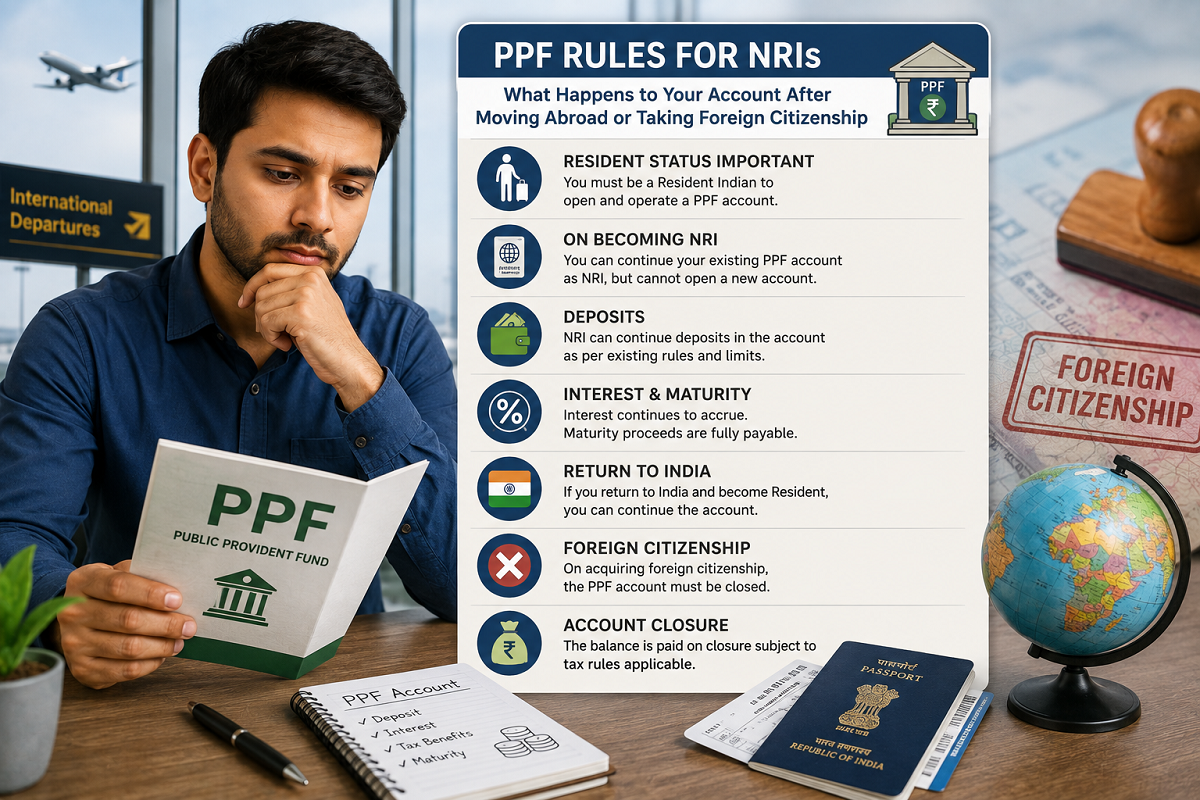
PPF Rules for NRIs: Moving abroad does not automatically mean that an existing Public Provident Fund account has to be closed immediately. However, once a PPF account holder becomes a Non-Resident Indian (NRI), the rules governing the account can change significantly.
A person who opened a PPF account while being a resident Indian may generally continue that account until its original maturity, subject to the applicable rules. But an NRI cannot open a fresh PPF account, and the usual option of extending a matured PPF account in blocks of five years is not available.
The situation can change further if the account holder later gives up Indian citizenship and becomes a citizen of another country. In that case, different compliance and closure requirements may apply.
Here is a detailed look at what happens to a PPF account after a person becomes an NRI or acquires foreign citizenship.
Can an NRI Open a New PPF Account?
No. NRIs are not permitted to open a new PPF account under the National Small Savings Scheme framework.
This means that if an individual has already become a non-resident before opening a PPF account, he or she cannot start a new account after the change in residential status.
The important exception applies to people who opened their PPF account while they were still resident Indians. Such an existing account does not necessarily have to be closed immediately after the person moves overseas.
What Happens to an Existing PPF Account After Becoming an NRI?
If a person becomes an NRI during the original tenure of the PPF account, the account can generally continue until its original maturity date.
PPF accounts normally have an initial tenure of 15 years, calculated according to the scheme's maturity rules.
During this period, the existing account may continue subject to the prevailing rules applicable to NRIs. The account holder should also update the bank or post office about the change in residential status.
This is important because continuing to operate the account as though the person were still a resident can create compliance issues later.
Can an NRI Continue Depositing Money in the PPF Account?
According to the information cited in the source article, an existing account opened while the individual was a resident may continue during its original tenure, with the normal annual deposit ceiling of up to ₹1.5 lakh remaining relevant.
However, investors should not assume that every feature available to a resident PPF subscriber will continue unchanged after becoming an NRI.
The exact treatment of deposits, interest and account operation should be checked with the bank or post office maintaining the account.
NRIs Cannot Extend PPF After Maturity
One of the biggest differences applies at maturity.
Resident PPF subscribers normally have the option to extend their account after maturity in blocks of five years, either with or without further contributions, depending on the applicable rules.
An NRI does not get the same extension facility.
Therefore, if a PPF account holder becomes an NRI before the original maturity date, the person should keep track of when the initial tenure ends and plan the withdrawal or closure process accordingly.
The account cannot simply be renewed for another five-year block in the same way as a resident account.
What Happens to the Interest on an NRI's PPF Account?
This is an area where account holders need to be particularly careful because special instructions have been issued in the past for certain PPF accounts held by people who subsequently became NRIs.
According to the 2024 Department of Posts instructions referred to in the source article, some irregular PPF accounts belonging to individuals who became NRIs after opening the account were to receive interest at the Post Office Savings Account rate only up to September 30, 2024.
After that date, no interest was to be paid on those accounts under the specified treatment.
The key point is that account holders should not automatically assume that the normal PPF interest rate will continue after a change in residency status.
The applicable treatment can depend on the type and status of the account and the government rules governing it.
Why Checking the Account Status Is Important
PPF rules have changed over time, and there have been specific government instructions for accounts that were opened under one status but later became inconsistent with eligibility conditions.
As a result, two NRI account holders may not necessarily face identical treatment if their accounts fall under different regulatory situations.
Anyone who has become an NRI should therefore contact the bank or post office maintaining the PPF account and confirm:
- the account's current status,
- whether further deposits are permitted,
- the applicable interest treatment,
- the maturity date, and
- the process to be followed at maturity.
Relying on older assumptions can lead to confusion over interest or withdrawal rights.
What If the Account Holder Becomes a Foreign Citizen?
Becoming an NRI and acquiring foreign citizenship are two different legal events.
A person can become an NRI for tax and residency purposes while continuing to remain an Indian citizen.
However, if the person later acquires citizenship of another country, the legal position changes because India generally does not permit full dual citizenship.
According to the information cited in the source article, the account holder should inform the concerned bank or post office about the citizenship change and follow the applicable procedure for closure or settlement of the PPF account.
This means that moving abroad alone does not necessarily trigger immediate closure, but acquiring foreign citizenship can create a separate set of requirements.
Update Your Bank or Post Office Records
Anyone moving abroad should avoid leaving the PPF account details unchanged.
The bank or post office should be informed about the change in residential status. Relevant KYC and account records may also need to be updated.
If citizenship later changes, that information should also be disclosed to the institution operating the account.
Keeping records updated can help avoid difficulties when withdrawing the maturity proceeds or handling tax and repatriation-related formalities.
PPF Rules for NRIs at a Glance
| Situation | What Generally Happens |
|---|---|
| NRI wants to open a new PPF account | Not permitted |
| Existing PPF opened while resident | May continue until original maturity, subject to applicable rules |
| Maximum annual contribution | Up to ₹1.5 lakh where permitted under the applicable account rules |
| Extension after maturity | Not available to NRIs |
| Interest after becoming NRI | Depends on applicable rules/account status; normal PPF rate should not be assumed automatically |
| Foreign citizenship acquired | Bank/post office should be informed; separate closure or settlement rules may apply |
Do Not Confuse NRI Status With Foreign Citizenship
This distinction is especially important for people planning to settle overseas.
Simply living abroad does not necessarily mean that a person has lost Indian citizenship. NRI is mainly a residency status, while citizenship is a separate legal concept.
Because PPF eligibility and account operation can depend on both residency and citizenship, investors should understand which change has actually occurred before deciding what to do with the account.
What PPF Investors Moving Abroad Should Do
If you already have a PPF account and are planning to become an NRI, check the original maturity date first. Then update your status with the bank or post office and ask for written clarification on how contributions, interest and maturity will be handled.
If you later acquire foreign citizenship, inform the account provider again and complete whatever closure or settlement process is required.
The most important takeaway is that an existing PPF account does not always behave exactly like a normal resident account after the holder moves abroad. The original maturity date, residential status, account classification and citizenship status can all affect what happens next.
Disclaimer: PPF and small-savings rules may be amended by the government from time to time. Investors should verify the latest provisions with the Department of Posts, the Ministry of Finance, or the bank/post office maintaining the account before making contributions, withdrawals or closure decisions.