
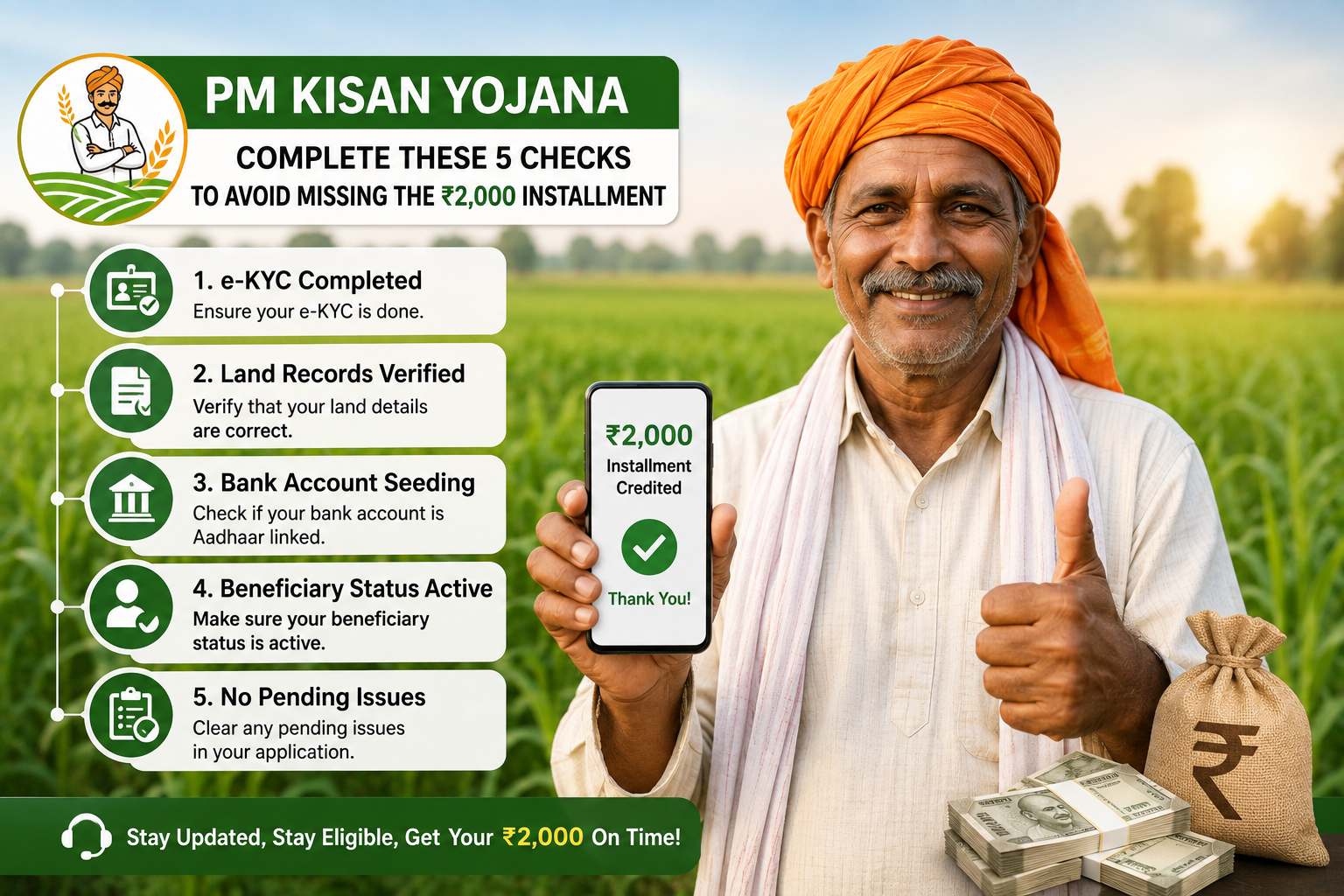
PM Kisan Yojana: The Pradhan Mantri Kisan Samman Nidhi (PM-KISAN) provides eligible landholding farmer families with ₹6,000 every year, paid in three equal installments of ₹2,000 each through Direct Benefit Transfer (DBT).
The scheme supports crores of farmers, but some beneficiaries may find that an installment does not reach their bank account even when they believe they are eligible. In many cases, the reason can be linked to incomplete eKYC, incorrect bank details, land-record mismatches, family-related verification issues or eligibility restrictions.
The 23rd installment, released on June 20, 2026, transferred more than ₹18,880 crore to 9.44 crore farmers, including around 2.18 crore women farmers.
If you are waiting for the next ₹2,000 payment, checking the following five points can help reduce the chances of a payment being held up.
1. Complete PM Kisan eKYC
eKYC is a mandatory requirement for registered PM-KISAN beneficiaries.
If eKYC has not been completed, the installment may be stopped until the required verification is finished.
Farmers with an active mobile number linked to Aadhaar can generally complete OTP-based eKYC through the official PM-KISAN system. Biometric and face-authentication options are also available through designated channels.
If your payment is pending, eKYC should therefore be one of the first things you verify.
Farmers should also ensure that the Aadhaar details used for authentication match the information available in their PM-KISAN record.
2. Check Bank Account and Payment Details
PM-KISAN payments are sent directly to beneficiaries' bank accounts through DBT. Any mismatch in banking information can therefore affect the transfer.
Farmers should confirm that the registered bank account is active and that the details linked with PM-KISAN are correct.
The Know Your Status section on the PM-KISAN portal can provide important payment-related information, including the payment status, bank name, payment mode, UTR number and the date on which the amount was credited.
If the portal shows that payment has been processed but the amount is not visible in the account, the farmer should also check with the concerned bank.
Incorrect or outdated details should be corrected through the authorised process rather than waiting for the next installment.
3. Make Sure Land Records Match PM-KISAN Data
Landholding information is an important part of PM-KISAN eligibility.
The scheme is intended for eligible landholding farmer families, which means discrepancies between government land records and the information entered in PM-KISAN can lead to verification problems.
Authorities have also identified certain cases where land ownership was acquired after February 1, 2019 and additional scrutiny may be required depending on the applicable eligibility rules.
In cases flagged for verification, payment can be temporarily withheld until physical or documentary verification is completed.
Farmers should therefore check whether their name, land ownership details and other relevant records are accurately reflected in official databases.
If there is an error in a land record, correcting it at the appropriate revenue or government office may be necessary before the benefit can resume.
4. Check Whether More Than One Family Member Is Receiving the Benefit
PM-KISAN follows a specific definition of a farmer family.
For scheme purposes, a family generally includes the husband, wife and minor children. Duplicate benefit claims within the same eligible family can lead to scrutiny.
For example, cases where both husband and wife are receiving separate PM-KISAN benefits, or where an ineligible duplicate claim exists in the same family, may be flagged for verification.
Payments can be temporarily stopped while authorities confirm which claim is valid.
Farmers should make sure that family details submitted under PM-KISAN are accurate and that there are no duplicate or conflicting entries.
5. Confirm That You Do Not Fall Under an Exclusion Category
Owning agricultural land does not automatically guarantee PM-KISAN eligibility.
The scheme contains specific exclusion categories that prevent certain people from receiving the benefit. These include some economically better-off groups as well as certain individuals holding specified constitutional, government or professional positions.
This is why a farmer whose land records are correct may still be found ineligible if the family falls under an excluded category.
Beneficiaries should review the current eligibility and exclusion criteria whenever there is a question about a stopped installment.
PM-KISAN to Continue Until 2031
A major update came in July 2026 when the Union Cabinet approved continuation of PM-KISAN from 2026-27 to 2030-31.
According to the announced plan, a financial outlay of around ₹3.15 lakh crore has been approved for this five-year period.
The existing assistance structure of ₹6,000 per year in three installments is set to continue for eligible beneficiaries during this period.
This means PM-KISAN will remain an important income-support programme for eligible farmers over the coming years.
How to Check PM Kisan Status Online
Farmers can use the Know Your Status option on the official PM-KISAN portal.
The registration number is generally required to access beneficiary and payment details.
Once logged in, farmers can check whether an installment has been processed, whether verification is pending and what payment information is available in the system.
If a farmer does not remember the registration number, the portal provides an option to retrieve it using the required identity details.
What to Check Before the Next ₹2,000 Installment
Before waiting for the next payment, farmers should confirm that all five areas are in order:
| Check | Why It Matters |
|---|---|
| eKYC | Mandatory for registered beneficiaries |
| Bank details | Required for successful DBT credit |
| Land records | Must match eligibility and ownership information |
| Family details | Duplicate claims can trigger verification |
| Eligibility status | Exclusion rules may make some applicants ineligible |
Resolving these issues early can help prevent avoidable payment delays.
Do Not Assume a Missing Installment Means Permanent Rejection
If a ₹2,000 installment does not arrive, it does not always mean that the farmer has permanently lost eligibility.
Payments can be held up because of incomplete verification, data mismatches or pending corrections. The most practical step is to check the beneficiary and payment status first and identify the exact reason shown in the system.
Once the issue is known, farmers can use the appropriate official channel to correct their records or complete the required verification.
Disclaimer: PM-KISAN eligibility rules, verification procedures and payment schedules can be revised by the government. Farmers should rely on the official PM-KISAN portal and authorised government channels for the latest information and should never share OTPs, passwords or banking credentials with unknown persons.