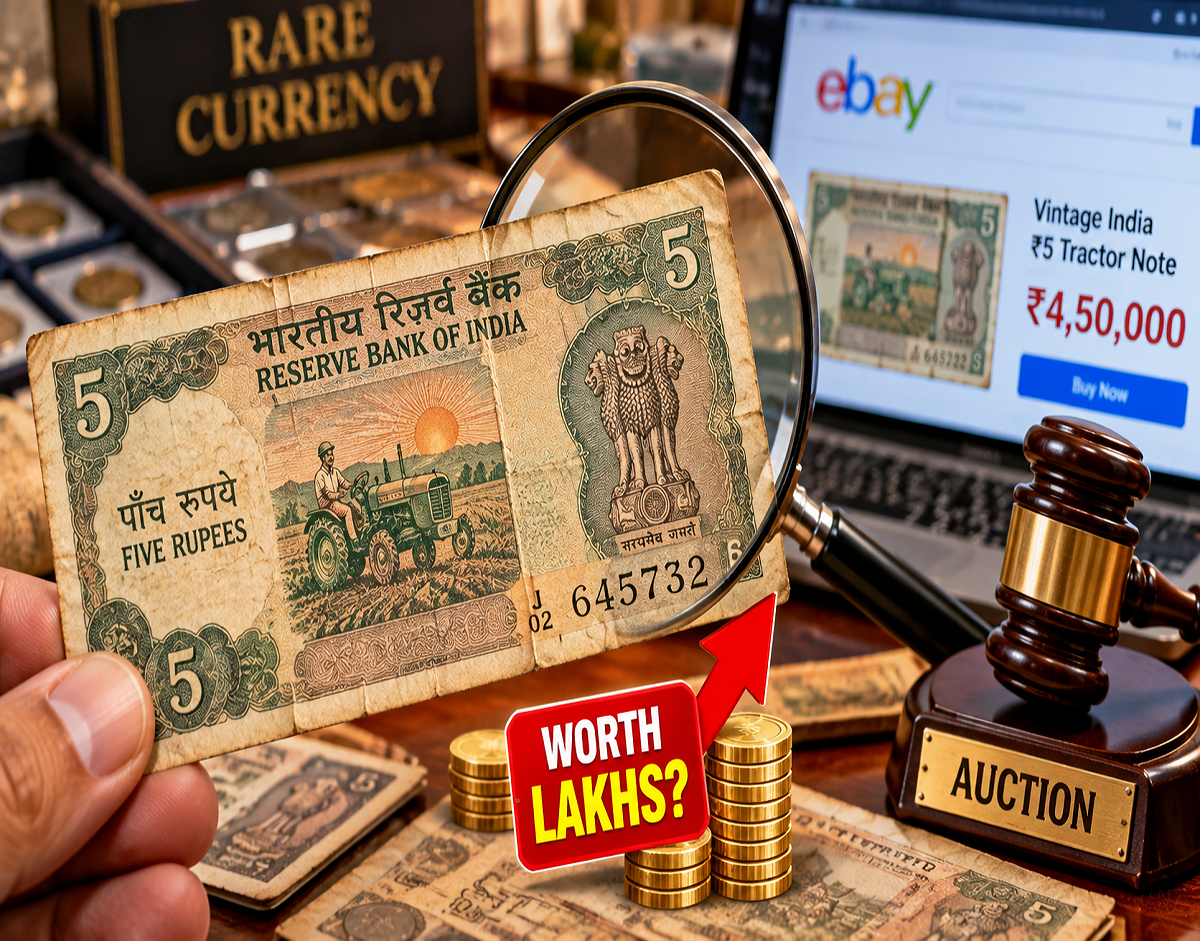
Old ₹5 Tractor Note Value 2026: Do you have an old ₹5 currency note featuring a tractor printed on the back? If yes, you may have come across online advertisements claiming that such notes can fetch thousands or even lakhs of rupees. Vintage Indian currency has attracted growing interest among collectors, but not every old banknote is valuable. Before attempting to sell a ₹5 tractor note online, it is important to understand what makes a currency note collectible, how its price is determined and how to avoid fraudulent buyers.
Old ₹5 Tractor Note: Why Are Collectors Interested in This Currency?
Many Indian households have preserved old currency notes and coins for years. Some are kept as family memories, while others are collected because of their unusual designs or historical significance.
Among these, the old ₹5 banknote featuring a tractor has gained attention on social media and online marketplaces.
The note is recognized for its distinctive design, which includes agricultural imagery on the reverse side. The tractor represents farming activities and India's agricultural economy.
Since these older designs are less commonly encountered in everyday transactions, some currency enthusiasts may be interested in adding them to their collections.
However, the age or design of a banknote does not automatically make it rare.
The potential value of an old ₹5 note depends on several factors, including its condition, printing characteristics, availability and actual demand among collectors.
Can an Old ₹5 Tractor Note Really Sell for Lakhs of Rupees?
Numerous online posts suggest that people can earn substantial amounts by selling old ₹5 tractor notes.
Some advertisements even claim that particular notes are worth several lakh rupees.
However, these claims should be treated carefully.
There is no fixed rule stating that every old ₹5 tractor note is worth a large amount of money.
A seller can advertise a note at almost any asking price, but that does not mean a buyer will agree to pay it.
The actual collectible value is determined by what interested buyers are willing to pay in a genuine transaction.
A commonly available note in poor condition may attract limited interest, while an unusually rare and well-preserved example could receive greater attention.
There is no verified evidence in the supplied information establishing that an ordinary ₹5 tractor note will sell for lakhs of rupees.
Therefore, owners should avoid assuming that finding one of these notes guarantees a major financial gain.
What Makes an Old ₹5 Currency Note Valuable?
Currency collectors, also known as numismatists, generally consider several characteristics when evaluating older banknotes.
1. Condition of the Note
The physical condition of a banknote can significantly influence its collectible appeal.
Notes that have been carefully preserved without major folds, stains, tears or writing may be more desirable than heavily damaged examples.
Collectors often prefer notes with clearly visible designs and minimal signs of circulation.
However, even an excellent condition does not guarantee a high selling price.
2. Unusual Serial Numbers
Every currency note carries a serial number that helps identify it.
Some collectors are particularly interested in distinctive number combinations.
Examples may include repeating digits, sequential patterns or numbers that hold cultural significance.
The number 786, for instance, attracts interest among certain collectors because of its religious and cultural associations.
However, a ₹5 note containing 786 in its serial number is not automatically worth thousands or lakhs of rupees.
Its potential price still depends on demand and other collectible characteristics.
3. Printing Errors
Genuine printing abnormalities can sometimes make a banknote interesting to specialist collectors.
Such errors may include misplaced printing, unusual alignment or missing design elements.
However, not every visual difference is a genuine printing error.
Damage, fading, stains and ordinary wear can sometimes be mistaken for rare printing defects.
A knowledgeable currency expert may be able to help distinguish genuine production errors from damage that occurred after circulation.
4. Rarity and Collector Demand
The availability of a particular banknote is another important factor.
If a note belongs to a relatively uncommon issue or possesses a verified unusual characteristic, collectors may show greater interest.
Nevertheless, rarity alone is not sufficient to establish a particular selling price.
Market demand and authenticated sales are more reliable indicators than promotional advertisements.
Where Can You Sell an Old ₹5 Tractor Note Online?
People interested in selling collectible currency may explore online classified platforms or specialist numismatic marketplaces.
The original report mentions websites such as OLX, Quikr and eBay as possible places where collectible items may be advertised.
However, sellers should first confirm whether the chosen platform currently permits listings for Indian currency notes and whether any legal or policy restrictions apply.
Not every e-commerce or classified website allows the sale of currency.
Specialist coin and banknote dealers, reputable numismatic organizations and established auction houses may also provide information about collectible value.
Before choosing a marketplace, sellers should compare its reputation, buyer verification procedures, transaction policies and applicable fees.
Posting an advertisement does not guarantee that a buyer will be found.
How to Sell an Old ₹5 Tractor Note Online: Step-by-Step Guide
If you own an old tractor-design ₹5 note and want to explore its collectible value, you can follow a careful process.
Step 1: Examine the Currency Note
Begin by checking the physical condition of the note.
Look for visible damage, unusual markings, distinctive serial numbers and any possible printing irregularities.
Avoid cleaning, ironing or attempting to repair the note, as such actions may damage it further.
Step 2: Research Similar Banknotes
Before setting an asking price, compare your note with similar examples offered by reputable dealers.
Where possible, examine completed sales rather than advertisements showing unusually high asking prices.
This can provide a more realistic understanding of potential market demand.
Step 3: Choose a Suitable Marketplace
Select a reputable platform that explicitly permits the sale of collectible currency and supports secure transactions.
Review its terms and conditions before registering.
Step 4: Take Clear Photographs
Capture high-quality photographs of both sides of the banknote.
Ensure that the design, condition and other important characteristics are clearly visible.
Avoid altering photographs to make the note appear rarer or better preserved than it actually is.
Step 5: Provide Accurate Information
Describe the note honestly, including its visible condition, distinctive features and any information you can verify.
Do not claim that it has a rare printing error or a guaranteed market value without reliable evidence.
Step 6: Communicate Safely With Buyers
If someone expresses interest, verify the buyer's credibility and discuss the payment and delivery arrangements.
Avoid sharing sensitive personal or banking information unnecessarily.
Step 7: Confirm Payment Before Completing the Transaction
Do not hand over or ship the banknote merely because someone has sent a payment screenshot.
Verify that the agreed payment has actually been received through a trusted payment method.
All transactions should comply with applicable laws and marketplace rules.
RBI Warning: Beware of Old Currency Buying and Selling Scams
Online advertisements promising large payments for old notes and coins can sometimes be used to deceive unsuspecting individuals.
Fraudsters may contact sellers and claim that their currency is worth an extraordinary amount.
They may then demand advance payments under different descriptions, including registration charges, processing fees, taxes or commissions.
Some scammers falsely claim to represent the Reserve Bank of India.
The RBI has previously cautioned the public that it does not deal in the buying or selling of old banknotes and coins and does not authorize individuals or institutions to collect fees or commissions on its behalf for such transactions.
People should therefore be extremely cautious when someone uses the RBI's name to demand money for a supposed currency sale.
Five Safety Tips Before Selling Collectible Banknotes
Anyone considering an online transaction involving old currency should follow basic safety precautions.
- Never pay an unknown buyer an advance fee merely to receive money for your note.
- Do not share OTPs, UPI PINs or banking passwords with anyone claiming to arrange a sale.
- Verify the buyer's identity and avoid dealing with individuals who refuse reasonable verification.
- Do not trust unrealistic price promises without evidence of genuine completed sales.
- Check legal and platform requirements before advertising or transferring collectible currency.
Remember that receiving money through UPI does not require entering your UPI PIN to approve a collection request.
If someone asks you to enter a PIN to receive payment, treat the request as a potential scam.
Does the RBI Buy Old ₹5 Tractor Notes From the Public?
A common misconception is that the Reserve Bank of India purchases rare currency notes directly from individuals at premium prices.
The RBI does not operate a public scheme promising lakhs of rupees for old ₹5 tractor notes.
It also does not appoint agents to collect registration fees for such sales.
People should be particularly suspicious of messages displaying RBI logos, forged certificates or claims that a payment has been approved by the central bank.
Such material should not be treated as proof that an offer is genuine.
Should You Sell Your Old ₹5 Tractor Note or Keep It?
The decision depends on whether the note has genuine collectible interest and whether a credible buyer is willing to offer an acceptable price.
For some people, older currency notes have sentimental or historical value that may be greater than their resale value.
Others may prefer to obtain a professional assessment before deciding whether to sell.
If the note appears to have a genuine printing error or another unusual feature, consulting an experienced numismatist may help clarify its significance.
However, spending large amounts on valuation services or advance charges based solely on an online promise is not advisable.
Old ₹5 Tractor Note Value 2026: What Collectors and Sellers Should Remember
The old ₹5 tractor note remains an interesting piece of Indian currency history and may appeal to collectors interested in vintage banknotes.
Its potential selling price depends on rarity, preservation, serial numbers, printing characteristics and genuine buyer demand.
Although social media advertisements sometimes claim that such notes can fetch lakhs of rupees, these amounts should not be mistaken for verified market prices.
Owning an old ₹5 tractor note does not guarantee a high-value sale, and there is no government scheme offering fixed rewards for possessing one.
Anyone wishing to sell collectible currency should research its value, use reputable channels and remain alert to fraud.
Disclaimer: This article is for general information only. The market value of collectible currency varies and is not guaranteed. Online asking prices do not establish actual resale value. Readers should verify applicable legal requirements and platform policies before selling old banknotes.