Business
NPS Swasthya 2026: ₹1,000 Initial Investment, Health Cover Up to ₹30 Lakh—Check Rules, Premium and Benefits
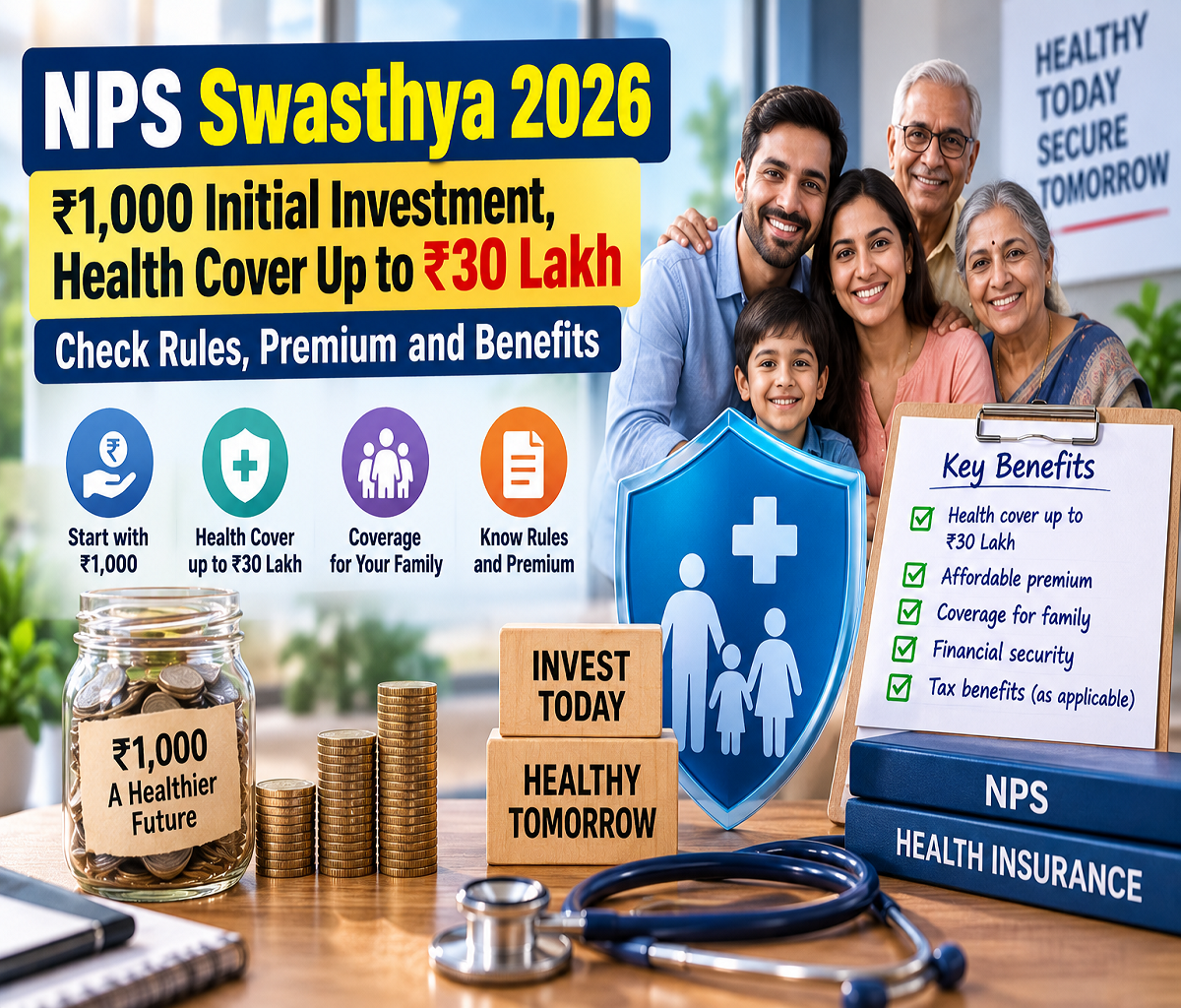
Rising hospital bills can put considerable pressure on household finances, particularly when a family faces an unexpected medical emergency. A new NPS framework aims to address this concern by bringing investment and health-related financial protection together.
The Pension Fund Regulatory and Development Authority (PFRDA) has issued operational guidelines for NPS Swasthya, a specific-purpose scheme under the National Pension System.
The framework combines an NPS Swasthya Investment Account with a super top-up health insurance policy, giving eligible subscribers a way to build a health-focused corpus while also obtaining insurance protection.
Depending on the insurance option selected, the super top-up cover can go as high as ₹30 lakh.
However, there is an important point to understand before interpreting the scheme as “₹30 lakh health insurance for ₹1,000.”
The ₹1,000 figure refers to the initial minimum investment component. The subscriber must also pay the applicable first-year insurance premium, taxes and prescribed charges. The premium itself will depend on factors such as age and the insurance option selected.
What Is NPS Swasthya?
NPS Swasthya is designed as a purpose-specific scheme within the National Pension System.
It was initially introduced by PFRDA in January 2026 as a Proof of Concept under the Regulatory Sandbox framework. PFRDA subsequently issued detailed operational guidelines on September 18, 2026.
The structure essentially brings together two components:
NPS Swasthya Investment Account: A market-linked investment account intended to build a corpus that can be used in accordance with the scheme's health-related rules.
Super Top-Up Health Insurance: An insurance policy providing hospitalization-related protection subject to the selected sum insured, deductible, exclusions, waiting periods and policy terms.
Health insurance is an integral part of the NPS Swasthya framework rather than an optional add-on.
Can You Really Start With ₹1,000?
Yes, but the ₹1,000 figure needs to be understood correctly.
The initial contribution involves more than simply depositing ₹1,000.
A subscriber will need to provide money for the first-year insurance premium and applicable taxes, the prescribed annual HBA-related charge, and the minimum amount required for investment.
The minimum investment component is ₹1,000.
Subsequent contributions can be much smaller, with the operational framework allowing contributions from ₹10, subject to applicable rules.
Therefore, NPS Swasthya should not be marketed as a ₹1,000 health insurance policy. The actual initial cash requirement will be higher because the insurance premium and other applicable charges must also be funded.
Health Cover Can Go Up to ₹30 Lakh
One of the most notable aspects of NPS Swasthya is the availability of multiple super top-up insurance options.
The structure pairs different deductibles with different sums insured.
| Deductible | Super Top-Up Sum Insured |
|---|---|
| ₹10,000 | ₹1 lakh |
| ₹50,000 | ₹5 lakh |
| ₹1 lakh | ₹10 lakh |
| ₹3 lakh | ₹30 lakh |
This means a subscriber selecting the highest option can obtain a ₹30 lakh super top-up cover with a ₹3 lakh deductible.
The deductible is crucial.
A ₹30 lakh super top-up does not mean the insurer automatically starts paying every hospital bill from the first rupee. Claims are governed by the deductible and the terms and conditions of the insurance policy.
Subscribers should therefore understand how the deductible works before choosing a cover level.
Who Can Join NPS Swasthya?
The scheme is available within the NPS framework, subject to eligibility and operational conditions.
For the standard health insurance component, the entry-age framework provides for applicants between 18 and 70 years, while renewal may be permitted up to age 85 subject to the policy terms.
Premiums can vary depending on the subscriber's age and other insurance-related factors.
The framework uses age bands for determining premiums, including 18–40 years, 40–60 years and 60–70 years.
This means two subscribers selecting the same insurance cover should not automatically assume that they will pay exactly the same premium.
Family Floater Option Is Available
NPS Swasthya also provides for family-floater health insurance arrangements.
The standard family structure can include the:
Subscriber, spouse and up to two dependent children.
Parents are not part of the standard family-floater configuration described under this structure.
This distinction is important for households looking for a single health policy that also covers elderly parents. Such subscribers may need separate health insurance arrangements for their parents.
Can Money Be Withdrawn for Medical Treatment?
NPS Swasthya is designed to provide greater flexibility for healthcare expenses than an ordinary retirement-only account.
Subject to the scheme's conditions, partial withdrawals can be permitted for eligible medical expenses.
The permitted withdrawal can be up to 25% of eligible subscriber contributions, rather than simply 25% of the entire account balance in every situation.
Eligible expenses can include qualifying healthcare requirements covered under the operational framework.
Another notable feature is the payment mechanism.
Where applicable, healthcare withdrawals are intended to be paid directly to the hospital or healthcare service provider rather than simply being transferred to the subscriber as unrestricted cash.
This helps maintain the health-specific purpose of the account.
What Medical Expenses Can Be Covered?
The health-insurance component is designed to provide coverage for specified healthcare services subject to the insurer's policy wording.
Depending on the policy terms, this can include areas such as hospitalization, eligible day-care procedures, domiciliary treatment, AYUSH treatment and specified modern treatment methods.
However, “covered” should not be interpreted as meaning that every medical bill will automatically be paid in full.
Insurance policies can contain:
- Deductibles
- Waiting periods
- Exclusions
- Sub-limits
- Claim conditions
- Network-hospital requirements
- Other policy-specific restrictions
Subscribers should therefore read the insurer's policy document before purchasing the cover.
What About Pre-Existing Diseases?
This is another area where customers need to read the terms carefully.
Reports around the NPS Swasthya framework indicate a waiting-period structure for pre-existing diseases, including a 12-month waiting period in the relevant standard arrangement.
However, subscribers should confirm the exact waiting period, definition of a pre-existing disease and applicable exclusions in the insurance policy offered to them.
A medical condition existing before the policy starts should never be assumed to receive immediate coverage unless the policy explicitly provides for it.
How Much Will the Insurance Premium Cost?
There is no single premium amount applicable to every subscriber.
The premium is determined by the participating insurer within the applicable insurance regulatory framework.
Factors such as the subscriber's age, selected cover, deductible and family configuration can influence the amount payable.
For the first year, the required insurance premium and applicable taxes have to be funded upfront.
For subsequent renewals, the scheme provides mechanisms under which the premium can be met from the available corpus, subject to prescribed conditions.
Subscribers should check how much of their contribution is being invested and how much is being used towards insurance and charges.
Charges Also Need to Be Considered
NPS Swasthya is not a completely free account.
The framework provides for prescribed charges associated with administration and fund management.
The source material refers to an annual ₹200 HBA maintenance charge and a pension-fund management charge that can be up to the applicable prescribed limit.
These costs should be considered when evaluating the product because not every rupee deposited necessarily remains invested for long-term growth.
Is NPS Swasthya the Same as Normal Health Insurance?
Not exactly.
Traditional health insurance primarily focuses on transferring specified medical-expense risk to an insurer in exchange for a premium.
NPS Swasthya adds another layer by combining health insurance with a dedicated market-linked investment account.
This means subscribers need to evaluate both investment and insurance considerations.
The investment corpus can fluctuate depending on the performance of the underlying investments, while the insurance component is governed by the insurer's terms.
What Happens If There Isn't Enough Money for Renewal?
Subscribers should also understand that maintaining adequate funds is important.
If the available corpus is insufficient to meet the applicable insurance premium or other required amounts, the health-insurance protection may be affected in accordance with the scheme rules.
Under specified circumstances, the NPS Swasthya arrangement can also be closed or shifted into the applicable NPS All Citizen framework.
It is therefore not enough to open the account with the minimum investment and then assume that ₹30 lakh of insurance will continue indefinitely.
Regular funding and premium requirements matter.
₹30 Lakh Cover Does Not Cost Just ₹1,000
This is the most important point for anyone considering NPS Swasthya.
The scheme does allow an initial minimum investment component of ₹1,000, and its super top-up insurance options can extend to ₹30 lakh.
But these two numbers should not be combined to suggest that a customer can simply pay ₹1,000 and receive ₹30 lakh of medical insurance.
The ₹30 lakh option comes with a ₹3 lakh deductible, while the subscriber also needs to fund the applicable insurance premium, taxes and charges.
Before enrolling, customers should compare the premium, deductible, waiting periods, exclusions, family coverage, investment risks, withdrawal conditions and renewal requirements.
NPS Swasthya could offer an interesting combination of healthcare-focused savings and insurance protection, but the benefits depend on the option selected and the detailed terms applicable to each subscriber.
Disclaimer: Insurance and NPS investments are subject to applicable terms, conditions, charges and risks. Insurance coverage is subject to deductibles, exclusions, waiting periods and policy conditions. The NPS investment component is market-linked and does not offer guaranteed investment returns. Subscribers should read the official PFRDA guidelines and insurance policy documents before enrolling.