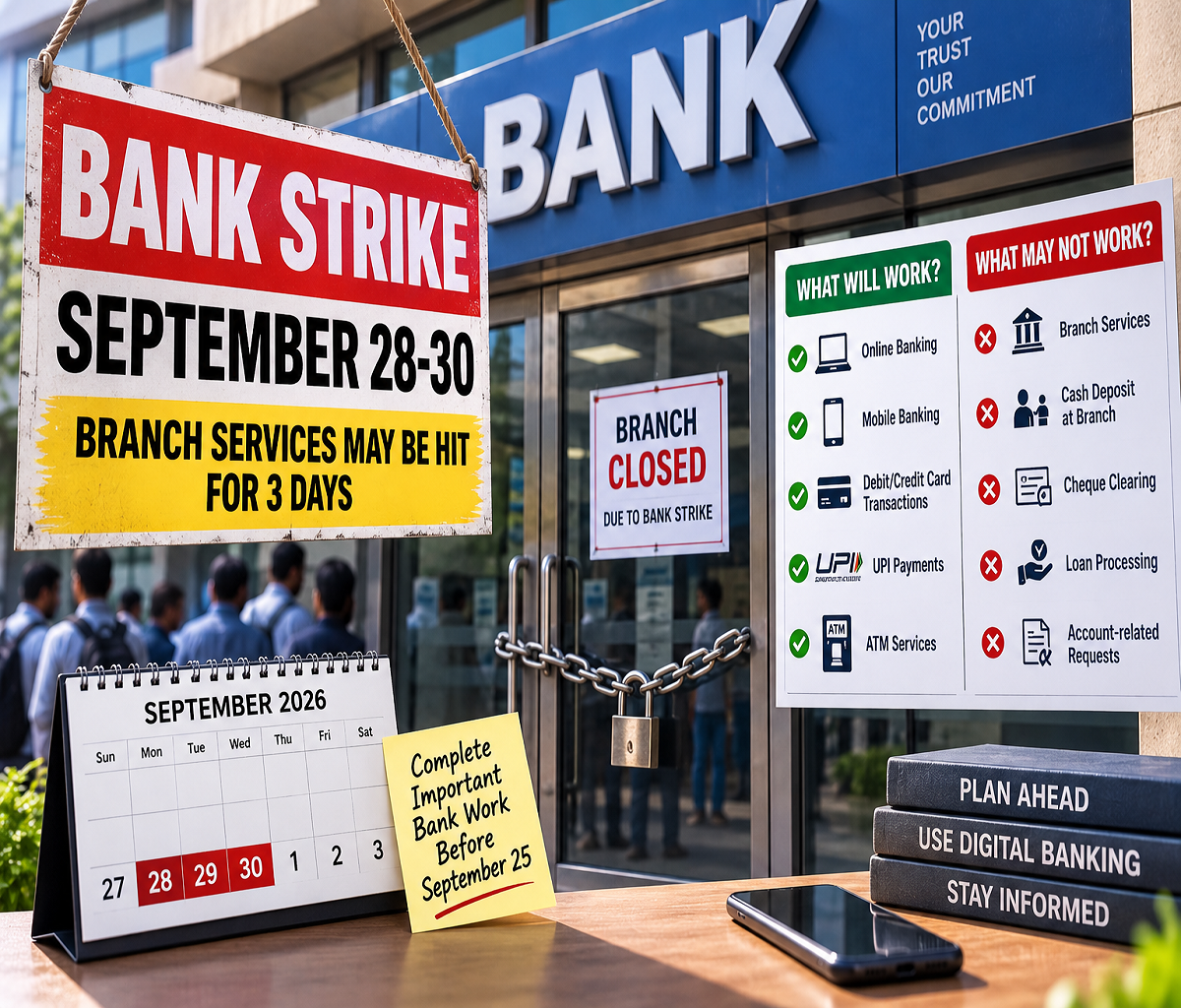
Business
SBI Customer Alert: Finish Important Bank Work by September 25 as 3-Day Strike May Disrupt Branch Services
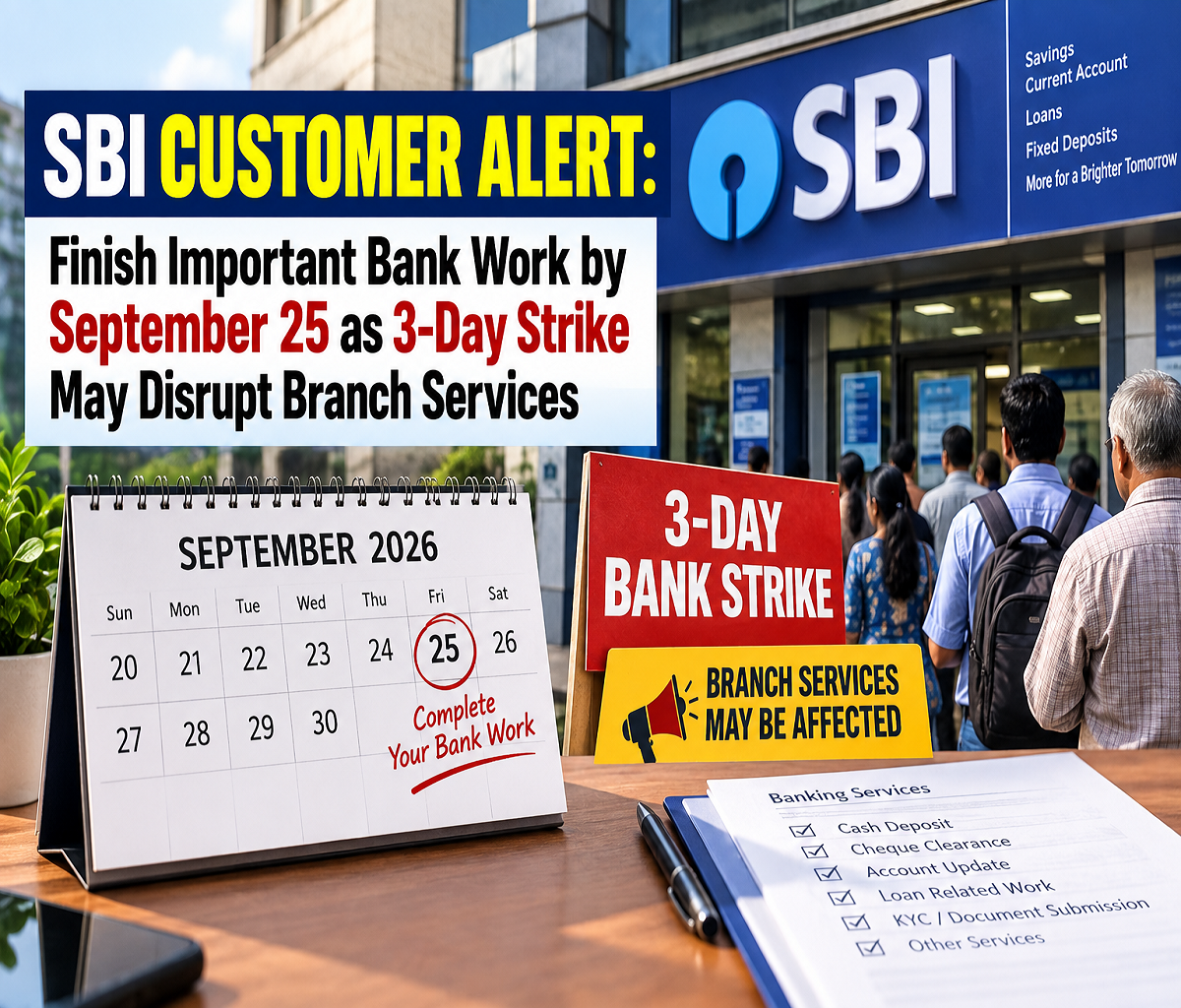
State Bank of India customers who have important branch-related work pending may want to complete it before the last weekend of September. A three-day nationwide bank strike called by the United Forum of Bank Unions (UFBU) is scheduled for September 28, 29 and 30, 2026, raising the possibility of disruption to branch services.
The timing could be particularly important for customers because the proposed strike immediately follows a regular banking weekend.
September 26 is the fourth Saturday of the month, when banks are normally closed, while September 27 is a Sunday. The proposed strike then covers the following three working days.
As a result, customers who rely on physical bank branches could potentially face limited access to some branch services for as many as five consecutive days—from September 26 through September 30.
SBI has therefore advised customers to complete important transactions requiring branch visits or staff assistance in advance.
Why September 25 Is Important for SBI Customers
The proposed nationwide strike begins on Monday, September 28.
Before that, banks will observe their regular weekend closure on:
September 26 – Fourth Saturday
September 27 – Sunday
This makes Friday, September 25, the last regular working day before the five-day period.
Therefore, customers who need to complete time-sensitive branch work may find it practical to finish it by September 25 instead of waiting until the strike begins.
It is important to clarify that September 25 is not a special regulatory deadline announced by SBI. Rather, it is the final regular banking day immediately preceding the weekend and proposed strike.
Will SBI Branches Remain Closed for Five Consecutive Days?
Not necessarily.
The phrase “banks will remain closed for five days” can be misleading.
Branches are scheduled to be closed on September 26 because it is the fourth Saturday and on September 27 because it is Sunday.
The situation from September 28 to 30 is different.
These are the dates of the proposed nationwide strike, and SBI has warned that branch operations may be affected depending on employee participation.
Therefore, customers should expect the possibility of disruption rather than assume that every SBI branch across India will definitely remain completely closed for all five days.
SBI Bank Strike Schedule
| Date | Day | Reason | Likely Branch Situation |
|---|---|---|---|
| September 25 | Friday | Regular working day | Customers should consider completing important branch work |
| September 26 | Saturday | Fourth Saturday | Banks normally closed |
| September 27 | Sunday | Weekly holiday | Banks normally closed |
| September 28 | Monday | Proposed UFBU strike | Branch services may be affected |
| September 29 | Tuesday | Proposed UFBU strike | Branch services may be affected |
| September 30 | Wednesday | Proposed UFBU strike | Branch services may be affected |
The three-day strike comes after bank unions had already observed nationwide industrial action on September 11.
What Has SBI Advised Customers to Do?
SBI has asked customers to plan important banking transactions ahead of the strike period.
This is particularly relevant for services requiring a physical visit, employee assistance, document verification or other branch-level processing.
Customers who have urgent work should therefore avoid leaving it until September 28–30.
Depending on the type of transaction, cheque-related processes and other services that depend on branch staff could also face delays.
Salary and Pension Customers Should Plan Ahead
The advisory is particularly relevant to customers who depend heavily on branch-based services, including some pensioners and salary-account holders.
However, customers should not assume that regular electronic salary or pension credits will automatically stop because of the strike.
Electronic credits and digital transactions generally operate through banking systems that are separate from normal counter services.
The bigger concern is with activities that require physical documentation, manual processing, verification or direct assistance from bank employees.
Pensioners or other customers who have time-sensitive paperwork should therefore check whether it can be submitted before the proposed disruption.
Will UPI Work During the Bank Strike?
SBI has advised customers to use its digital banking facilities during the proposed strike.
Customers should generally be able to access routine services through:
- UPI
- SBI YONO
- Mobile banking
- Internet banking
- ATMs
- Automated Deposit and Withdrawal Machines (ADWMs)
- Customer Service Points (CSPs)
These channels can be used for many common transactions without visiting a bank branch.
Customers can use digital services for activities such as transferring money, making payments and managing many routine banking requirements.
However, availability of digital banking does not mean every banking service can be completed online.
What About ATM Cash?
SBI has said it is making efforts to maintain essential banking services during the strike period and has advised customers to use ATMs and ADWMs for their cash requirements.
The government has also asked public-sector banks and regional rural banks to take measures to keep ATMs adequately stocked and minimise disruption during the strike.
Nevertheless, with a long weekend followed immediately by three strike days, cash demand at some ATMs could increase.
Customers who primarily use cash may therefore want to plan routine withdrawals in advance, without keeping unnecessarily large amounts of cash at home.
Why Have Bank Unions Called the Strike?
The United Forum of Bank Unions has called the September 28–30 nationwide strike as part of an ongoing campaign over several demands.
A major issue is the demand for a five-day banking week, under which all Saturdays would become holidays.
Other demands reported in connection with the agitation include pension-related issues, a uniform dearness allowance formula for pensioners and an option for certain employees covered under the National Pension System to move to the Old Pension Scheme.
The unions had previously held a one-day nationwide strike on September 11.
The Finance Ministry has appealed to employees not to participate in the upcoming strike and has been working with banks on measures intended to maintain essential services.
Which Banking Services Could Be Most Affected?
The impact is expected to be greatest on services that depend directly on branch employees.
These can include certain cheque-related processes, documentation, account servicing requiring staff intervention and some counter-based transactions.
The exact effect could vary by branch and location depending on employee participation.
Digital payments and automated channels, meanwhile, are expected to provide customers with alternatives for many everyday requirements.
Customers Should Avoid Waiting Until the Last Moment
For SBI customers, the most important takeaway is not that all banking will stop for five days.
Instead, the combination of a normal weekend and a three-day nationwide strike creates a five-day window in which access to physical branch services could be limited or disrupted.
Customers with urgent branch-dependent work should therefore consider completing it by Friday, September 25.
For everyday payments and transfers during the strike period, SBI is encouraging customers to use YONO, UPI, mobile banking, internet banking, ATMs, ADWMs and Customer Service Points.
Since strike plans can also change following negotiations between unions, bank management and the government, customers with critical transactions should check the latest communication from their bank before visiting a branch.