Business
MP Tribal Welfare 2026: ₹47,295 Crore Budget Allocation, Nearly 19 Lakh Families to Benefit From Government Schemes
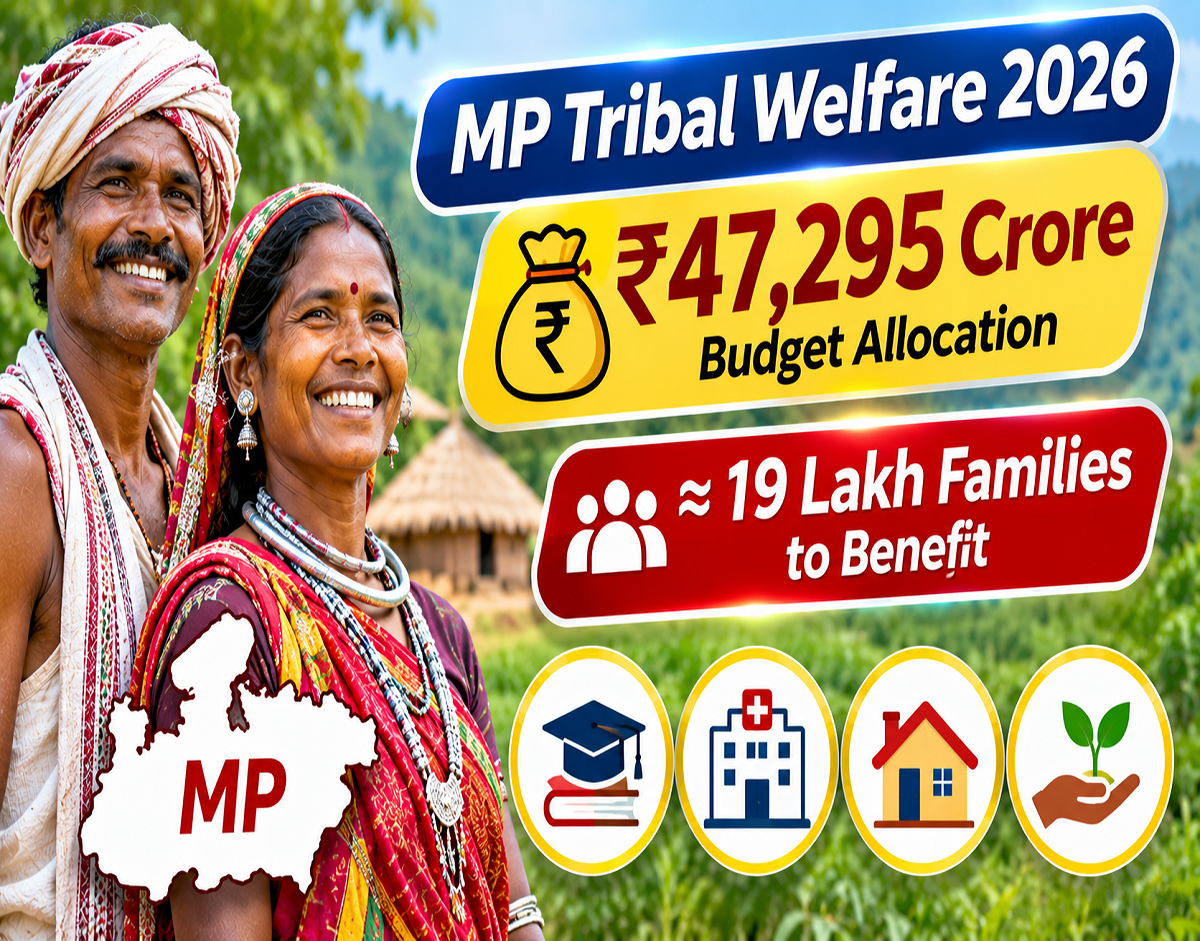
Madhya Pradesh Tribal Welfare 2026: The Madhya Pradesh government has highlighted a budget allocation of ₹47,295 crore for tribal welfare initiatives, reaffirming its focus on improving the social and economic conditions of tribal communities across the state. According to an official public awareness communication associated with Jansampark Madhya Pradesh, nearly 19 lakh tribal families are benefiting from government welfare schemes.
The announcement comes in connection with Janjatiya Gaurav Diwas 2026, observed on November 15 to commemorate the birth anniversary of tribal freedom fighter Birsa Munda.
The state government's communication highlights financial provisions and welfare initiatives aimed at supporting tribal households through development programmes.
However, the announcement does not provide a scheme-wise breakdown of the ₹47,295 crore allocation or specify the exact benefits received by each family.
Madhya Pradesh Announces ₹47,295 Crore for Tribal Welfare
The Madhya Pradesh government has highlighted ₹47,295 crore in budgetary provisions associated with tribal welfare.
The allocation reflects the scale of financial resources identified by the state for initiatives concerning tribal communities.
Government spending on tribal development can involve several sectors, including education, healthcare, infrastructure, housing, livelihood support and community development.
Such programmes may be implemented through different departments and government schemes.
However, the supplied announcement does not specify whether the entire ₹47,295 crore amount belongs to a single departmental budget or represents combined provisions across multiple heads.
The detailed budget documents would be required to establish the precise composition of the allocation.
Nearly 19 Lakh Tribal Families Benefiting From Welfare Schemes
Another major point highlighted in the state government's communication is that approximately 19 lakh tribal families are benefiting from government schemes.
This represents nearly 1.9 million households.
The figure indicates the reported reach of welfare initiatives among tribal communities in Madhya Pradesh.
However, the announcement does not identify the individual programmes included in this count.
It also does not clarify whether the figure represents unique beneficiary families across all schemes or another administrative measure.
Therefore, the number should be understood as the government's reported estimate rather than evidence that every household has received an identical financial benefit.
Madhya Pradesh Tribal Welfare 2026: Key Highlights
| Particulars | Details |
|---|---|
| State | Madhya Pradesh |
| Government Announcement | Tribal welfare budget allocation and beneficiary coverage |
| Reported Budget Allocation | ₹47,295 crore |
| Reported Beneficiary Coverage | Nearly 19 lakh tribal families |
| Awareness Occasion | Janjatiya Gaurav Diwas 2026 |
| Commemorative Date | November 15 |
| Associated Historical Figure | Birsa Munda |
| Information Source | Jansampark Madhya Pradesh |
The figures are based on the supplied government communication and should be read alongside official budget and programme documents for detailed interpretation.
What Is Janjatiya Gaurav Diwas?
Janjatiya Gaurav Diwas is observed annually on November 15 in India.
The day commemorates the birth anniversary of Birsa Munda, a prominent tribal freedom fighter and social reformer.
The observance recognises the contributions of tribal communities to India's history, cultural heritage and freedom struggle.
It also provides an occasion to highlight contemporary issues affecting tribal populations, including education, healthcare, livelihoods and development opportunities.
Government departments and institutions organise awareness activities and commemorative programmes around the occasion.
In 2026, the Madhya Pradesh government's communication has used Janjatiya Gaurav Diwas to highlight its reported tribal welfare allocation and beneficiary coverage.
Who Was Birsa Munda?
Birsa Munda was born on November 15, 1875, in the region that is now part of Jharkhand.
He emerged as an influential leader among tribal communities during the British colonial period.
Birsa Munda is remembered for mobilising resistance against colonial policies and systems of exploitation affecting tribal communities.
His movement, associated with the Ulgulan or Great Tumult, became an important chapter in the history of tribal resistance.
He died in 1900 while in British custody.
His legacy continues to be commemorated through educational institutions, public programmes and national observances.
Janjatiya Gaurav Diwas recognises his contributions while also celebrating the wider historical role of India's tribal communities.
Why Tribal Welfare Is Important in Madhya Pradesh
Madhya Pradesh has a substantial Scheduled Tribe population and is home to several tribal communities with distinct cultural traditions, languages and livelihoods.
Communities such as the Bhil, Gond, Baiga, Sahariya and Korku form part of the state's diverse tribal population.
The needs of tribal households can vary considerably depending on geography, access to public services, employment opportunities and local economic conditions.
Some communities live in remote or forested areas where transport connectivity and access to public facilities can be challenging.
As a result, tribal welfare policies often involve coordinated efforts across education, healthcare, infrastructure and livelihood-related sectors.
Effective implementation requires attention not only to financial allocations but also to the accessibility and quality of services delivered.
Education and Skill Development for Tribal Communities
Education is an important component of long-term social and economic development.
Government initiatives concerning tribal education may include residential schooling, scholarships, hostels and support for students pursuing higher education.
Skill development and vocational training can also help young people explore employment and self-employment opportunities.
However, the supplied Madhya Pradesh government communication does not specify how much of the announced ₹47,295 crore allocation is earmarked for education or training.
Such details would need to be verified through the state's official budget documents and departmental programme statements.
Healthcare and Basic Infrastructure
Access to healthcare is another important consideration for tribal development.
Remote settlements may face difficulties involving travel distances, medical facilities and timely access to specialised treatment.
Public health programmes, nutrition services and improvements in local infrastructure can help address these challenges.
Road connectivity, drinking water facilities, sanitation and electricity access are also important for improving living conditions.
The extent to which the reported budget allocation supports these areas would depend on the specific programmes and financial provisions included in the government's plans.
Livelihood Opportunities and Economic Development
Many tribal households depend on agriculture, forest-based activities, wage employment and small businesses.
Government livelihood programmes can support economic participation through training, access to markets and other eligible assistance mechanisms.
In forest-dependent communities, the collection and sale of minor forest produce can also contribute to household income.
Efforts to improve market access, local infrastructure and entrepreneurship opportunities may help strengthen livelihoods.
However, actual outcomes depend on programme design, eligibility conditions, implementation and local economic circumstances.
The government's announcement does not establish a specific cash payment or guaranteed income benefit for each of the nearly 19 lakh families mentioned.
Does the ₹47,295 Crore Allocation Mean Direct Cash Payments?
No such conclusion can be drawn from the supplied announcement.
A government budget allocation may cover a broad range of programmes, including infrastructure projects, educational institutions, public services and financial assistance schemes.
It should not automatically be interpreted as money that will be transferred directly into beneficiaries' bank accounts.
Similarly, dividing the total budget allocation by the number of reported beneficiary families would not provide an accurate estimate of the amount each household receives.
Different schemes have different objectives, eligibility criteria and spending structures.
Families seeking information about direct financial assistance should check the rules of the specific welfare programme concerned.
How Can Eligible Tribal Families Access Government Schemes?
Tribal households interested in government welfare programmes should obtain information through authorised state and central government channels.
The appropriate application procedure depends on the scheme.
Some programmes may require proof of Scheduled Tribe status, residence, income, educational enrolment or other eligibility conditions.
Applicants should contact the relevant department or local government office to understand the applicable requirements.
They should also check official government websites for current scheme guidelines, deadlines and application procedures.
No universal application link for all benefits was provided in the supplied announcement.
Why Budget Allocation and Actual Spending Are Different
A budget allocation represents financial resources provided or proposed for particular government purposes.
Actual expenditure refers to money spent through the implementation of approved programmes.
These figures are not necessarily identical.
For example, the pace of project implementation, administrative approvals and programme demand can affect expenditure during a financial year.
Similarly, the number of beneficiaries reported under government schemes does not by itself indicate the quality or financial value of assistance delivered.
To evaluate programme outcomes, detailed information about spending, coverage and measurable results is necessary.
The Madhya Pradesh government's announcement provides headline figures but not the supporting breakdown required for such an assessment.
Janjatiya Gaurav Diwas 2026 Highlights Tribal Development
The observance of Janjatiya Gaurav Diwas provides an opportunity to recognise the contributions of tribal communities and discuss development priorities.
In Madhya Pradesh, the government has highlighted its reported ₹47,295 crore allocation and the reach of welfare schemes covering nearly 19 lakh tribal families.
These figures form part of the state's public communication concerning tribal welfare.
Further details about individual schemes, departmental allocations and beneficiary eligibility would help citizens better understand how the announced resources are being used.
Conclusion
The Madhya Pradesh government has highlighted a ₹47,295 crore budget allocation for tribal welfare and reported that nearly 19 lakh tribal families are benefiting from government schemes.
The announcement, associated with Janjatiya Gaurav Diwas 2026, draws attention to the state's welfare initiatives and the continuing importance of development opportunities for tribal communities.
While the figures indicate the scale of the government's reported commitments and programme coverage, the supplied communication does not provide a detailed financial breakdown or specify benefits for individual households.
The key takeaway is that Madhya Pradesh has highlighted ₹47,295 crore in tribal welfare provisions and nearly 19 lakh beneficiary families, with scheme-specific details requiring confirmation through official government records.
Source Credit: Department of Public Relations, Government of Madhya Pradesh (Jansampark MP) — Official public awareness communication for Janjatiya Gaurav Diwas 2026, referencing Chief Minister Dr. Mohan Yadav and the state's tribal welfare initiatives. Additional reference: Government of Madhya Pradesh, Tribal Affairs Department.
Editorial Note: The budget allocation and beneficiary figures are attributed to the supplied government communication. The financial year, allocation categories, actual expenditure and beneficiary methodology have not been independently verified.