Business
India’s Cash Paradox: Why Currency Demand Is Rising Even as UPI and Digital Payments Expand
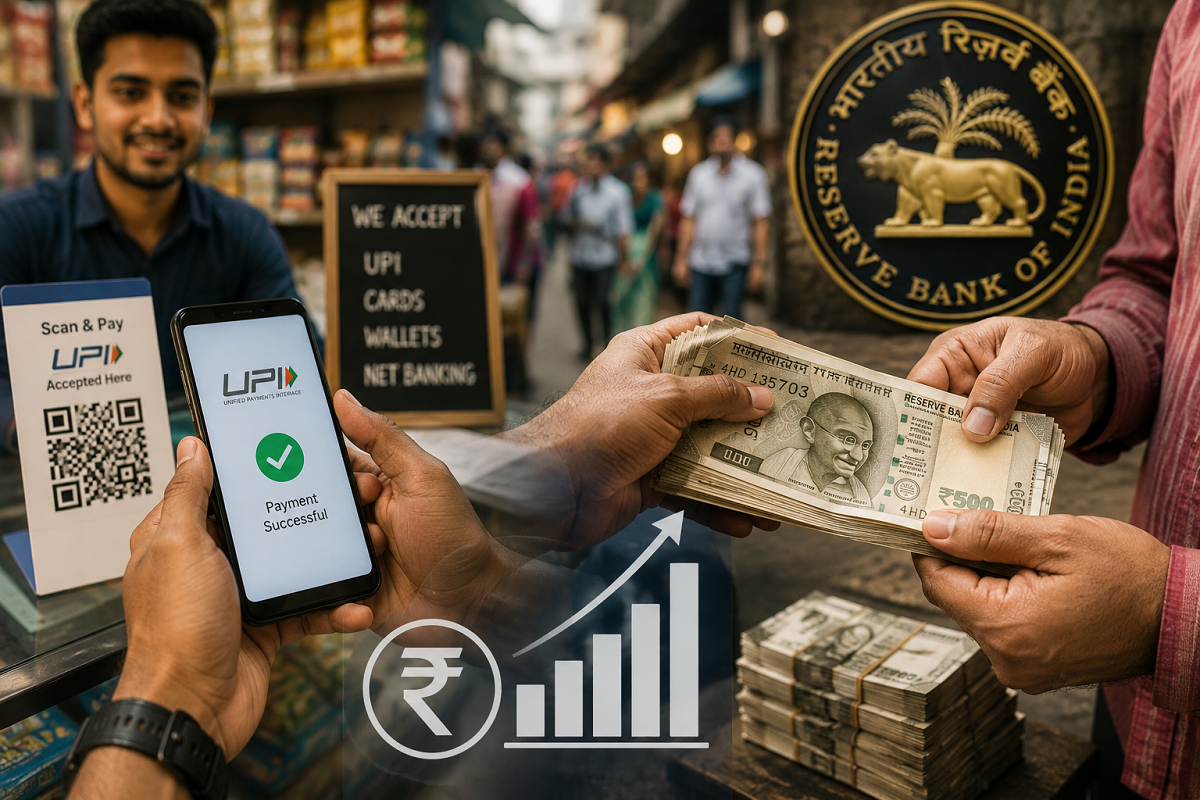
India Cash Paradox: Digital payments have transformed the way Indians pay for everyday purchases, yet demand for physical currency has not disappeared. In fact, the amount of cash in circulation has continued to rise even as UPI and other digital payment methods become more widely used.
The Reserve Bank of India has described this unusual trend as a “cash paradox” — a situation in which people are using less cash for many day-to-day transactions, but the overall stock of currency notes in the economy is still increasing.
RBI Deputy Governor Shirish Chandra Murmu recently highlighted this trend while discussing the challenge of estimating future cash requirements. The issue is important for the central bank because it affects everything from banknote printing to distribution, storage and currency management across the country.
Digital Payments Are Rising, but Cash Has Not Disappeared
UPI, mobile banking, cards and other digital payment systems have expanded rapidly in India. For many consumers, small-value payments that were once made in cash are now completed through smartphones within seconds.
However, this does not necessarily mean that people have stopped holding cash.
According to the RBI deputy governor, currency in circulation has continued to grow at a strong pace even as the share of cash in person-to-person and retail transactions has declined.
This creates a forecasting problem. If cash is being used less frequently at shops and in personal payments, conventional assumptions would suggest that demand for physical currency should also fall. Instead, both trends are occurring at the same time.
Why Is It Called a Cash Paradox?
The paradox lies in the difference between cash usage and cash holdings.
Consumers may use digital payments for groceries, fuel, restaurant bills and online purchases, but they may still keep currency at home or in wallets for emergencies, informal transactions, travel, festivals or situations where digital payments are not practical.
Cash can also continue to play an important role in rural and semi-urban markets where digital connectivity may not always be reliable.
In other words, fewer cash transactions do not automatically mean lower demand for currency notes.
RBI Faces a Bigger Forecasting Challenge
For the Reserve Bank, predicting how much cash the economy will need is a critical operational task.
Too little currency in circulation can create shortages during periods of high demand, while excessive printing can raise storage, handling and replacement costs.
The rise of digital payments has made this process more complicated because older demand models may no longer work in the same way.
The RBI now has to consider a wider range of factors, including digital payment adoption, seasonal spending, currency held as a store of value, rural demand and emergency cash requirements.
RBI Is Looking at Ways to Make Banknotes Last Longer
Since physical currency continues to remain important, the central bank is also exploring ways to improve the durability of banknotes.
One option under consideration is the use of special protective coatings on paper currency. Such coatings could help reduce wear and tear and extend the usable life of notes.
Another option is the wider use of polymer banknotes, particularly in smaller denominations.
Polymer notes are generally considered more durable than conventional paper notes and can remain in circulation for a longer period before needing replacement.
₹10 and ₹20 Polymer Notes Could Be Introduced
The government has approved the introduction of polymer notes in the ₹10 and ₹20 denominations.
According to the information cited in the source article, Finance Minister Nirmala Sitharaman told the Rajya Sabha that one billion polymer notes each of ₹10 and ₹20 denominations are planned.
The move could help reduce frequent replacement of low-value notes, which typically change hands more often and therefore face greater wear.
If implemented on a large scale, polymer currency could also help the RBI manage printing and replacement costs more efficiently.
Festive Season Could Push Cash Demand Higher
India typically witnesses stronger demand for physical currency during the festive season.
The period beginning around September and continuing through mid-November sees higher spending on shopping, travel, gifts, weddings and household purchases.
Even though digital payments have become common during festivals, cash demand can still rise because economic activity itself increases significantly.
Banks and the RBI therefore need to prepare for larger withdrawals and higher circulation during this period.
Could Digital Payment Charges Increase Cash Usage?
Another factor that could influence cash demand is the cost of digital payments.
If banks or payment providers begin imposing charges on certain types of digital transactions, some consumers may prefer to return to cash for smaller payments.
Even modest transaction charges can influence behaviour in price-sensitive segments.
This is why any future changes in the cost structure of digital payments could affect the balance between cash and electronic transactions.
India Has Built Strong Domestic Banknote Capacity
India has also strengthened its domestic capacity to produce currency notes.
The country now has domestic facilities for banknote paper, printing presses and specialised currency ink production.
According to the figures cited in the source article, India's infrastructure is capable of printing approximately 28 to 30 billion banknotes annually across six denominations.
This level of capacity gives the country greater control over currency production and reduces dependence on imported materials.
Cash and Digital Payments May Continue to Coexist
The growth of UPI does not necessarily mean India is moving toward a completely cashless economy.
Instead, the payment system appears to be moving toward a model where both cash and digital methods coexist.
Digital transactions offer speed, convenience and easy record-keeping, while physical currency continues to provide universal acceptance, privacy, familiarity and a backup during technical disruptions.
For consumers, this means the choice between cash and digital payments may depend on the situation rather than one method completely replacing the other.
Why the Cash Paradox Matters
The continuing demand for physical currency shows that payment behaviour is more complex than headline digital-transaction numbers suggest.
India can simultaneously become one of the world's largest digital-payment markets and still maintain substantial demand for banknotes.
For the RBI, the challenge is to ensure that sufficient currency remains available while avoiding unnecessary printing and replacement costs. That explains the growing focus on more durable notes, better forecasting models and technologies such as polymer currency.
The broader lesson is clear: rapid growth in UPI does not automatically make cash irrelevant. Both forms of payment are likely to remain important parts of India's economy for the foreseeable future.