
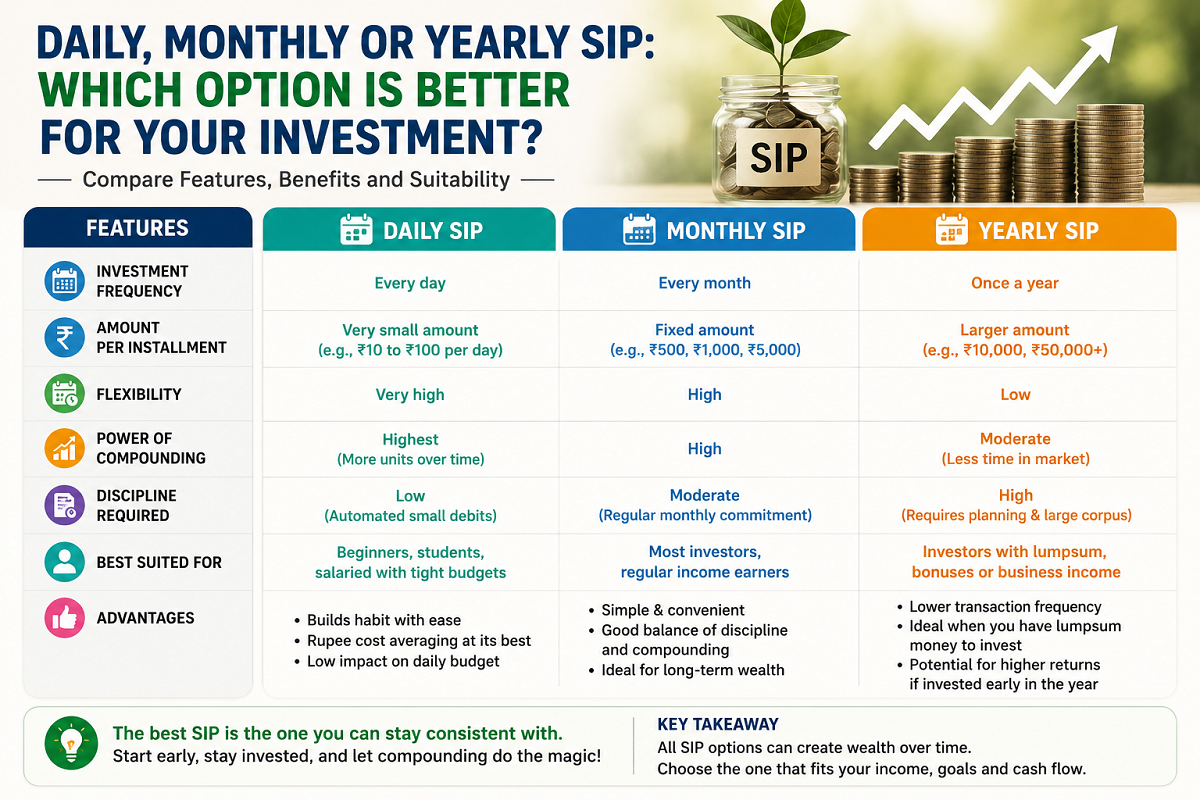
SIP Investment Tips: Systematic Investment Plans (SIPs) have become one of the most widely used ways to invest regularly in mutual funds. Instead of investing a large amount at once, investors can put in smaller amounts at fixed intervals and gradually build a corpus over time.
Monthly SIPs remain the most common choice, especially among salaried investors. However, investors may also come across daily investment options or choose to invest a larger amount once a year. This raises an important question: Is it better to invest daily, monthly or yearly?
There is no single option that works best for everyone. The right frequency depends on your income pattern, cash flow, financial goals and ability to stay consistent.
What Is a Daily SIP?
Under a daily SIP or similar frequent-investment arrangement, a small amount is invested on eligible business days.
For example, if you invest ₹100 on every working day, your monthly investment could be around ₹2,000–₹2,300, depending on the number of investment days.
Since investments happen frequently, mutual fund units are purchased at different NAV levels. When markets fall, the same investment amount may buy more units, while fewer units are purchased when markets rise.
However, investing daily does not automatically mean higher returns. Ultimately, performance depends much more on the underlying mutual fund, market movement, investment duration and asset allocation.
Daily investing may be convenient for people who receive income frequently and prefer investing small amounts rather than accumulating money for a monthly contribution.
Why Is Monthly SIP So Popular?
A monthly SIP is generally the simplest option for investors who receive a regular salary.
Suppose you start a SIP of ₹5,000 per month. Over one year, you would invest ₹60,000. Once the SIP mandate is set up, the specified amount can automatically be debited from your bank account on the selected date.
This automation is one of the biggest advantages of a monthly SIP. Investors do not have to repeatedly decide whether it is the "right time" to enter the market.
It also helps maintain investment discipline during both rising and falling markets.
For salaried individuals, scheduling a SIP shortly after receiving their monthly salary can make investing easier and reduce the temptation to spend the amount elsewhere.
How Does Yearly Investing Work?
An investor may also invest a larger amount once a year rather than contributing every month.
This approach can suit people whose income is irregular or who receive a significant portion of their earnings through annual bonuses, business profits, incentives or seasonal income.
For instance, instead of investing ₹5,000 every month, an investor might invest ₹60,000 when an annual bonus is received.
However, these two approaches are not identical from a timing perspective. With a monthly SIP, money enters the market throughout the year. With a once-a-year investment, the entire amount enters the market at one particular point.
If money is already available for investment, unnecessarily keeping it idle simply to wait for an annual investment date may not always be beneficial.
Daily vs Monthly vs Yearly SIP: Quick Comparison
| Investment Frequency | May Suit | Key Advantage |
|---|---|---|
| Daily | People with frequent cash flow | Small amounts invested frequently |
| Monthly | Salaried individuals | Simple, automated and disciplined |
| Yearly/Lump Sum | Bonus or irregular-income earners | Convenient for large periodic cash flows |
Which SIP Gives Higher Returns?
There is no guarantee that a daily SIP will outperform a monthly SIP or that investing once a year will produce better returns.
Mutual fund returns are market-linked and are not guaranteed.
Over the long term, factors such as the performance of the chosen scheme, investment horizon, asset allocation, costs and investor behaviour can have a much greater impact than simply choosing between daily and monthly investing.
Trying to find the "perfect SIP date" can therefore be less important than investing consistently.
How Rupee-Cost Averaging Helps SIP Investors
One important feature associated with regular SIP investing is rupee-cost averaging.
Suppose you invest ₹5,000 every month. When the fund's NAV is lower, ₹5,000 buys more units. When the NAV is higher, the same ₹5,000 buys fewer units.
Over time, investing across different market levels can average out the purchase cost of mutual fund units.
This does not eliminate investment risk or guarantee profits, but it can reduce the need to repeatedly time market entry.
Which SIP Frequency Should You Choose?
For most salaried investors, a monthly SIP can be the most practical choice because income also arrives monthly. It is easy to automate, track and include in a household budget.
Someone earning money daily or at shorter intervals may find frequent investments more suitable. Meanwhile, investors receiving annual bonuses or irregular business income may prefer periodic lump-sum investments.
Investors can also combine approaches. For example, they may continue a monthly SIP and invest an additional portion of their annual bonus when available.
Consistency Matters More Than Frequency
Whether you choose daily, monthly or periodic investing, the more important goal is to build a sustainable investment habit.
A very aggressive SIP that you are forced to stop after a few months may be less useful than a manageable investment that continues for many years.
Investors should therefore select an amount and frequency that match their income and expenses while maintaining an emergency fund and other essential financial commitments.
Disclaimer: Mutual fund investments are subject to market risks. Returns are not guaranteed, and past performance does not guarantee future results. Investors should read scheme-related documents carefully and consider their goals and risk tolerance before investing.