Business
DA Hike October 2026: Himachal Pradesh Raises Dearness Allowance to 50%, Announces ₹10,000 Arrears Before Diwali
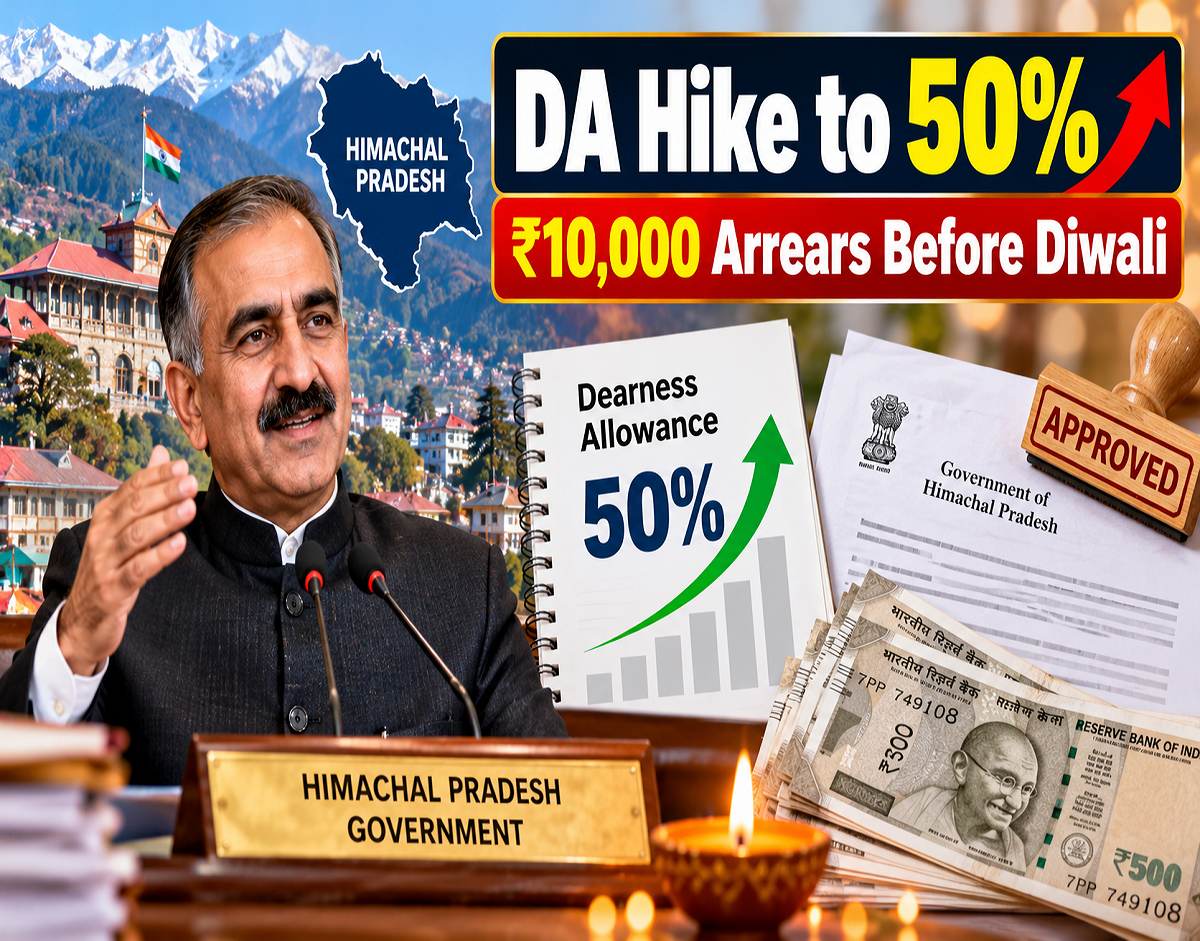
Dearness Allowance News 2026: Government employees in Himachal Pradesh are set to receive higher dearness allowance following an announcement by Chief Minister Sukhvinder Singh Sukhu on October 23, 2026. The state government has announced a combined five-percentage-point increase in DA, taking the reported rate from 45% to 50% of basic pay.
The announcement comes ahead of Diwali and also includes a separate decision to release ₹10,000 in pending pay-revision arrears to eligible Class IV employees.
According to the announcement, the five-percentage-point increase comprises a fresh 4% DA revision and an additional 1% that had remained pending from an earlier revision.
The enhanced allowance is expected to be reflected in salary payments released before Diwali, while eligible employees with outstanding pay-revision dues will receive the separately announced arrears.
However, employees should distinguish between the monthly DA increase and the one-time arrears payment, as they are different benefits.
Himachal Pradesh DA Hike 2026: Key Highlights
| Particulars | Announced Details |
|---|---|
| State | Himachal Pradesh |
| Announcement date | October 23, 2026 |
| Chief Minister | Sukhvinder Singh Sukhu |
| Previous DA rate | 45% |
| Revised DA rate | 50% |
| Total increase | 5 percentage points |
| Fresh DA revision | 4 percentage points |
| Previously pending component | 1 percentage point |
| Pay-revision arrears | ₹10,000 for eligible Class IV employees |
| Expected payment | Before Diwali, through the applicable salary/payment cycle |
The actual amount received by each employee will depend on basic pay, eligibility and the provisions of the implementing government orders.
How Much Will Employees Receive After the 5% DA Increase?
Dearness Allowance is calculated as a percentage of an employee's basic salary.
With the rate increasing from 45% to 50%, the additional monthly DA equals 5% of basic pay, assuming the employee is covered by the revised rate.
For example, an employee with a basic salary of ₹30,000 would see monthly DA rise from ₹13,500 to ₹15,000, an increase of ₹1,500.
DA Hike Salary Calculation
| Monthly Basic Pay | DA at 45% | DA at 50% | Monthly Increase |
|---|---|---|---|
| ₹18,000 | ₹8,100 | ₹9,000 | ₹900 |
| ₹25,000 | ₹11,250 | ₹12,500 | ₹1,250 |
| ₹30,000 | ₹13,500 | ₹15,000 | ₹1,500 |
| ₹40,000 | ₹18,000 | ₹20,000 | ₹2,000 |
| ₹50,000 | ₹22,500 | ₹25,000 | ₹2,500 |
| ₹60,000 | ₹27,000 | ₹30,000 | ₹3,000 |
These are illustrative calculations. Actual take-home salary will depend on deductions, eligibility and other applicable pay rules.
When Will Employees Receive the Increased DA?
The Himachal Pradesh Finance Department reportedly issued an office memorandum on October 23, 2026, formalising the revised DA rate.
According to the reported order, the increase from 45% to 50% will be paid in cash with the October 2026 salary, payable in November.
The revision includes one percentage point effective from July 1, 2023, and four percentage points effective from January 1, 2024. Separate instructions are expected for accumulated arrears up to September 30, 2026.
This distinction matters because the effective dates used to calculate past dues are different from the date on which the increased monthly allowance will be paid.
Who Will Receive the Additional ₹10,000?
The state government has separately announced ₹10,000 for eligible Class IV employees against outstanding pay-revision arrears.
The amount is not a permanent increase in basic salary or DA. It is a payment against existing arrear liabilities.
Reports indicate that the government has also discussed ₹10,000 payments for pensioners, although the precise eligibility and disbursement arrangements should be checked against the relevant departmental orders.
The payment for eligible Class IV employees is reported to be scheduled for November 1, 2026.
Will Pensioners Benefit From the DA Revision?
Pensioners generally receive Dearness Relief (DR), which is calculated on eligible basic pension rather than basic salary.
The Himachal Pradesh announcement has been reported as covering government employees and pensioners. However, pensioners should refer to the applicable Dearness Relief and pension-payment instructions to confirm the revised rate and payment schedule.
A salary-related DA order does not necessarily establish every pension-related entitlement by itself.
Is This DA Increase Applicable to Central Government Employees?
No. The announcement concerns employees covered by the Himachal Pradesh government's applicable pay rules.
Central government employees are governed by separate DA decisions.
As of October 23, 2026, the central government's next DA revision remained a separate matter. Reports suggested that employees were awaiting a decision concerning the July 2026 revision cycle.
A state government's announcement does not automatically change DA rates for central government employees or employees of other states.
Why Is the DA Revision Important?
Dearness Allowance is intended to help government employees manage the effects of inflation on household expenses.
Unlike a one-time payment, an increase in the DA rate affects the recurring monthly allowance for eligible employees.
For someone earning ₹40,000 in basic pay, a five-percentage-point rise means an illustrative additional ₹2,000 per month, or ₹24,000 over 12 months, assuming the same basic salary and DA rate throughout that period.
The separately announced ₹10,000 arrears payment provides additional cash to eligible recipients but should not be included when calculating recurring monthly salary.
Final Takeaway
Himachal Pradesh has announced a five-percentage-point Dearness Allowance increase, raising the reported rate from 45% to 50%.
The revised allowance is scheduled to be paid with October salary in November, while eligible Class IV employees are also expected to receive ₹10,000 against outstanding arrears.
Employees should check their salary slips and the applicable Finance Department orders to confirm the revised DA, accumulated arrears and individual payment eligibility.
Disclaimer: This article reflects the October 23, 2026 announcement and subsequent reporting on the Finance Department's order. Individual payments are subject to the applicable service rules and official instructions.