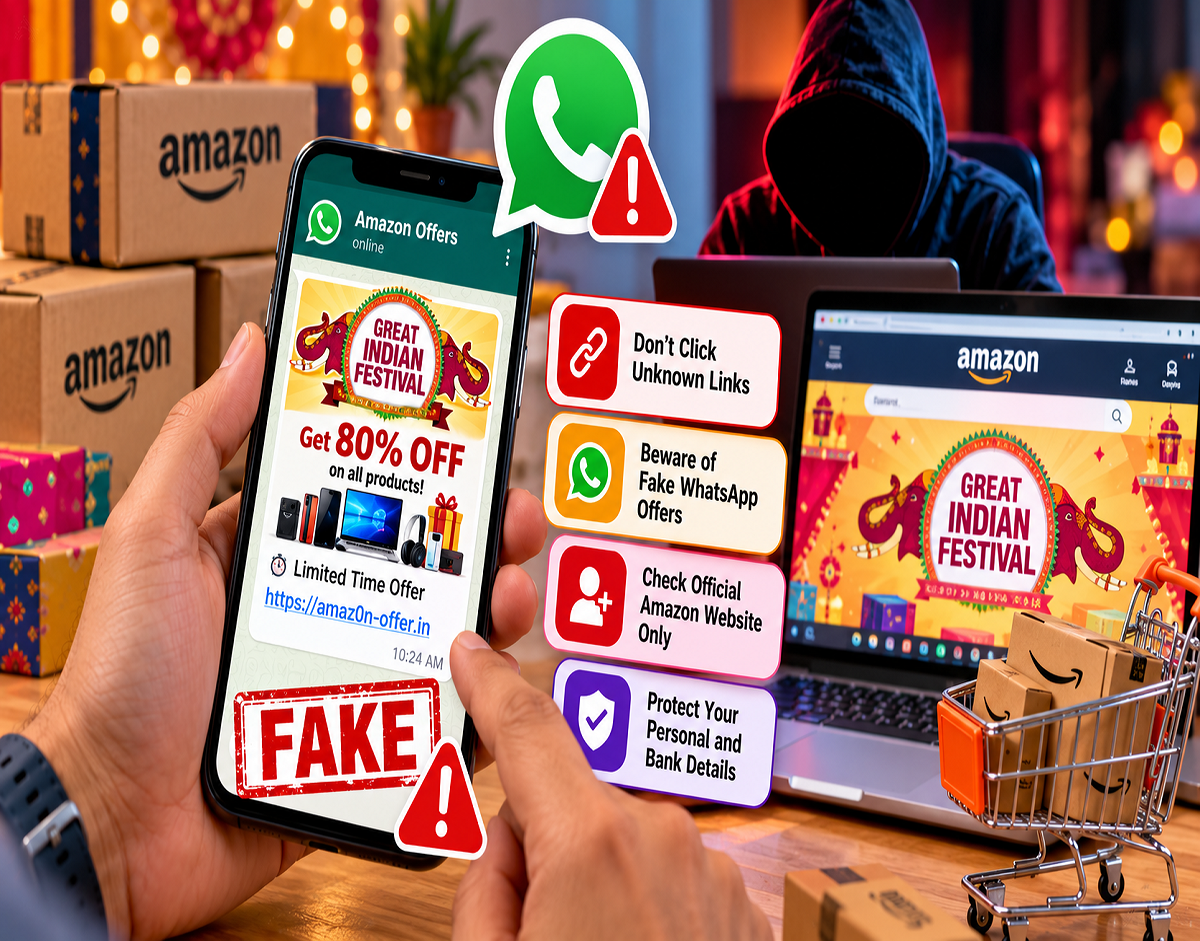
The festive shopping season brings attractive discounts on smartphones, laptops, home appliances and other products. But as shoppers look for deals during the Amazon Great Indian Festival 2026, cybercriminals may also try to exploit the excitement by circulating fake offers through WhatsApp.
A message claiming that you have won a free gift, received an exclusive discount or qualified for a limited-time deal may appear genuine at first glance. Fraudsters can use familiar brand names, logos and promotional language to make such messages look convincing.
The biggest danger often begins when the message asks you to click an unfamiliar link.
That link could lead to a fake shopping or payment page designed to collect personal and financial information. Shoppers should therefore verify festival offers independently instead of trusting links received through WhatsApp or other messaging platforms.
Fake Amazon Offers May Arrive on WhatsApp
Cybercriminals can create messages that appear to have been sent on behalf of well-known online shopping brands.
A fake Great Indian Festival message might claim that you have been selected for a special reward or are eligible for a huge discount available only for a few minutes.
The message may also display Amazon's name or branding to create a sense of authenticity.
However, seeing a familiar logo does not prove that the message is genuine.
Images, brand names and promotional graphics can easily be copied and used in fraudulent messages.
Be Careful With Links in Shopping Messages
A suspicious link is one of the biggest warning signs.
After clicking it, a shopper may be taken to a website designed to resemble a legitimate shopping page.
The fraudulent site could then request information such as your name, phone number, card details, banking information or other credentials.
In some scams, the page may claim that the information is required to confirm a prize or complete delivery of a free gift.
Users should avoid providing sensitive information on websites reached through unexpected messages.
Don't Rush Because of a Huge Discount
Scammers often depend on urgency.
A WhatsApp message may claim that an expensive smartphone normally costing thousands of rupees is available at an unbelievable price for the “next 10 minutes.”
Another message might say that only a few units remain.
The objective is to prevent the shopper from taking enough time to verify the offer.
If a deal appears unusually generous, open the retailer's official app or website independently and search for the same product.
If the advertised price or promotion cannot be found there, treat the WhatsApp offer with suspicion.
Expensive Electronics Are an Easy Bait
Smartphones, laptops, televisions, gaming devices and other electronics can be particularly effective bait because shoppers actively search for large festive-season discounts on these products.
A scammer may advertise a premium product at a fraction of its normal price and demand advance payment.
The fraudulent page could even display a countdown timer, fake customer reviews or fabricated stock information.
These visual elements should not be considered proof that an offer is genuine.
Verify the product and deal independently before making a payment.
Never Share Your UPI PIN
Your UPI PIN should never be shared with a seller, customer-care representative or person claiming to help you receive a shopping offer.
The UPI PIN is used to authorise transactions from your account.
Receiving money normally does not require you to reveal your UPI PIN to another person.
Be particularly cautious if someone calls after you click a suspicious shopping link and asks for your PIN to “activate a refund” or “confirm a prize.”
Do not provide it.
Keep OTP, CVV and Banking Passwords Private
The same rule applies to other sensitive financial credentials.
Never disclose your:
- UPI PIN
- ATM or debit-card PIN
- Net-banking password
- One-time password (OTP)
- Card CVV
A fraudster may claim that an OTP is required to verify your identity or release a gift.
Always read the full OTP message before taking any action, and never forward an authentication code to an unknown person.
A Fake Website Can Look Very Convincing
Modern phishing websites can closely imitate genuine e-commerce pages.
They may use copied logos, product photographs and similar layouts.
That is why visual appearance alone is not a reliable way to determine whether a page is genuine.
Instead of opening a shopping site through an unsolicited WhatsApp message, access the retailer through its official app or type the known website address yourself.
This reduces the risk of being redirected to a lookalike phishing page.
Don't Install Apps Sent Through WhatsApp
Some shopping scams can go beyond fake websites.
A message may ask users to download an application file to access “VIP deals,” “special festival prices” or an exclusive shopping coupon.
Android users should be especially careful with unknown APK files received through messaging apps.
Installing a malicious application can expose the device to serious security risks, particularly if the app requests sensitive permissions such as SMS, notifications, accessibility services, contacts or other device access.
Festival discounts should not require you to install an unknown app received as a WhatsApp attachment.
Beware of Fake Customer-Care Calls
A fraudulent offer can also be followed by a phone call.
The caller may claim to represent Amazon or another well-known company and say that your payment failed, your order has been blocked or your prize needs verification.
They may then ask for banking information or instruct you to install a remote-access application.
Do not provide sensitive credentials or remote access to your phone.
If you have a genuine order-related concern, open the official shopping app or website and use the customer-support options available there.
Urgency Is a Common Scam Technique
Scammers frequently use phrases such as:
“Offer expires in five minutes.”
“Pay now or your gift will be cancelled.”
“Your account will be blocked.”
“You are today's lucky winner.”
These messages are designed to create excitement or fear so that users act before verifying the claim.
A legitimate shopping decision does not need to be made under pressure from an unknown WhatsApp sender.
If a message tries to force immediate payment, stop and verify it independently.
Check the Offer in the Official App
The simplest way to verify a suspicious festival deal is to look for it independently.
If a WhatsApp message claims that a particular smartphone is available at a massive discount during the Great Indian Festival, do not use the link in the message.
Open the official shopping app yourself and search for that product.
Check the listed price, seller information, applicable bank offers and terms of the promotion.
This small verification step can prevent a costly mistake.
What If You Already Clicked the Link?
Simply clicking a link does not necessarily mean that money has already been stolen.
The level of risk depends on what happened after the link was opened.
If you only opened a page and did not enter credentials, download a file or approve a payment, close the page and avoid further interaction.
If you entered a password, card information or banking credentials, take immediate steps to secure the affected account.
If you installed an unknown application, particularly an APK, review the device carefully and avoid conducting financial transactions on it until the risk has been addressed.
What If You Already Made a Payment?
If you believe you have transferred money to a scammer, act quickly.
Contact your bank or payment provider immediately and report the transaction as suspected fraud.
In India, victims of cyber financial fraud can also report the incident through the official cybercrime reporting system and use the 1930 cybercrime helpline where applicable.
Keep evidence such as screenshots, transaction IDs, phone numbers, messages and details of the fraudulent website.
Quick reporting can be important, although recovery of money cannot be guaranteed.
Don't Blame the Real Brand for an Impersonation Scam
A fake message using Amazon's name does not mean that the message actually came from Amazon.
Cybercriminals routinely impersonate banks, government departments, delivery companies and popular online platforms.
Users should distinguish between a genuine offer displayed through an authorised platform and a scammer using a company's branding without permission.
The presence of a company logo in a WhatsApp message is not evidence of authenticity.
Shop Carefully During the Festive Sale
The Amazon Great Indian Festival 2026 can attract shoppers looking for discounts, and that same demand can be exploited by fraudsters.
Be suspicious of unsolicited WhatsApp messages offering expensive products at unbelievable prices, free gifts or secret festival deals.
Avoid clicking unknown links, do not install unfamiliar APK files and never disclose OTPs, UPI PINs, ATM PINs, CVVs or banking passwords.
Most importantly, verify the offer independently through the retailer's official app or website before paying.
A few extra seconds spent checking a deal can be far more valuable than the discount being promised.
Cyber Safety Note: Receiving a suspicious WhatsApp message or merely seeing an offer does not automatically compromise your bank account. The greater risk arises when users disclose sensitive information, approve fraudulent transactions, enter credentials on phishing pages or install malicious software.