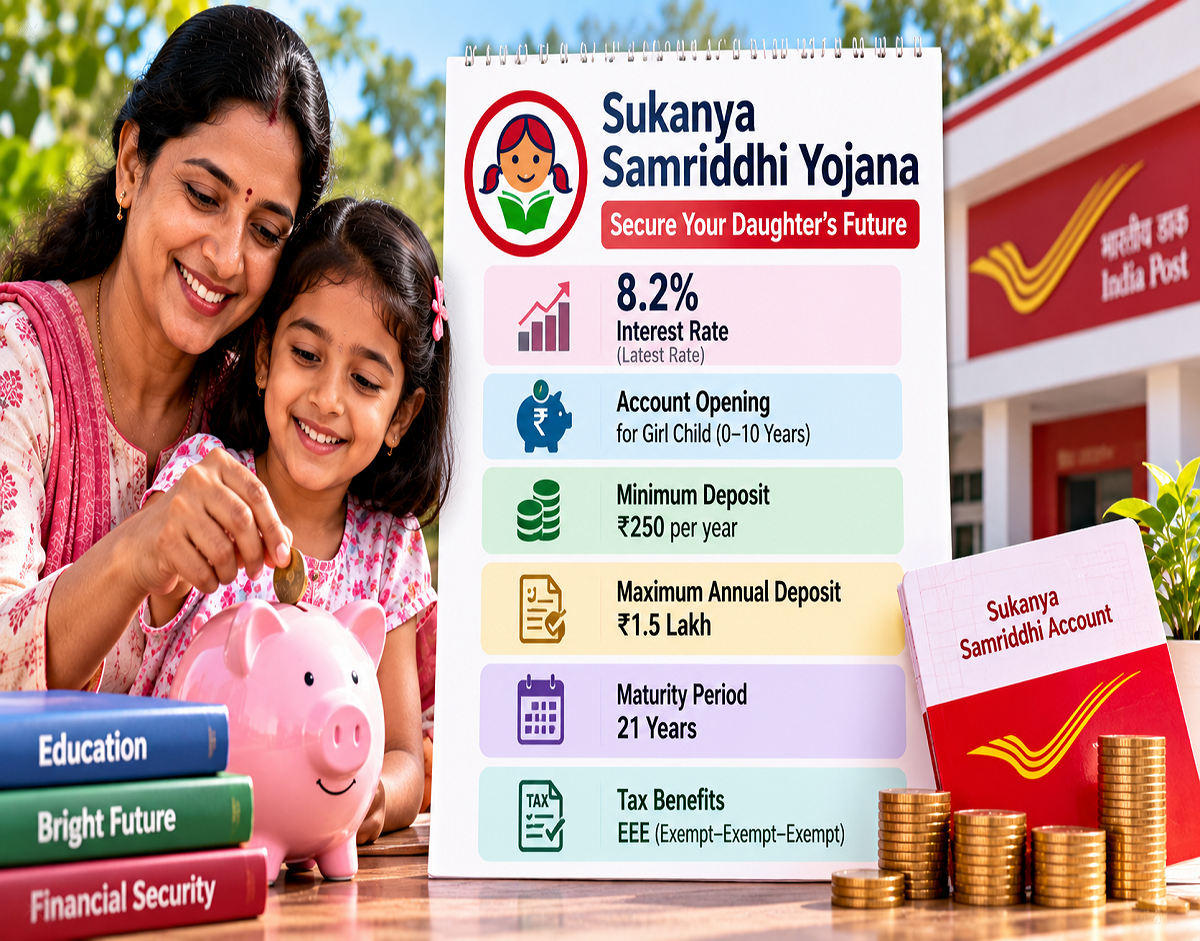
Parents investing for their daughter's future through the Sukanya Samriddhi Yojana (SSY) will continue to get an interest rate of 8.2% per annum for the October-December 2026 quarter, according to the supplied information.
The government has kept interest rates on small savings schemes unchanged for the quarter beginning October 1, 2026. This means the Sukanya Samriddhi interest rate remains at 8.2%, while the basic rules governing deposits, maturity, withdrawals and account regularisation continue to be important for account holders.
SSY is a long-term government-backed savings scheme designed specifically for a girl child. An account can generally be opened in the name of an eligible girl before she reaches the prescribed age limit.
Here's what parents and guardians should know about the current interest rate and major account rules.
Sukanya Samriddhi Interest Rate Remains 8.2%
The interest rate for the Sukanya Samriddhi Yojana has been kept unchanged at 8.2% per annum for October to December 2026.
The government reviews interest rates on small savings schemes every quarter.
However, a quarterly review does not necessarily mean that rates will change every three months. The government may decide to retain existing rates for another quarter.
Therefore, investors should not assume that the current 8.2% rate will remain unchanged throughout the entire life of an SSY account.
Future returns will depend on the interest rates notified by the government for subsequent periods.
Who Can Open a Sukanya Samriddhi Account?
A Sukanya Samriddhi account is intended to help families build a long-term financial corpus for a girl child's education and other future needs.
Under the applicable rules, the account can generally be opened by a guardian in the name of a girl child before she turns 10 years old.
The scheme comes with annual minimum and maximum deposit limits.
Here are the main figures highlighted in the supplied information:
| SSY Rule | Details |
|---|---|
| Current Interest Rate | 8.2% per annum |
| Minimum Annual Deposit | ₹250 per financial year |
| Maximum Annual Deposit | ₹1.5 lakh per financial year |
| Deposit Period | Up to 15 years from account opening |
| Maturity | 21 years from the date of account opening |
| Partial Withdrawal | Up to 50% for eligible education purposes, subject to rules |
These conditions make SSY primarily a long-term savings option rather than an account intended for frequent withdrawals.
How Long Do You Have to Deposit Money?
Deposits can be made for 15 years from the date the account is opened.
The account itself generally matures after 21 years from the opening date, subject to the applicable scheme rules.
This distinction is important.
Parents do not have to continue depositing money for the full 21 years. The contribution period ends earlier, while the balance can continue under the scheme until maturity according to the applicable rules.
Minimum Investment Is Only ₹250 a Year
An SSY account does not require a large annual investment to remain compliant with the minimum deposit requirement.
The minimum amount that must generally be deposited is ₹250 in a financial year.
At the other end, total deposits cannot exceed ₹1.5 lakh in a financial year.
Families can therefore choose a contribution level based on their financial capacity, provided they stay within the prescribed minimum and maximum limits.
A higher contribution does not change the notified interest rate, although it can result in a larger maturity corpus.
How Is Interest Calculated?
The timing of deposits can matter for interest calculation.
According to the scheme rules described in the supplied report, interest is calculated on the lowest balance in the account between the close of the fifth day and the end of each month.
This means deposit timing can affect the balance considered for that month's interest calculation.
Account holders who make regular contributions should therefore understand the calculation rule instead of assuming that the date of deposit never matters.
Interest is credited according to the prescribed scheme provisions.
What Happens If You Don't Deposit ₹250 in a Year?
If the required minimum deposit is not made during a financial year, the account can become a defaulted account under the applicable rules.
However, it may be possible to regularise it before completion of the prescribed deposit period.
According to the supplied information, the account can be restored by paying the required ₹250 minimum contribution for each defaulted year, along with a ₹50 penalty for each year of default.
For example, simply resuming deposits in a later year may not be sufficient if earlier default years remain unresolved.
Account holders should check their account status and clear any applicable default amount and penalty.
Can Money Be Withdrawn Before Maturity?
SSY is designed for long-term savings, but partial withdrawal is permitted for specified purposes.
The supplied information states that up to 50% of the eligible balance may be withdrawn for the account holder's higher education after she reaches the prescribed age or educational stage.
The relevant rule is linked to the girl attaining 18 years of age or passing Class 10, subject to the applicable withdrawal conditions.
The permissible amount is generally linked to the balance standing in the account at the end of the preceding financial year.
The withdrawal can be made as a lump sum or, where permitted, in instalments over a period of up to five years.
Documentation supporting the education requirement may be required.
Can the SSY Account Be Closed Early?
Premature closure is not intended to be a routine withdrawal facility.
According to the supplied report, special circumstances can permit premature closure after the prescribed period, including situations involving serious hardship.
Such cases can include certain life-threatening illnesses or the death of the guardian, subject to the scheme rules and approval requirements.
The supplied report refers to premature closure after five years from account opening in specified compassionate circumstances.
The account holder should not assume that an ordinary financial need will automatically qualify for premature closure.
The relevant bank or post office can provide the applicable procedure and documentation requirements.
What Happens If the Girl Child Dies?
If the girl child in whose name the account is maintained dies, the account can be closed after the required death certificate is submitted.
According to the supplied information, the account balance along with the applicable interest is then paid to the guardian.
The report also states that for the period between the date of death and closure of the account, interest may be handled according to the applicable Post Office Savings Account rate under the prescribed rules.
The guardian will need to submit the required documents before the account is settled.
What Are the Tax Benefits of Sukanya Samriddhi?
SSY can also provide tax benefits under the applicable provisions of the Income Tax Act.
The supplied article refers to a different section number, but investors should be careful with that reference. Sukanya Samriddhi deposits have traditionally been associated with eligible deductions under Section 80C, subject to the overall limit and the tax regime selected by the taxpayer.
The tax treatment of interest and maturity proceeds is also governed by the applicable Income Tax rules.
Importantly, taxpayers using the new tax regime should not automatically assume that they can claim the same deduction available under the old tax regime.
Tax rules can change, so investors should check the provisions applicable to the relevant financial year.
Is the 8.2% Return Guaranteed for 21 Years?
No.
The 8.2% rate applies to the currently notified period and should not be interpreted as a fixed rate guaranteed for the entire 21-year life of the account.
Small savings rates are reviewed periodically by the government.
If future SSY interest rates rise or fall, the returns earned over the life of the account will also be affected.
Therefore, maturity calculations that assume a constant 8.2% interest rate for 15 or 21 years are illustrations, not guaranteed maturity amounts.
Why SSY Is Used for Long-Term Planning
The scheme combines a long investment horizon with government-notified interest rates and specific withdrawal rules.
For parents, this structure can encourage disciplined saving for a daughter's long-term financial needs.
However, families should also consider liquidity.
Money deposited in SSY cannot be withdrawn as freely as money in an ordinary savings account. Withdrawals before maturity are restricted and must meet prescribed conditions.
Families should therefore avoid putting all their emergency savings into a long-term locked-in product.
Don't Confuse the 15-Year Deposit Period With Maturity
One common misunderstanding about Sukanya Samriddhi is that the account matures after 15 years.
That is not the same as the deposit period.
Under the structure described in the supplied information, contributions can be made for 15 years from the opening of the account, while the account generally reaches maturity 21 years after it was opened.
Understanding this difference is essential when calculating how long money will remain invested.
Check These Rules Before Investing
For the October-December 2026 quarter, the Sukanya Samriddhi Yojana continues to offer a notified interest rate of 8.2% per annum.
The minimum annual deposit is ₹250, while the maximum permitted contribution is ₹1.5 lakh per financial year. Deposits can generally continue for 15 years, while the account has a 21-year maturity period from its opening date.
If the minimum contribution is missed, the account can generally be regularised under the applicable rules by paying the outstanding minimum deposits along with the prescribed penalty.
Partial withdrawals are permitted only under specified conditions, particularly for the girl's education.
Parents should also remember that 8.2% is the current notified rate, not a guaranteed rate for all 21 years. Future interest rates will depend on government notifications.
Note: Interest rates, tax provisions and SSY operating rules can be revised. Account holders should check the latest applicable rules with an authorised bank, post office or relevant government notification before making important financial decisions.