
Business
SCSS vs SBI Senior Citizen FD 2026: How Much Interest Will ₹10 Lakh to ₹30 Lakh Earn in 5 Years?
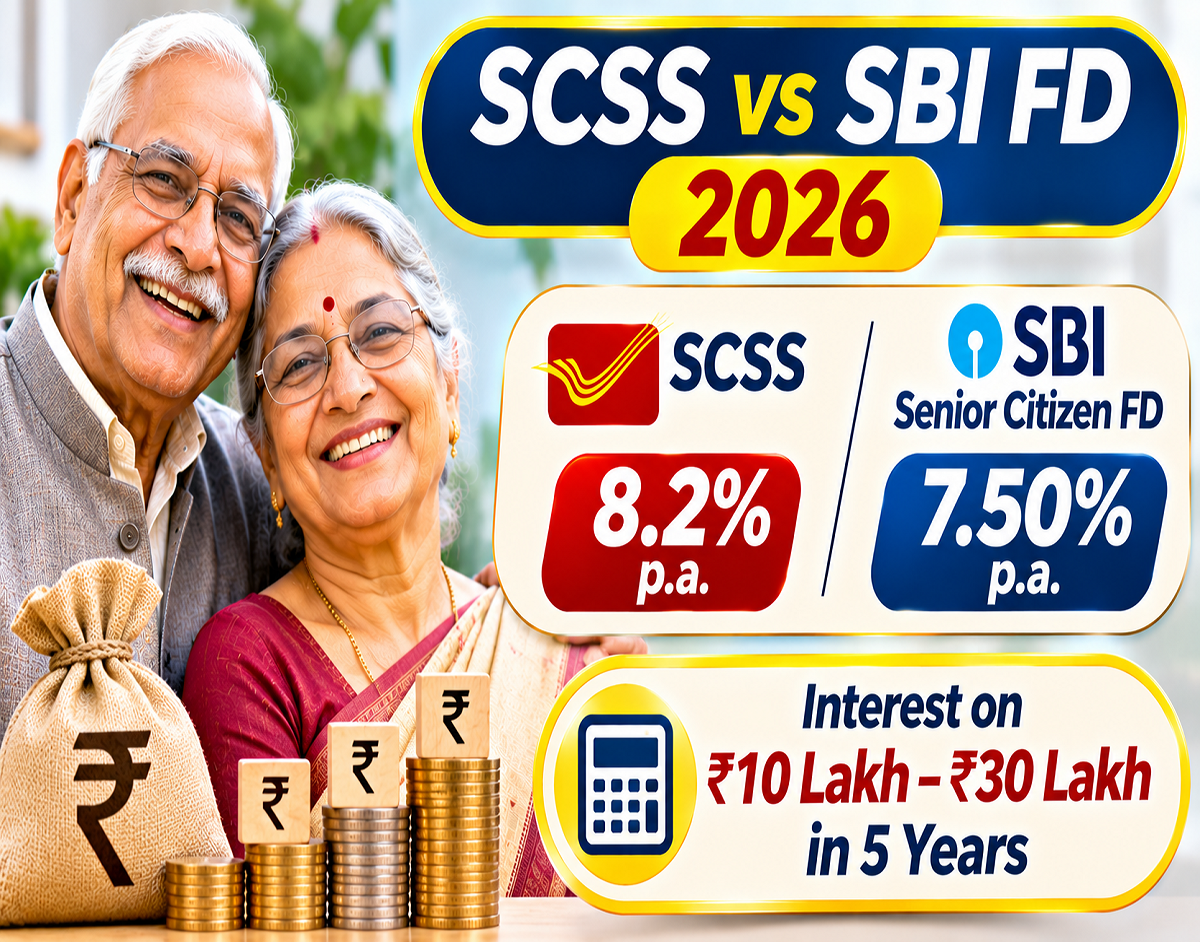
SCSS vs SBI FD 2026: Senior citizens looking for a reliable source of income after retirement often compare government-backed savings schemes with bank fixed deposits. Two popular options are the Senior Citizens Savings Scheme (SCSS) and the State Bank of India's senior citizen fixed deposit.
Both investment options offer a five-year tenure, but their interest rates, payout structures and investment limits differ significantly.
According to the rates cited in a November 19, 2026, comparison, SCSS offers 8.20% annual interest, while SBI's five-year senior citizen FD offers 7.05% annually.
This creates a difference of 1.15 percentage points. Although the gap may appear small, it can result in substantially different earnings when investing ₹10 lakh, ₹20 lakh or ₹30 lakh.
For example, an investment of ₹30 lakh would generate ₹34,500 more annual interest under SCSS than under SBI FD, based on a simple annual interest comparison at the stated rates.
However, investors should understand the difference between quarterly interest payouts and cumulative fixed deposits before making a decision.
SCSS vs SBI FD: Interest Rates and Key Features
The Senior Citizens Savings Scheme is a government-backed small savings programme designed to provide regular income to eligible senior citizens.
SBI senior citizen fixed deposits are bank deposits that offer an additional interest benefit to qualifying older customers.
Here is a comparison based on the rates provided in the source report.
| Feature | SCSS | SBI Senior Citizen FD |
|---|---|---|
| Annual Interest Rate | 8.20% | 7.05% |
| Investment Tenure | 5 years | 5 years |
| Maximum Investment | ₹30 lakh per eligible individual | No general maximum deposit ceiling |
| Interest Payment | Quarterly | Periodic payout or cumulative option, subject to product terms |
| Minimum Age | Generally 60 years, with specified exceptions | Generally 60 years |
| Government Backing | Government small savings scheme | Bank deposit, subject to applicable deposit insurance |
| Tax Treatment | Interest taxable | Interest taxable |
| Section 80C Benefit | Eligible subject to tax regime and limits | Eligible five-year tax-saving FD, subject to conditions |
Note: The SBI rate of 7.05% is the rate quoted in the supplied November 19 report. Investors should verify the rate applicable to their deposit before booking.
How Much Interest Will ₹10 Lakh Earn in One Year?
Suppose a senior citizen has ₹10 lakh available for investment.
At an annual interest rate of 8.20%, SCSS would generate ₹82,000 in interest over a full year.
Since SCSS pays interest quarterly, the equivalent quarterly amount would be ₹20,500.
By comparison, an SBI senior citizen FD offering 7.05% would generate ₹70,500 in annual interest on a simple-interest basis.
The annual difference would therefore be ₹11,500.
For someone depending on investment income to meet household expenses, this difference could be meaningful.
₹20 Lakh Investment: SCSS vs SBI FD Calculation
The difference becomes larger when the investment amount increases.
A ₹20 lakh investment under SCSS at 8.20% would generate ₹1,64,000 annually.
This is equivalent to ₹41,000 every quarter.
At the assumed SBI FD rate of 7.05%, the annual simple-interest equivalent would be ₹1,41,000.
The annual difference between the two options would be ₹23,000.
Over five years, the simple-interest difference would amount to ₹1,15,000, assuming unchanged rates and no reinvestment of interest.
₹30 Lakh Investment: Which Option Pays More?
The maximum investment permitted under SCSS is ₹30 lakh per eligible individual.
At the stated annual rate of 8.20%, this amount would generate ₹2,46,000 in annual interest.
The quarterly interest payout would be ₹61,500.
An SBI senior citizen FD offering 7.05% would generate an annual simple-interest equivalent of ₹2,11,500.
This means SCSS would provide ₹34,500 more annual interest.
Over five years, the difference would total ₹1,72,500 under a simple-interest comparison.
SCSS vs SBI FD: Annual Interest Comparison
| Investment Amount | SCSS at 8.20% | SBI FD at 7.05% | Extra Annual Interest From SCSS |
|---|---|---|---|
| ₹10 lakh | ₹82,000 | ₹70,500 | ₹11,500 |
| ₹20 lakh | ₹1,64,000 | ₹1,41,000 | ₹23,000 |
| ₹30 lakh | ₹2,46,000 | ₹2,11,500 | ₹34,500 |
These figures compare annual interest using the principal multiplied by the quoted annual rate. Actual bank FD payouts may differ depending on the interest payment option and compounding method.
How Much Interest Will You Earn Over Five Years?
Assuming the stated interest rates remain applicable for the full investment tenure, the five-year simple-interest comparison is as follows.
| Investment | SCSS Interest in 5 Years | SBI FD Simple Interest in 5 Years | Difference |
|---|---|---|---|
| ₹10 lakh | ₹4,10,000 | ₹3,52,500 | ₹57,500 |
| ₹20 lakh | ₹8,20,000 | ₹7,05,000 | ₹1,15,000 |
| ₹30 lakh | ₹12,30,000 | ₹10,57,500 | ₹1,72,500 |
Important: This table assumes interest is paid out rather than reinvested. SCSS pays interest quarterly, while a cumulative SBI FD compounds interest. Consequently, a cumulative FD's maturity proceeds cannot be directly compared with the simple-interest figures above without accounting for compounding.
What Happens If SBI FD Interest Is Compounded?
Some investors prefer a cumulative FD because they do not need regular income.
In a cumulative fixed deposit, interest is generally compounded quarterly and paid along with the principal at maturity.
Using 7.05% annual interest with quarterly compounding over five years, the approximate maturity values would be:
| Initial Investment | Approximate SBI FD Maturity Value | Approximate Interest Earned |
|---|---|---|
| ₹10 lakh | ₹14,18,000 | ₹4,18,000 |
| ₹20 lakh | ₹28,36,000 | ₹8,36,000 |
| ₹30 lakh | ₹42,54,000 | ₹12,54,000 |
These are rounded illustrations calculated using the stated annual rate and quarterly compounding, before tax.
SCSS does not automatically compound quarterly payouts within the same account. If investors reinvest their SCSS interest elsewhere, their total returns will depend on the reinvestment rate.
Therefore, the comparison changes depending on whether the investor wants regular income or maximum accumulated value.
SCSS Quarterly Interest: How Much Will Retirees Receive?
One of the major attractions of SCSS is its quarterly interest payment structure.
For retired individuals who need predictable income, quarterly payments may help with budgeting.
| SCSS Investment | Quarterly Interest at 8.20% |
|---|---|
| ₹10 lakh | ₹20,500 |
| ₹15 lakh | ₹30,750 |
| ₹20 lakh | ₹41,000 |
| ₹25 lakh | ₹51,250 |
| ₹30 lakh | ₹61,500 |
These amounts are before applicable taxes.
SCSS interest is generally credited on the prescribed quarterly payment dates rather than necessarily three months after the investment date.
The first payout may therefore differ depending on when the account is opened.
What Is the Maximum Investment Limit Under SCSS?
The maximum investment limit under SCSS is ₹30 lakh per eligible individual.
Eligible senior citizens can open an account through authorised banks or post offices.
Multiple SCSS accounts may be permitted, but the combined deposits must remain within the applicable individual investment ceiling.
A joint SCSS account is subject to the scheme's ownership and investment rules, and opening a joint account does not automatically double one person's investment limit.
SBI fixed deposits, on the other hand, do not have the same ₹30 lakh SCSS ceiling.
Investors with larger retirement savings may therefore consider bank deposits for amounts exceeding the permitted SCSS investment.
Who Can Open an SCSS Account?
SCSS is primarily available to individuals aged 60 years or above.
Certain retired civilian employees aged 55 to below 60 may qualify under specified conditions.
Retired defence personnel may also be eligible from age 50 under applicable rules.
Investors should check the relevant eligibility conditions before opening an account.
For SBI senior citizen FDs, the usual age requirement is 60 years or above.
Specific interest benefits depend on the bank's prevailing deposit terms.
Is SCSS Safer Than an SBI Fixed Deposit?
SCSS is a government-backed small savings scheme.
Its principal and interest obligations are supported by the Government of India under the applicable scheme framework.
SBI fixed deposits are liabilities of the bank.
Eligible bank deposits are covered by deposit insurance through the Deposit Insurance and Credit Guarantee Corporation (DICGC), subject to the prescribed limit of ₹5 lakh per depositor per bank, including principal and interest.
This distinction is important for investors placing large amounts in a single bank.
Both products are widely used for conservative savings, but their underlying protection structures are different.
Tax Rules: SCSS vs SBI FD
Interest earned from both SCSS and SBI fixed deposits is taxable according to the investor's applicable income tax provisions.
Tax deduction at source may apply when interest exceeds the prescribed threshold.
For eligible senior citizens, the applicable bank and post office interest TDS threshold is generally ₹1 lakh per financial year under current provisions.
However, TDS rules should not be confused with the final tax liability.
SCSS deposits may qualify for a deduction under Section 80C within the applicable overall limit, subject to the investor's tax regime.
A qualifying five-year tax-saving bank FD may also provide Section 80C benefits.
Regular five-year FDs do not automatically qualify as tax-saving deposits.
Investors should check the specific product before claiming deductions.
Can SCSS or SBI FD Be Closed Before Five Years?
Both products have rules governing premature withdrawal.
SCSS allows premature closure subject to the applicable conditions and deductions.
SBI fixed deposits may also permit premature withdrawal, but penalties and restrictions depend on the particular deposit product.
A five-year tax-saving FD generally has a statutory lock-in period and different withdrawal restrictions from ordinary deposits.
Investors who may need emergency access to their money should review these conditions carefully.
Which Option Is More Suitable for Retirement Income?
The answer depends on the investor's financial requirements.
For senior citizens who prioritise quarterly income, SCSS offers a higher stated interest rate in the comparison and a regular payout structure.
For those who want to accumulate interest until maturity, a cumulative SBI FD may be worth examining because of its compounding feature.
Investors with more than ₹30 lakh may also need to consider additional products because of the SCSS investment ceiling.
Tax liability, liquidity requirements, existing savings and the need for regular income should all influence the decision.
SCSS vs SBI FD 2026: Final Comparison
Based on the rates quoted in the November 19, 2026 report, SCSS offers a higher annual interest rate than SBI's five-year senior citizen FD.
At ₹10 lakh, the simple annual interest difference is ₹11,500.
At ₹20 lakh, the difference increases to ₹23,000.
At ₹30 lakh, SCSS generates ₹34,500 more annual interest than the SBI FD simple-interest equivalent.
For investors seeking regular quarterly income, this difference may be particularly relevant.
However, those comparing maturity proceeds should account for compounding, tax treatment and reinvestment assumptions.
Before investing, senior citizens should confirm the prevailing rates and product conditions through official sources.
Official Websites:
- India Post: https://www.indiapost.gov.in/
- State Bank of India: https://sbi.co.in/
- National Savings Institute: https://www.nsiindia.gov.in/
Source Credit: Adapted and independently rewritten from a Moneycontrol Hindi report by Suneel Kumar, updated November 19, 2026, comparing the Senior Citizens Savings Scheme and SBI senior citizen fixed deposits. Calculations are based on the interest rates quoted in the supplied report.
Disclaimer: This article is for general financial information and does not constitute investment advice. The SBI FD rate of 7.05% has been taken from the supplied report and has not been independently verified against a live SBI rate card. Interest rates, compounding methods, tax treatment and premature withdrawal conditions may vary. Investors should confirm the latest official terms and consult a qualified financial adviser before making investment decisions.