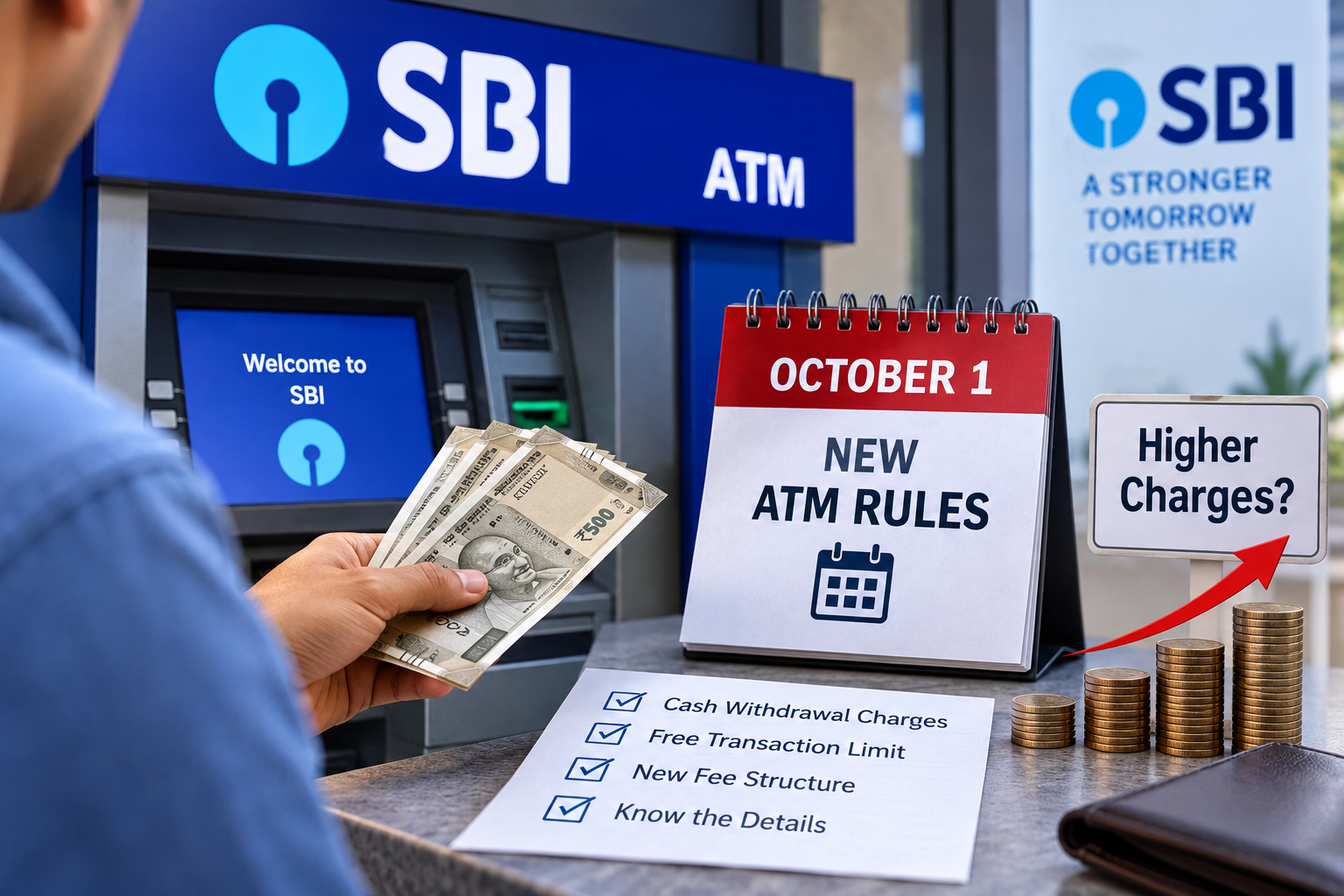
State Bank of India (SBI) customers should pay attention to an important banking rule change scheduled to take effect from October 1, 2026. The country's largest public-sector bank is revising certain rules related to ATM transactions, which could make cash withdrawals more expensive for some customers.
The change does not mean that every SBI customer will automatically have to pay a fee each time they withdraw cash. Charges will depend on factors such as the type of account, the number of free transactions available and whether the customer uses an SBI ATM or another bank's ATM.
Customers who regularly withdraw cash through ATMs should therefore understand their account-specific limits before the revised rules come into force.
SBI ATM Rule Change From October 1
SBI provides a certain number of free ATM transactions to eligible customers, depending on the account category and applicable banking rules. Once the permitted free transaction limit is exhausted, additional transactions may attract a fee.
From October 1, 2026, SBI is changing its ATM-related charging structure. As a result, customers exceeding their applicable free transaction allowance could face higher costs for subsequent ATM usage.
The revised structure is particularly relevant to customers who frequently use ATMs of banks other than SBI.
However, customers should remember that ATM rules may differ depending on the type of transaction. Cash withdrawals and non-financial transactions, such as checking a balance or requesting a mini statement, can be treated differently under the bank's schedule of charges.
Does This Mean Every ATM Withdrawal Will Become Expensive?
No. The change should not be interpreted to mean that SBI will begin charging all customers for every cash withdrawal from October 1.
Free transaction limits will continue to matter. If a customer's withdrawal falls within the applicable free transaction allowance, no additional ATM fee would arise merely because the new rules have taken effect.
Charges generally become relevant after a customer exhausts the number of free transactions permitted under the applicable rules.
Therefore, SBI customers should first determine how many free ATM transactions their particular account provides instead of assuming that every withdrawal will attract a fee.
Using Another Bank's ATM Could Matter
The ATM used for a transaction can also affect the applicable charges.
Banks generally distinguish between transactions conducted through their own ATM network and those performed at ATMs operated by other banks. Depending on the customer's account and the applicable free-transaction allowance, using another bank's ATM repeatedly can result in the free limit being exhausted sooner.
This is particularly important for customers who make several small cash withdrawals during a month.
Instead of withdrawing small amounts frequently, customers who depend heavily on cash may want to keep track of their ATM usage so they know when they are approaching the free transaction limit.
Cash Withdrawal and Other ATM Transactions Are Not Always Treated the Same
An ATM is not used only for withdrawing money. Customers also use these machines to check account balances, obtain mini statements and perform other supported banking functions.
These are generally referred to as non-financial transactions.
Depending on the applicable rules, both financial and non-financial ATM transactions can count toward a customer's transaction allowance. Customers should therefore not assume that only cash withdrawals are relevant when calculating how many free transactions they have used.
The exact treatment depends on SBI's applicable terms and the customer's account category.
Why SBI Customers Should Check Their Account Type
One important point often overlooked in discussions about ATM charges is that the same limit may not necessarily apply to every SBI customer.
Banks offer multiple savings-account products and debit-card variants. Some account categories can have different transaction entitlements or conditions.
This means a customer should check the terms attached to their own account and debit card before calculating potential ATM charges.
Customers can review SBI's latest Schedule of Charges and official communication regarding the October 1 revision to understand exactly how the new structure applies to them.
How to Reduce Unnecessary ATM Charges
Customers who frequently use ATMs can take a few practical steps to avoid paying charges unnecessarily.
First, keep track of the number of ATM transactions made during the month. This is especially useful if you regularly use ATMs belonging to other banks.
Second, consider withdrawing the amount of cash you reasonably expect to need in fewer transactions instead of making repeated small withdrawals.
For services such as balance enquiries, customers can also consider SBI's digital banking channels where appropriate rather than repeatedly using an ATM.
However, customers should always choose the banking method that is convenient and secure for their circumstances.
Check the Revised Charges Before October 1
The revised SBI ATM rules are scheduled to come into effect from October 1, 2026. Customers who frequently depend on cash withdrawals should check the bank's latest official fee schedule before the effective date.
The key point is that ATM withdrawals are not suddenly becoming chargeable for everyone. The financial impact will depend primarily on the customer's account type, applicable free transaction limit, number and type of ATM transactions, and whether SBI or another bank's ATM is being used.
Keeping track of these limits can help SBI customers avoid unexpected deductions from their accounts once the revised charging structure takes effect.
Reduce repetition around free limitsClarify the effective date prominently