Business
RBI Restricts Puducherry Cooperative Bank: ₹5,000 Withdrawal Limit Reported, Check Deposit Insurance Rules
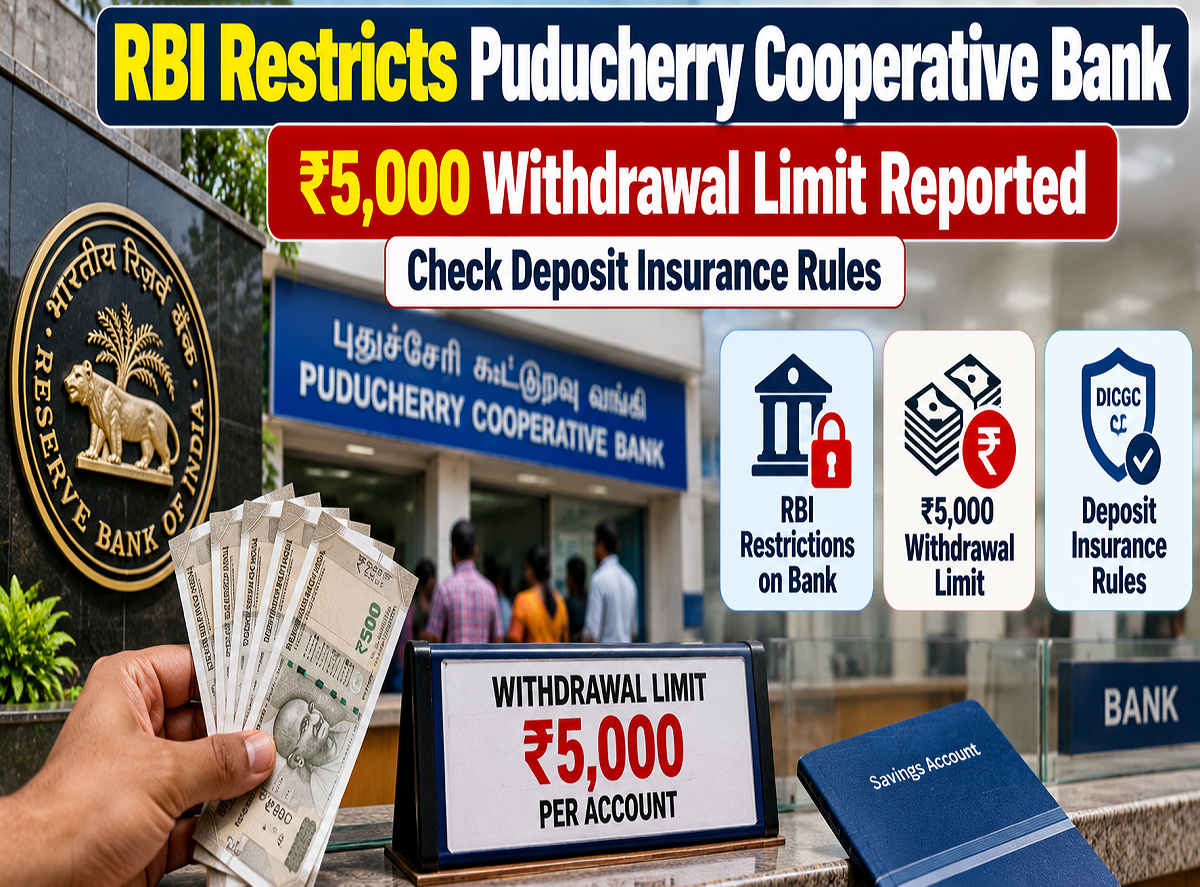
RBI Bank Restrictions 2026: Customers of Puducherry Cooperative Bank are facing uncertainty after reports that the Reserve Bank of India (RBI) has imposed restrictions on the bank's operations because of concerns over its financial position.
According to a report dated October 22, 2026, the banking regulator has restricted deposit withdrawals to ₹5,000 and placed limits on several other banking activities.
The restrictions reportedly came into effect on October 21, 2026, for an initial period of six months, subject to regulatory review.
The reported decision is intended to protect depositors' interests while preventing further deterioration in the bank's financial condition.
Customers should understand that such restrictions can affect access to funds, but they do not automatically mean that the bank has been liquidated or that all deposits have been lost.
Here is a detailed explanation of the reported RBI action, the withdrawal restrictions, prohibited banking activities, and deposit insurance protection.
RBI Restrictions on Puducherry Cooperative Bank: What Happened?
The Reserve Bank of India has reportedly issued regulatory directions to Puducherry Cooperative Bank following concerns about the institution's financial health.
According to the source report, the regulator had previously engaged with the bank's management regarding measures needed to improve its operations and address supervisory concerns.
However, the report states that the RBI considered the bank's response insufficient to resolve the identified problems and adequately protect depositors.
Consequently, restrictions were reportedly imposed under the Banking Regulation Act, 1949.
The directions are intended to limit certain transactions and activities while the bank's position remains under regulatory examination.
Importantly, such measures should not be confused with a blanket announcement that every cooperative bank in India is facing similar restrictions.
The reported action concerns the specific institution named in the regulatory directions.
Bank Withdrawal Limit: How Much Can Customers Take Out?
The most immediate concern for account holders is the reported ₹5,000 withdrawal ceiling.
According to the supplied report, customers may withdraw up to ₹5,000 from their deposit accounts, subject to the conditions specified in the RBI directions.
The restriction reportedly covers savings, current, and other deposit accounts.
However, customers should not interpret the ₹5,000 figure as a daily withdrawal allowance.
When RBI imposes withdrawal restrictions under specific banking directions, the limit may apply to the aggregate amount that a depositor can withdraw during the period covered by those directions.
The exact treatment of multiple accounts, joint accounts, and other arrangements must be determined from the official order.
Key Details of the Reported Restrictions
| Particulars | Reported Details |
|---|---|
| Bank | Puducherry Cooperative Bank |
| Regulator | Reserve Bank of India |
| Effective Date | October 21, 2026 |
| Initial Duration | Six months |
| Withdrawal Ceiling | ₹5,000, subject to official conditions |
| Reason | Concerns about financial condition and depositor protection |
| Legal Framework | Banking Regulation Act, 1949 |
| Deposit Insurance | Up to ₹5 lakh for eligible deposits, subject to DICGC rules |
| Review | Restrictions reportedly subject to periodic review |
These details are based on the supplied news report. Customers should verify the exact bank name, withdrawal conditions, and effective period in the RBI's official directions.
Which Banking Activities Have Been Restricted?
The report indicates that the RBI directions cover more than cash withdrawals.
The bank has reportedly been restricted from undertaking several activities without the regulator's permission.
These include granting or renewing loans and advances, making investments, and incurring certain liabilities.
The directions also reportedly restrict the disposal or transfer of assets.
Such measures are intended to prevent a financially stressed institution from entering into transactions that could worsen its position.
However, the exact scope of each restriction, including permitted exceptions, depends on the wording of the official RBI order.
Customers and borrowers should therefore avoid assuming that every banking activity has been completely suspended.
Can Customers Withdraw More Than ₹5,000 in an Emergency?
The supplied report does not establish a general emergency exemption allowing depositors to withdraw more than ₹5,000.
Any exception would need to be expressly permitted under the applicable regulatory directions.
Customers requiring funds for urgent expenses should contact the bank and request clarification about the official withdrawal provisions.
They should not rely on unverified assurances that larger withdrawals can be approved through informal arrangements.
The reported directions also mention that certain loan liabilities may be adjusted against deposits under prescribed conditions.
However, such adjustments are different from ordinary cash withdrawals and should not be treated as an unrestricted way to access deposits.
Why Does RBI Impose Restrictions on Cooperative Banks?
The RBI supervises regulated banking institutions to promote financial stability and protect depositors.
When a bank experiences serious financial or operational difficulties, the regulator may impose restrictions to control its activities.
These measures can be intended to preserve available resources, limit further financial exposure, and provide time for corrective action.
Possible supervisory concerns can include liquidity pressures, weaknesses in financial management, or other regulatory deficiencies.
However, the supplied report does not provide a complete financial assessment of Puducherry Cooperative Bank.
It would therefore be inappropriate to attribute the reported action to any particular financial irregularity without supporting evidence.
Does the ₹5,000 Limit Mean Depositors Will Lose Their Money?
A withdrawal restriction does not automatically mean that deposits have been written off.
It means that customers' ability to access funds is limited under the applicable regulatory directions.
The eventual outcome depends on the bank's financial position, corrective measures, and subsequent decisions by the regulator.
The RBI may review restrictions and take further action as permitted under the law.
Customers should also distinguish between a regulatory withdrawal limit and the deposit insurance framework.
These are separate mechanisms with different conditions.
DICGC Deposit Insurance: Are Deposits Protected Up to ₹5 Lakh?
The Deposit Insurance and Credit Guarantee Corporation (DICGC), a wholly owned subsidiary of the RBI, provides insurance for eligible bank deposits under the applicable legal framework.
The general insurance ceiling is ₹5 lakh per depositor per insured bank, covering principal and interest together.
Eligible deposits may include savings, current, fixed, and recurring deposits, subject to the applicable exclusions and conditions.
The ₹5 lakh limit does not apply separately to every account held by the same depositor in the same right and capacity at one insured bank.
For example, if an individual has multiple eligible accounts in the same insured bank in the same capacity, those balances are generally aggregated for insurance purposes.
How the ₹5 Lakh Insurance Limit Works
| Eligible Deposit Balance | Maximum Insurance Coverage |
|---|---|
| ₹50,000 | Up to ₹50,000 |
| ₹2,00,000 | Up to ₹2,00,000 |
| ₹4,50,000 | Up to ₹4,50,000 |
| ₹5,00,000 | Up to ₹5,00,000 |
| ₹8,00,000 | Up to ₹5,00,000 |
The examples assume the deposits are eligible, the bank is insured, and no special account-capacity rules change the calculation.
Depositors should also understand that deposit insurance does not necessarily mean they can immediately withdraw ₹5 lakh from a bank facing regulatory restrictions.
The timing and process for insurance claims depend on the legal provisions and the specific regulatory circumstances.
When Can DICGC Insurance Payments Be Made?
DICGC insurance arrangements can apply in situations specified under the relevant law, including certain cases involving restrictions on insured banks.
However, the availability of a payout depends on whether the legal requirements have been met.
Under the applicable framework for qualifying banks placed under certain restrictions, a prescribed process involving the bank, DICGC, and regulatory authorities may be triggered.
Depositors should not assume that the announcement of a withdrawal limit automatically results in an immediate insurance payment.
They should wait for official instructions concerning eligibility, documentation, and the applicable payment process.
The DICGC website provides information about deposit insurance coverage and relevant procedures.
What Should Customers of the Bank Do Now?
Customers affected by the reported restrictions should first verify the official RBI directions and the exact name of the regulated bank.
They should then confirm how the withdrawal ceiling applies to their accounts.
Account holders may consider the following steps:
- Check the official RBI notification: Verify the effective date, withdrawal limit, and permitted exceptions.
- Contact the bank: Ask for information about account access and any restrictions affecting deposits or loan repayments.
- Preserve account records: Keep updated statements, deposit receipts, passbooks, and other relevant documents.
- Verify deposit insurance eligibility: Check whether the institution and deposits are covered under the applicable DICGC framework.
- Avoid unofficial payment requests: Do not pay intermediaries claiming they can arrange early withdrawals or guaranteed insurance settlements.
- Monitor official updates: Regulatory directions may be reviewed, modified, extended, or withdrawn depending on subsequent decisions.
Customers should also avoid sharing OTPs, passwords, or banking credentials with callers claiming to represent the RBI or DICGC.
Will the Restrictions Remain for Six Months?
The report states that the restrictions have been imposed for six months beginning October 21, 2026.
However, the six-month period should not be interpreted as a guarantee that all restrictions will automatically end after that time.
Regulatory directions may be reviewed based on the bank's circumstances and the applicable legal framework.
The RBI may decide to modify, continue, or withdraw restrictions according to its assessment.
Customers should therefore rely on official announcements rather than assuming a fixed date when unrestricted withdrawals will resume.
Where Can Depositors Find Official Information?
The Reserve Bank of India publishes regulatory directions and press releases through its official website.
Customers can check the <Link url="https://www.rbi.org.in/" title="RBI website"/> for relevant notices.
Information about deposit insurance coverage and claims is available through the <Link url="https://www.dicgc.org.in/" title="DICGC official website"/>.
These sources are particularly important because inaccurate messages about bank restrictions can create confusion and unnecessary panic.
Final Word
The reported restrictions on Puducherry Cooperative Bank are a significant development for customers who depend on the institution for their savings and other banking needs.
According to the October 22 report, the RBI has imposed a ₹5,000 withdrawal ceiling and restrictions on certain banking activities for an initial six-month period beginning October 21, 2026.
Eligible deposits may receive protection under the DICGC insurance framework, subject to the prescribed conditions and limits.
However, customers should distinguish between the ₹5,000 withdrawal restriction and the separate ₹5 lakh deposit insurance ceiling. The insurance limit does not mean that every depositor can immediately withdraw ₹5 lakh.
Account holders should verify the official RBI order and follow instructions issued by the bank, regulator, and DICGC.
Disclaimer: This article is based on the supplied October 22, 2026 news report. The specific RBI directions and the bank's exact regulatory identity have not yet been independently verified. Depositors should consult official RBI and DICGC communications before taking financial decisions.