Business
Rajasthan e-Mitra Alert 2026: Follow These Important Document Safety Rules Before Visiting a Kiosk
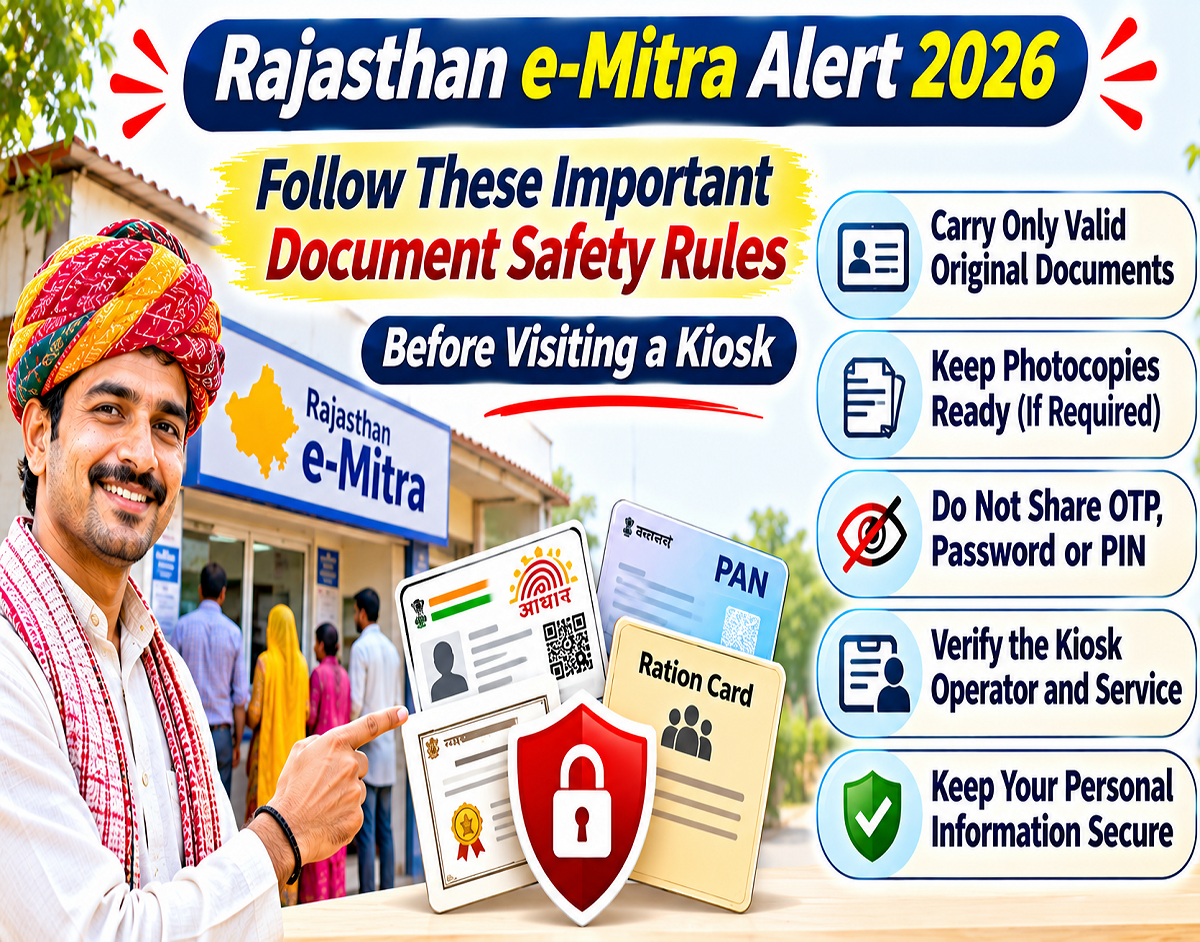
Rajasthan e-Mitra Update 2026: Citizens using e-Mitra services in Rajasthan have been advised to exercise caution while submitting personal documents at authorised kiosks. A recent citizen awareness message highlights the importance of protecting original documents, avoiding unnecessary photocopies and carefully checking transaction receipts after completing an application.
The advisory encourages residents to provide only the documents required for their selected government service and collect all original documents immediately after verification.
It also reminds applicants to review the information printed on their e-Mitra receipts to ensure that their personal details and service requests have been recorded correctly.
These simple precautions can help prevent documentation errors, reduce unnecessary exposure of personal information and make government service applications more secure.
Rajasthan e-Mitra Issues Important Document Safety Advisory
Rajasthan's e-Mitra platform provides citizens with access to a wide range of government and public services through authorised kiosks.
People regularly visit these centres for certificates, government scheme applications, identity-related services, utility payments and other administrative requirements.
Many applications require identity documents, address proof or supporting certificates.
As these records may contain sensitive personal information, citizens should handle them carefully during the application process.
The latest awareness advisory focuses on three important precautions: submit only necessary documents, retrieve originals after verification and check the receipt before leaving the kiosk.
1. Submit Only the Documents Required for Your Application
Citizens should first confirm which documents are necessary for the service they want to access.
For example, an application for a certificate may require identification, residence information or other supporting records depending on the applicable government rules.
Applicants should avoid handing over additional documents that are not required.
Providing unnecessary copies of Aadhaar, PAN, bank passbooks or other personal records can increase the risk of information being retained or misused.
Before submitting an application, ask the kiosk operator to explain the document requirements.
If an unfamiliar document is requested, applicants can seek clarification about why it is necessary.
2. Always Collect Original Documents After Verification
The advisory specifically reminds citizens not to leave original documents at the e-Mitra kiosk after verification.
Original records may be required for identity confirmation, scanning or checking information.
However, once the authorised verification process is completed, applicants should collect their documents unless a particular government procedure expressly requires their formal submission.
Before leaving, check that all original documents have been returned.
This is especially important for records such as Aadhaar cards, PAN cards, educational certificates, birth certificates and other important documents.
Losing original records can create difficulties when applying for other government services.
3. Do Not Leave Unnecessary Photocopies at the Kiosk
Citizens should also ensure that extra photocopies are not left behind after an application.
If a document copy is not required for the transaction, it should be taken back or disposed of securely.
Applicants should not assume that every copy left on a counter will automatically be destroyed.
Where document copies must be retained under official rules, citizens can ask how they will be used and stored.
This precaution can help reduce the unnecessary circulation of personal information.
4. Check the e-Mitra Receipt Before Leaving
One of the most important recommendations is to verify the details printed on the transaction receipt.
After submitting an application, citizens should carefully examine the acknowledgement provided by the kiosk.
The receipt may contain information such as the applicant's name, service description, application or transaction number, date and amount paid.
Applicants should check that the information matches their request.
If they notice an error, they should immediately inform the kiosk operator and ask about the prescribed correction procedure.
Rajasthan e-Mitra Kiosk Safety Checklist
| What to Check | Recommended Action |
|---|---|
| Required documents | Submit only documents necessary for the selected service |
| Original documents | Collect them after verification |
| Extra photocopies | Do not leave unnecessary copies behind |
| Applicant's name | Check spelling and personal details |
| Service selected | Confirm that the correct application was submitted |
| Transaction number | Preserve the acknowledgement number |
| Fees paid | Check the amount shown on the receipt |
| Receipt | Keep a copy for future reference |
Following this checklist can help applicants identify problems before leaving the service centre.
Why Is Receipt Verification Important?
An e-Mitra receipt serves as an important record of the transaction.
It can help applicants identify the service requested and may provide details needed to check application progress.
If incorrect information is entered during submission, the mistake may affect subsequent processing.
For example, an incorrectly entered name or an application submitted under the wrong service category could require additional correction steps.
Checking the receipt immediately gives applicants an opportunity to raise concerns while the transaction details are readily available.
However, the receipt should not automatically be treated as proof that the government department has approved the application.
Submission and final approval are separate stages.
How to Verify an e-Mitra Transaction Online
Citizens can use the official Rajasthan e-Mitra portal to access available transaction-related services.
Step 1: Visit https://emitra.rajasthan.gov.in.
Step 2: Look for the available transaction verification or application status facility.
Step 3: Enter the requested transaction or acknowledgement information.
Step 4: Complete any verification required by the portal.
Step 5: Review the displayed transaction details.
Step 6: Contact the authorised kiosk or concerned department if the information does not match the receipt.
The exact online options may differ depending on the service and current portal interface.
What Should You Do If a Kiosk Operator Keeps Your Documents?
If an operator retains original documents without a valid procedural requirement, citizens should ask for their return.
They should first clarify whether the particular government service requires formal submission of the original record.
If no such requirement applies, they can request the documents back after verification.
Where the matter remains unresolved, citizens can contact the relevant e-Mitra administrative authority or use an official grievance channel.
Applicants should preserve their transaction details and any supporting evidence.
Protect Aadhaar, PAN and Banking Information
Many government applications involve documents containing personal identification information.
Citizens should be particularly careful when submitting Aadhaar, PAN or banking records.
They should avoid sharing OTPs, banking passwords, UPI PINs or other confidential authentication details with unauthorised individuals.
If an application requires digital authentication, the applicant should understand the purpose of the verification and follow the official procedure.
Where accepted for the relevant service, masked Aadhaar or other privacy-preserving document options may help limit unnecessary disclosure.
Citizens should not allow unknown individuals to use their personal documents for unrelated transactions.
How to Find Official e-Mitra Information
Residents can visit the official Rajasthan e-Mitra website at emitra.rajasthan.gov.in for information about services and available online facilities.
They should use authorised kiosks and request an official receipt for transactions.
If they encounter problems involving incorrect charges, documentation or application processing, they can consult the grievance information published on the official portal.
Citizens should avoid relying on unofficial agents promising guaranteed approvals or unusually fast processing in exchange for extra payments.
Important Reminder for Rajasthan Residents
The latest e-Mitra citizen awareness advisory highlights simple but important precautions that every applicant should follow.
Submitting only the necessary documents, collecting original records after verification and checking transaction receipts can help protect personal information and reduce avoidable mistakes.
Applicants should also preserve their acknowledgement numbers and monitor the status of their applications through authorised channels.
The key takeaway: Before leaving an e-Mitra kiosk, confirm that you have received your original documents, collected unnecessary copies and checked every important detail on your receipt. A few minutes of verification can help prevent future inconvenience.
Source Credit: Rajasthan e-Mitra Citizen Awareness Advisory — Document Submission and Receipt Verification Guidelines; Department of Information Technology and Communication, Government of Rajasthan; Rajasthan e-Mitra Official Portal — https://emitra.rajasthan.gov.in.