
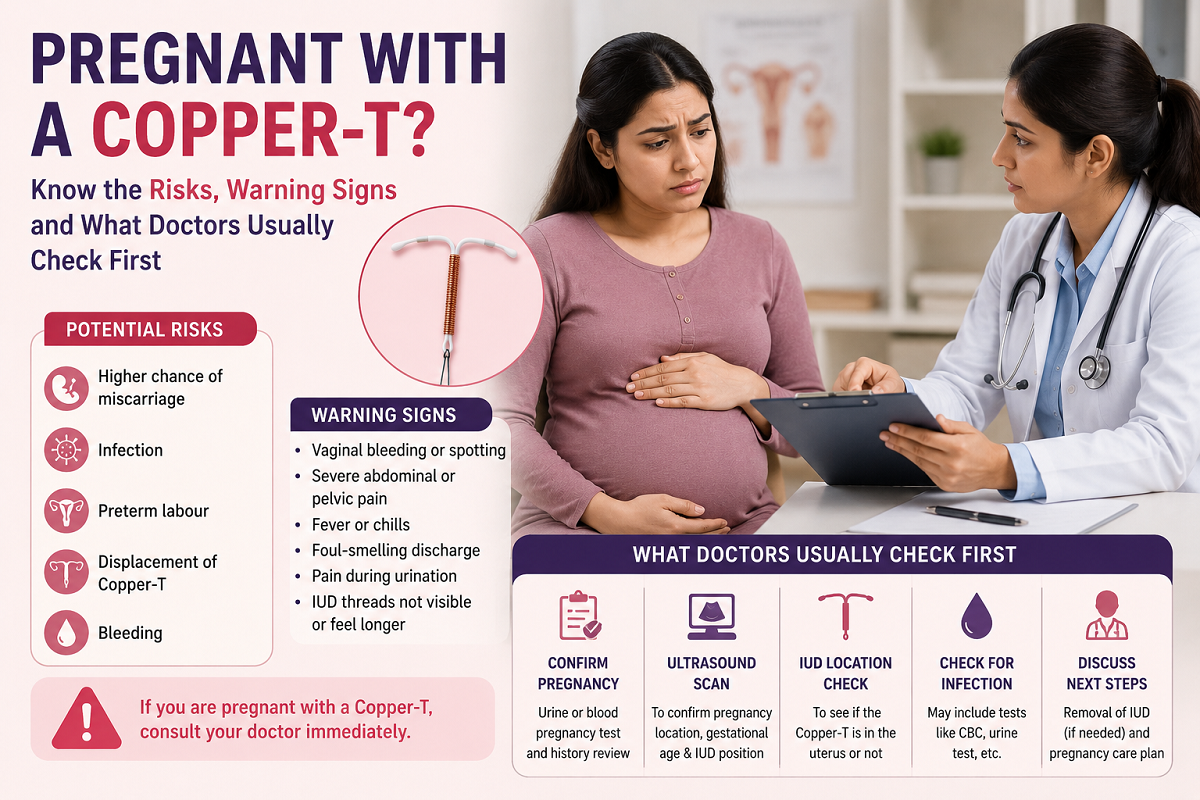
Copper-T Pregnancy Risks: Copper-T, also known as a copper intrauterine device or copper IUD, is one of the most effective long-acting reversible methods of contraception. Pregnancy while using it is uncommon, but it can still happen.
That possibility can be alarming, especially for someone who believed the device offered complete protection. The first questions are usually whether the pregnancy can continue safely, whether the Copper-T could harm the baby, and whether the device needs to be removed.
The most important step is not to panic or try to remove the device yourself. A positive pregnancy test with a Copper-T in place needs prompt medical assessment so that the location of the pregnancy and the position of the IUD can be checked.
How Effective Is Copper-T at Preventing Pregnancy?
Copper IUDs are highly effective contraceptives.
According to the CDC, the typical-use failure rate for a copper IUD is about 0.8%, meaning fewer than one pregnancy occurs per 100 users in a year.
However, no contraceptive method other than complete avoidance of intercourse is considered absolutely failure-proof.
Pregnancy may occasionally occur if an IUD is expelled without the user noticing, is positioned incorrectly, or is no longer being used within its recommended lifespan.
The duration of effectiveness can vary by product, so users should follow the schedule recommended for the specific device they have.
What Should You Do if the Pregnancy Test Is Positive?
A positive pregnancy test while a Copper-T is still in place should be evaluated by a healthcare professional promptly.
The first priority is to confirm where the pregnancy is located.
Doctors may use an ultrasound, often an early transvaginal ultrasound, together with clinical assessment and, when necessary, blood tests.
The examination can help determine whether the pregnancy is developing inside the uterus and where the IUD is positioned in relation to the pregnancy.
This information is important before deciding what to do next.
Why Do Doctors Check for Ectopic Pregnancy?
Ectopic pregnancy occurs when a fertilised egg implants outside the uterus, most commonly in a fallopian tube.
An important point is that Copper-T does not increase a woman's overall absolute risk of ectopic pregnancy. In fact, because an IUD prevents most pregnancies, the absolute risk is very low.
However, if pregnancy occurs despite an IUD being in place, the pregnancy is proportionally more likely to be ectopic than a pregnancy occurring without an IUD.
For that reason, doctors generally want to exclude ectopic pregnancy early.
Warning Signs That Need Urgent Medical Attention
Anyone who is pregnant with an IUD in place should seek urgent medical care if they experience severe or worsening abdominal or pelvic pain, especially on one side.
Heavy vaginal bleeding, fainting, severe dizziness or shoulder-tip pain can also be warning signs of internal bleeding associated with a ruptured ectopic pregnancy.
These symptoms should not be watched at home while waiting for a routine appointment.
An ectopic pregnancy cannot develop normally and requires medical treatment.
What Happens if the Pregnancy Is Inside the Uterus?
If testing confirms that the pregnancy is inside the uterus, the next question is whether the Copper-T can be safely removed.
According to CDC guidance, if the IUD strings are visible or the device can be safely retrieved from the cervical canal, removal is generally recommended for someone who wishes to continue the pregnancy.
Removing the device improves pregnancy outcomes compared with leaving it in place.
However, removal should be performed by a trained healthcare professional.
A pregnant person should never pull on the strings or attempt to remove the IUD themselves.
Is There a Miscarriage Risk When the IUD Is Removed?
Yes, there is some risk associated with removing an IUD during pregnancy.
However, leaving the device in place carries a substantially higher risk of complications.
CDC guidance notes that pregnancies continuing with an IUD retained in the uterus have increased risks of spontaneous abortion, infection and preterm delivery.
This is why clinicians generally recommend removal when it can be done safely.
The individual situation matters, including gestational age, the location of the device and whether the strings are accessible.
What if the Copper-T Strings Cannot Be Seen?
Sometimes the strings are not visible at the cervix.
In that situation, the approach can be different.
A doctor may use ultrasound to determine the location of the IUD and the pregnancy.
The device is not usually blindly or forcefully searched for inside the uterus because an invasive attempt to retrieve it could disrupt the pregnancy.
Management should therefore be individualised by an obstetrician or other qualified clinician.
If the IUD cannot be removed safely, the pregnancy usually requires closer medical monitoring because complication risks remain higher than in a pregnancy without an IUD.
Can a Copper-T Directly Cause Birth Defects?
The major concern with a retained copper IUD is not that the device is physically touching the fetus.
The pregnancy develops inside the gestational sac, while the IUD remains outside that sac within the uterus.
Available guidance focuses primarily on increased pregnancy complications such as miscarriage, infection and preterm birth when an IUD is left in place.
Current evidence does not support making a blanket claim that a retained Copper-T will directly cause congenital abnormalities.
That said, every pregnancy involving an IUD should be assessed individually.
What Complications Are More Likely if the IUD Stays in Place?
If an intrauterine pregnancy continues with an IUD still present, the risk of certain complications is higher.
These include miscarriage, serious infection and premature delivery.
There may also be risks related to premature rupture of membranes and other obstetric complications depending on the individual pregnancy.
Removing the IUD, when it can be done safely, lowers these risks but does not reduce them completely to the level seen in a pregnancy that began without an IUD.
Why Can Copper-T Fail?
Several situations can contribute to an unintended pregnancy during IUD use.
One possibility is partial or complete expulsion. In some cases, the device may come out without obvious symptoms.
Incorrect positioning can also reduce contraceptive effectiveness.
This is why people may be advised to attend follow-up care after insertion and seek medical advice if they cannot feel the strings when they previously could, notice a sudden change in string length, develop unusual pain or suspect the device has moved.
However, users should not repeatedly manipulate the strings themselves.
Does Postpartum Copper-T Need Follow-Up?
Copper IUDs can be inserted at different times, including after childbirth when clinically appropriate.
Postpartum insertion is a useful contraceptive option, but expulsion can occur, particularly after placement soon after delivery.
Follow-up may therefore be important to confirm that the device remains correctly positioned.
Anyone who suspects the device has been expelled or displaced should use medical guidance rather than assuming contraceptive protection is still intact.
Can a Pregnancy With Copper-T Still Result in a Healthy Baby?
Yes, a pregnancy that occurs with a Copper-T in place can still result in a healthy birth, especially when the pregnancy is confirmed to be intrauterine and the device is removed safely when appropriate.
However, such pregnancies should not be treated as routine without evaluation.
Early assessment gives clinicians the opportunity to rule out ectopic pregnancy, determine the position of the IUD and discuss whether removal is possible.
The risks vary from person to person, so online information cannot predict the outcome of an individual pregnancy.
The Most Important Steps After a Positive Test
If you discover that you are pregnant while using a Copper-T, contact a gynaecologist or other qualified healthcare professional as soon as practical.
Do not remove the device yourself.
Seek emergency medical attention if you develop severe abdominal pain, fainting, significant bleeding, severe dizziness or shoulder-tip pain.
Once the pregnancy location is confirmed, your clinician can explain the safest next steps based on whether the pregnancy is intrauterine, where the IUD is located and whether its strings are accessible.
The key message is that pregnancy with a Copper-T is uncommon but requires timely assessment. Early evaluation can identify potentially dangerous ectopic pregnancy and can also help reduce complications when an intrauterine pregnancy is continuing.
Disclaimer: This article is for general informational purposes only and is not a substitute for diagnosis or treatment by a qualified medical professional. Pregnancy with an IUD in place requires individual medical assessment.