
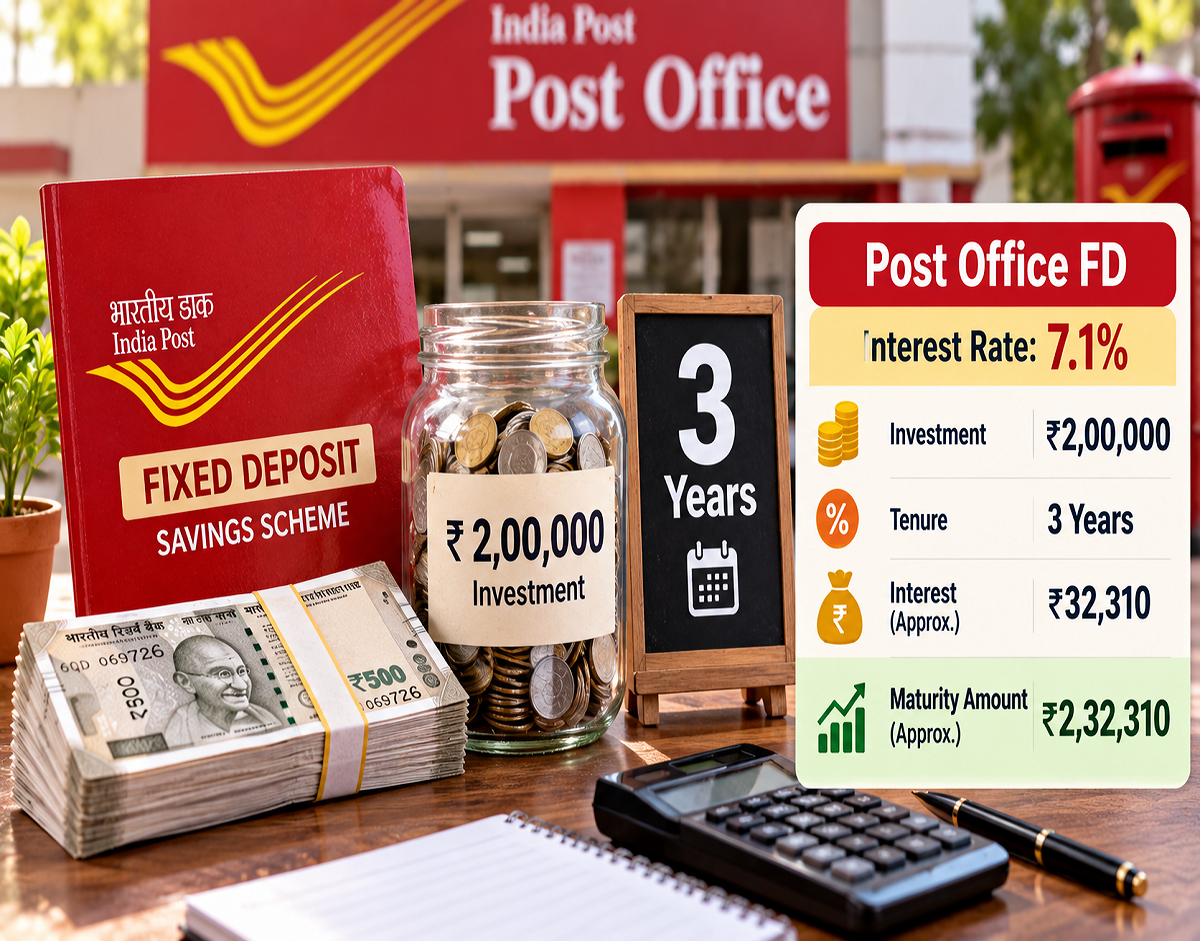
Post Office Time Deposit 2026: Investors looking for a government-backed fixed-income option can consider the Post Office Time Deposit (TD) scheme. Often referred to as the Post Office FD, the scheme allows depositors to invest a lump sum for a fixed tenure and earn interest at the rate applicable when the account is opened.
For a 3-year Post Office Time Deposit, the stated annual interest rate is 7.1%. Based on the applicable calculation, a ₹2 lakh deposit can grow to approximately ₹2.47 lakh over three years.
That means an investor could earn roughly ₹47,000 in interest during the tenure, subject to the scheme's official interest-calculation and payment rules.
What Is a Post Office Time Deposit?
A Post Office Time Deposit works broadly like a fixed deposit.
You invest a lump sum for a predetermined period, and the applicable interest rate is fixed according to the rate available for that tenure when the account is opened.
Unlike a regular savings account, the money is intended to remain invested for a defined period.
The Post Office currently offers Time Deposit accounts across four standard tenures—1 year, 2 years, 3 years and 5 years.
This allows investors to select a maturity period according to their financial requirements.
Post Office FD Interest Rates
The interest rate varies according to the selected tenure.
Based on the rates cited for the current period, the structure is:
| Post Office TD Tenure | Annual Interest Rate |
|---|---|
| 1 Year | 6.9% |
| 2 Years | 7.0% |
| 3 Years | 7.1% |
| 5 Years | 7.5% |
Among these options, the 5-year Time Deposit offers the highest stated rate at 7.5%, while the 3-year account carries a 7.1% annual rate.
Small-savings rates are reviewed periodically by the government. However, once a Time Deposit is opened, the applicable rate for that deposit is determined according to the scheme rules in force at the time of investment.
₹2 Lakh Investment: How Much Can You Get After 3 Years?
Suppose an investor places ₹2 lakh into a 3-year Post Office Time Deposit when the applicable annual interest rate is 7.1%.
Based on the stated calculation, the investment could generate approximately ₹47,015 in interest during the three-year period.
The overall calculation would look like this:
| Particular | Amount |
|---|---|
| Initial Investment | ₹2,00,000 |
| Tenure | 3 Years |
| Annual Interest Rate | 7.1% |
| Approx. Interest | ₹47,015 |
| Approx. Value Including Interest | ₹2,47,015 |
The figure is an illustration based on the stated rate and should not be treated as a separate guaranteed return calculation outside the official Post Office TD rules.
How Does Interest Work in Post Office TD?
The Post Office Time Deposit follows the interest-calculation method prescribed under the National Savings Time Deposit scheme.
Interest is calculated according to the scheme rules, with quarterly compounding used for calculation purposes and interest payable annually.
This distinction matters because simply multiplying ₹2 lakh by 7.1% and then by three years will not necessarily produce the same result as the official scheme calculation.
Investors should therefore use the official Post Office calculation method when determining the precise amount applicable to their deposit.
Why Is the 3-Year Option Popular?
A three-year deposit provides a middle ground between very short and longer fixed-income commitments.
An investor does not have to lock the money for five years, while still getting a fixed rate for a reasonably long period.
It can be useful for someone saving toward a financial goal that is approximately three years away.
However, whether a 3-year deposit is appropriate depends on when the investor expects to need the money.
Minimum Investment Is Affordable
A Post Office Time Deposit can be opened with a relatively small amount.
The minimum investment is ₹1,000, and additional investment can generally be made in prescribed multiples.
There is no maximum investment limit under the scheme itself.
This means the same account type can be used by someone investing a few thousand rupees as well as someone depositing several lakh rupees.
Tax implications, however, can become more significant as the investment amount increases.
Is Post Office FD Government-Backed?
One reason Post Office savings schemes remain popular is their government backing.
The Post Office Time Deposit is part of the government's small-savings framework.
For investors primarily concerned with capital safety and predictable interest rather than market-linked growth, this characteristic can be important.
However, safety does not mean the investment is automatically the best choice for every financial objective.
Inflation and taxation can reduce the effective return received by the investor.
Post Office TD vs Bank FD
Post Office Time Deposits and bank fixed deposits both allow investors to place a lump sum for a fixed period, but their structures are different.
Banks can offer a wide range of tenures—from a few days to several years—and their interest rates vary from one institution to another.
Post Office TDs have four standard maturity periods: one, two, three and five years.
Bank FDs can also provide special rates for certain customer categories, including senior citizens, while Post Office schemes follow their own prescribed rate structure.
Investors comparing the two should look beyond the headline interest rate and consider tenure, premature-withdrawal rules, interest payout structure and taxation.
Can You Withdraw a Post Office TD Before Maturity?
Premature closure is allowed subject to prescribed conditions.
A Time Deposit generally cannot be withdrawn immediately after opening. Under the applicable framework, premature closure is permitted only after the minimum prescribed period has passed.
If an investor closes the account before the original maturity date, the interest payable can be recalculated according to premature-closure rules.
Therefore, someone investing ₹2 lakh for three years should not assume that the same ₹2.47 lakh approximate value will be available if the account is closed early.
Does the 3-Year Post Office FD Give Section 80C Benefit?
This is another area where investors should be careful.
The 3-year Post Office Time Deposit does not receive the same Section 80C treatment as the eligible 5-year Time Deposit.
The 5-year Post Office Time Deposit is the tenure commonly associated with the eligible tax-saving provision, subject to applicable income-tax rules and the tax regime chosen by the taxpayer.
Therefore, investors should not open a 3-year TD expecting a Section 80C deduction merely because it is a Post Office fixed-income scheme.
Is the Interest Tax-Free?
No. Post Office Time Deposit interest should not automatically be considered tax-free.
Interest income can be taxable according to the investor's applicable income-tax rules.
The actual tax impact depends on factors including the investor's total income, age, tax regime and other applicable provisions.
Consequently, the headline rate of 7.1% is a pre-tax rate, and the effective post-tax return can be lower for a taxable investor.
What Happens When the Three Years End?
Once the prescribed tenure is completed, the Time Deposit reaches maturity.
The investor can then deal with the maturity proceeds according to the available Post Office options and applicable rules.
If the money is not required immediately, the investor can assess the interest rates available at that time before deciding whether to reinvest.
It is important to remember that the interest rate available three years later may be higher or lower than today's rate.
₹5 Lakh Example at the Same Rate
The ₹2 lakh example can also help illustrate how a larger deposit could behave at the same stated rate.
If the same calculation method is applied proportionately, a ₹5 lakh investment would naturally generate a larger rupee amount of interest.
However, investors should avoid assuming that every future Post Office TD will continue to offer 7.1%.
Small-savings rates are reviewed periodically, and the rate applicable to a new deposit depends on the rate notified when that account is opened.
Who May Consider a Post Office TD?
The scheme may appeal to investors who prefer predictable fixed-income returns and do not want their principal exposed to stock-market fluctuations.
It may also suit people saving toward a defined short- or medium-term goal.
At the same time, investors should maintain enough liquid money for emergencies because premature withdrawal can affect returns.
Putting all available savings into a fixed-term deposit can create liquidity problems even when the underlying investment is considered safe.
Check the Rate Before Investing
The most important step is to check the applicable interest rate on the actual date the account is opened.
The government reviews small-savings interest rates periodically.
An article mentioning 7.1% therefore reflects the rate applicable for the stated period and should not be treated as a permanent rate for all future deposits.
Investors should also check the latest premature-closure, nomination, interest-payment and taxation rules before depositing a large amount.
₹2 Lakh Could Grow to Around ₹2.47 Lakh
At the stated 7.1% annual interest rate, a ₹2 lakh investment in a 3-year Post Office Time Deposit could result in a value of approximately ₹2,47,015, including around ₹47,015 in interest under the cited calculation.
The scheme combines a fixed tenure with government backing, making it a straightforward fixed-income option for investors who prioritise predictability.
However, the 3-year TD should not be confused with the 5-year tax-saving Time Deposit. Investors should also remember that interest can be taxable and premature closure can reduce the expected return.
Before investing, check the latest Post Office interest rate and scheme conditions applicable on the account-opening date.
Disclaimer: The maturity figures in this article are illustrative and based on the stated 7.1% annual interest rate. Actual interest credit, payout and maturity proceeds are governed by the official Post Office Time Deposit rules. Small-savings rates are subject to periodic government review, and tax treatment depends on individual circumstances.



