Business
PMAY Urban 2.0: Over 18.77 Lakh Homes Approved, Check Income Limit, Eligibility and Housing Benefits
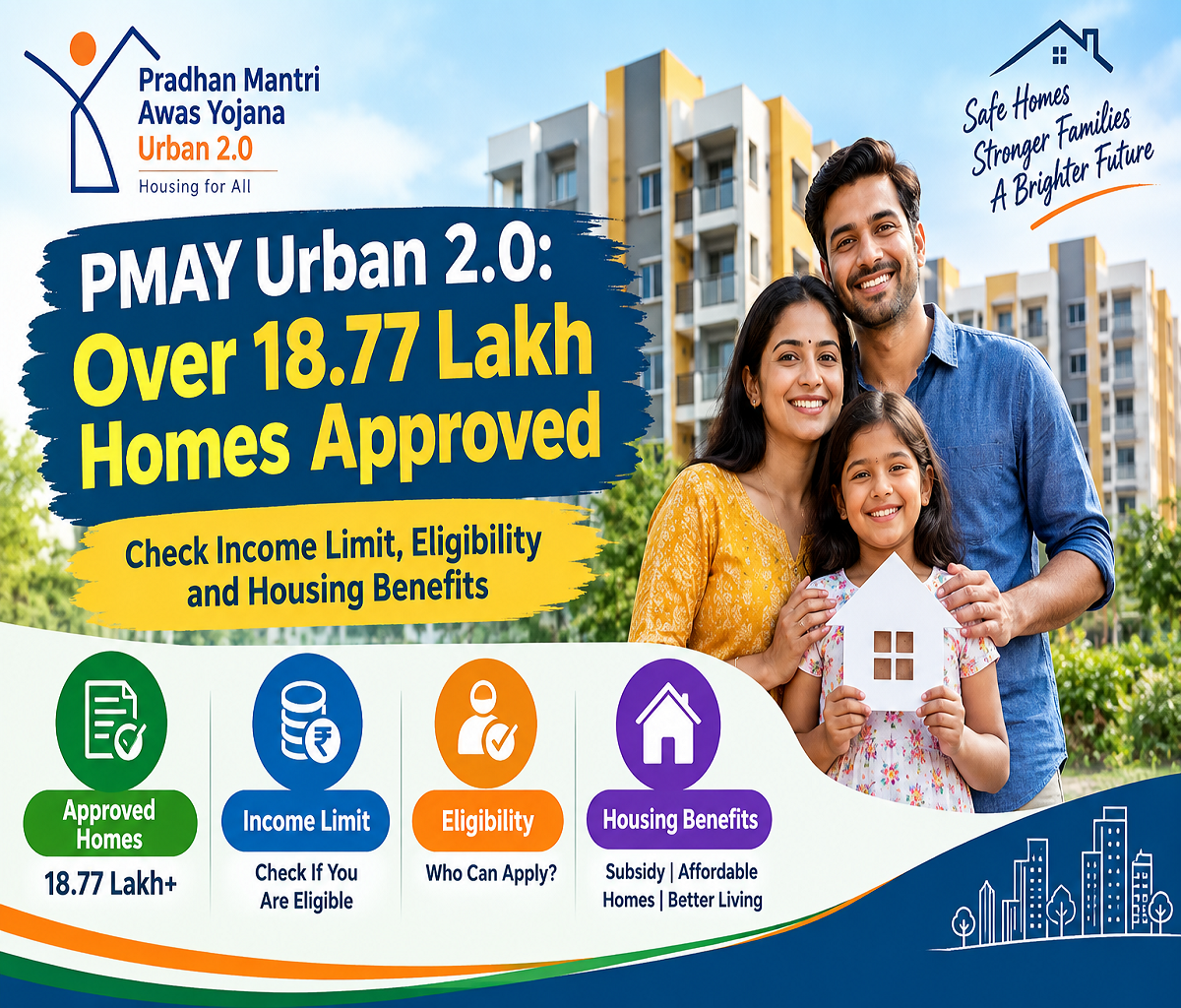
The government's flagship urban housing programme has crossed another major milestone. More than 18.77 lakh houses have been approved under Pradhan Mantri Awas Yojana-Urban 2.0 (PMAY-U 2.0), according to the latest figures cited by the Ministry of Housing and Urban Affairs.
The scheme is aimed at helping eligible families living in urban areas secure a permanent home. Depending on the applicable component, assistance can be available for constructing a house on one's own land, purchasing an affordable home, accessing affordable rental housing or receiving an interest subsidy on an eligible home loan.
Families with annual household income of up to ₹9 lakh can fall within the EWS, LIG or MIG categories covered by different components of PMAY-U 2.0, subject to the scheme's detailed eligibility requirements.
Here's what prospective beneficiaries need to know about the income criteria, housing conditions and four major components of PMAY-U 2.0.
Who Can Apply for PMAY-U 2.0?
PMAY-U 2.0 is designed for eligible urban families belonging to the Economically Weaker Section (EWS), Low Income Group (LIG) and Middle Income Group (MIG).
The applicable benefit depends on factors such as household income, housing requirement and the component under which assistance is sought.
An important eligibility condition is related to home ownership. The beneficiary family should generally not own a pucca house anywhere in India, subject to the detailed conditions prescribed under the programme.
Therefore, simply having an annual income below ₹9 lakh does not automatically guarantee assistance. Applicants must satisfy all relevant eligibility and documentation requirements.
Annual Household Income Limit Goes Up to ₹9 Lakh
The programme covers different income groups, with households earning up to ₹9 lakh annually potentially falling within the eligible categories for specified benefits.
However, the exact assistance available varies according to the applicant's income category and the PMAY-U 2.0 vertical being used.
Applicants should therefore determine their correct income category before applying rather than assuming that every family earning below ₹9 lakh will receive identical financial assistance.
PMAY-U 2.0 Offers Four Major Types of Housing Support
The programme has been structured around four verticals to address different housing requirements among urban households.
1. Beneficiary-Led Construction
The Beneficiary-Led Construction (BLC) component is intended for eligible families who have land but require financial support to construct a permanent house.
Instead of purchasing a ready-made property, qualifying beneficiaries can receive assistance toward building a pucca house on their available land, subject to scheme rules.
This option can be particularly relevant for low-income urban households that already possess suitable land but lack sufficient resources for construction.
2. Affordable Housing in Partnership
The Affordable Housing in Partnership (AHP) component focuses on affordable homes developed through approved housing projects.
Under this model, eligible beneficiaries can obtain housing through qualifying projects developed with the participation of government agencies, private developers or other approved entities, depending on the project structure.
The objective is to increase the supply of affordable housing for urban families that cannot purchase homes at regular market prices.
3. Affordable Rental Housing
Not every urban household is immediately in a position to purchase a home. PMAY-U 2.0 therefore also includes Affordable Rental Housing (ARH).
This component is aimed particularly at groups such as urban migrants, workers and economically vulnerable households that require reasonably priced rental accommodation.
Affordable rental housing can provide such families with formal housing without requiring them to immediately take on the financial burden of home ownership.
4. Interest Subsidy Scheme
The Interest Subsidy Scheme (ISS) is relevant for eligible beneficiaries planning to purchase or construct a house using a home loan.
Under this component, qualifying borrowers can receive an interest subsidy subject to the loan amount, property value, income and other conditions prescribed under PMAY-U 2.0.
The subsidy is intended to reduce the effective cost of borrowing for eligible homebuyers.
Applicants should check the detailed ISS rules before taking a loan because the entire home-loan amount does not necessarily qualify for the subsidy.
Women Account for a Large Share of Approved Homes
PMAY-U 2.0 also places significant emphasis on women's participation in home ownership.
According to the figures cited in the latest update, out of the 18.77 lakh houses sanctioned under PMAY-U 2.0, around 17.19 lakh—approximately 92%—have been allotted either solely or jointly in women's names.
The emphasis on female ownership or co-ownership is intended to strengthen women's financial and social security within beneficiary households.
Applicants should check the applicable ownership requirements when submitting their application.
How Many Homes Have Been Approved for Different Groups?
The reported sanction data also shows substantial coverage among various social and demographic groups.
Around 1.80 lakh houses have been sanctioned for senior citizens, while approximately 8.22 lakh are associated with beneficiaries from the Other Backward Classes (OBC) category.
The figures cited for Scheduled Caste beneficiaries stand at approximately 3.25 lakh houses, while Scheduled Tribe beneficiaries account for around 1.02 lakh houses.
These numbers relate to sanctioned homes and should not be interpreted as meaning that every sanctioned property has already been constructed and handed over.
More Than 1.25 Crore Homes Sanctioned Across PMAY-U
When the earlier phase of PMAY-U and PMAY-U 2.0 are considered together, the scale of the government's urban housing programme becomes considerably larger.
According to the reported government figures, more than 1.25 crore houses have been sanctioned across the programme.
Of these, over 1 crore pucca houses have reportedly been completed and delivered to beneficiaries.
The 18.77 lakh figure specifically refers to homes sanctioned under PMAY-U 2.0, while the larger 1.25 crore figure covers the broader PMAY-U programme across its phases.
What Should Applicants Check Before Applying?
Prospective beneficiaries should first confirm whether their household meets the prescribed income and home-ownership conditions.
They should also identify which of the four components—BLC, AHP, ARH or ISS—matches their housing requirement.
Income documents, Aadhaar and other identity details, bank information, property or land records where applicable, and other supporting documents may be required during verification.
Applicants should provide accurate information because eligibility is subject to verification by the authorities.
PMAY-U 2.0 Benefits Depend on Eligibility
PMAY-U 2.0 offers multiple routes to housing assistance rather than providing the same benefit to every applicant.
A family with its own land may be better suited to the Beneficiary-Led Construction component, while someone purchasing a house with a loan may qualify under the Interest Subsidy Scheme. Urban workers requiring rental accommodation could benefit through the affordable rental housing framework.
The key takeaway is that families earning up to ₹9 lakh annually may be covered under different PMAY-U 2.0 categories, but the final benefit depends on income, existing home ownership, property conditions and the specific component's eligibility rules.
With more than 18.77 lakh houses already sanctioned under PMAY-U 2.0, eligible urban families considering the programme should check the latest official guidelines and their eligibility before submitting an application.