
Business
Need ₹3 Lakh Urgently? Should You Break a ₹5 Lakh FD or Take a Loan Against It? Check the Math
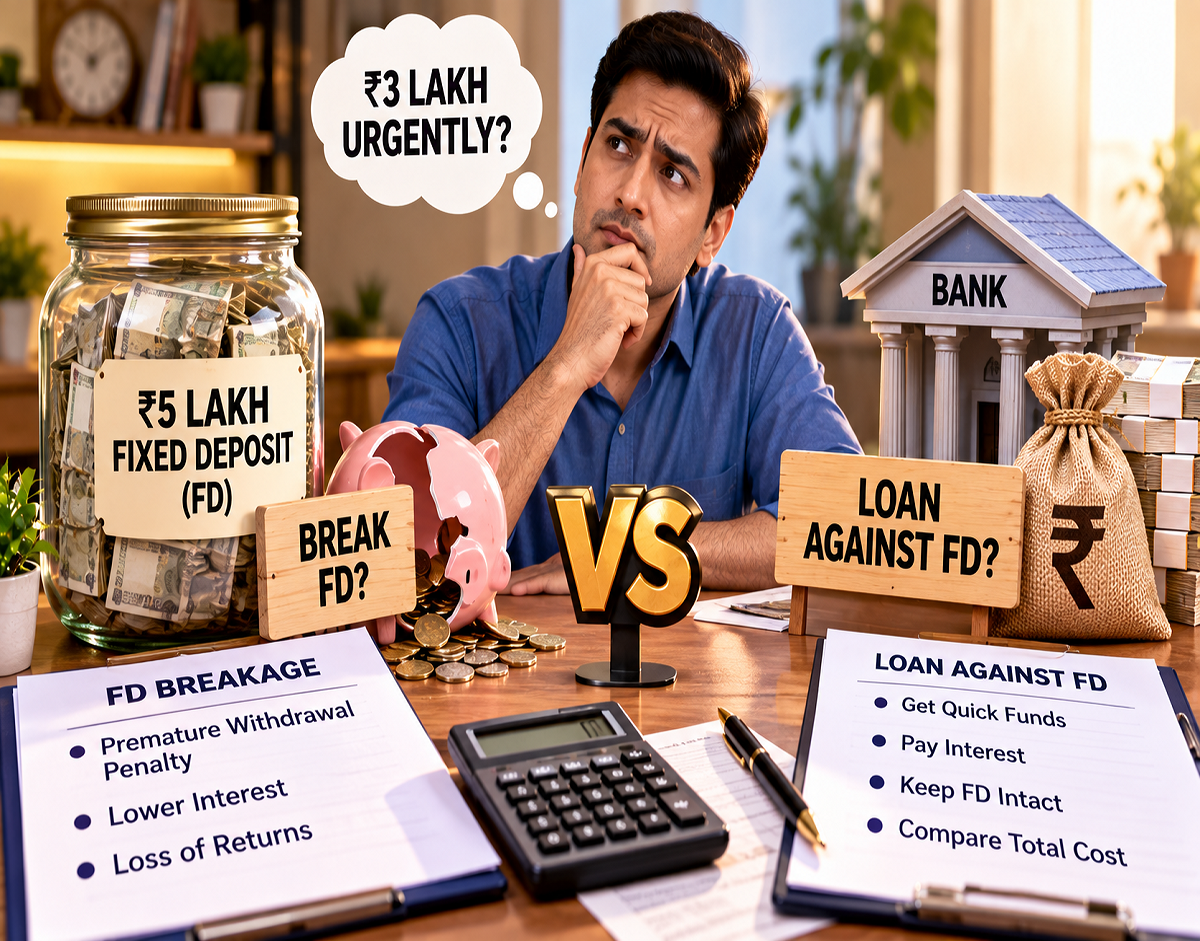
An unexpected financial requirement can force you to use savings that were originally meant for another purpose. If a large part of your money is locked in a fixed deposit (FD), one common question is whether you should close the FD early or borrow against it.
Suppose you urgently need ₹3 lakh but have ₹5 lakh invested in a one-year FD earning 7% annually.
You broadly have two choices. You could prematurely close the fixed deposit and use the money, or you could keep the FD running and take a ₹3 lakh loan against it.
Both options give you access to funds, but their financial consequences are different.
Let's understand the numbers using a six-month example.
Example: You Have a ₹5 Lakh FD at 7%
Assume you invested ₹5 lakh in a one-year fixed deposit carrying an annual interest rate of 7%.
If the FD remains invested for its full one-year tenure, a simplified calculation gives interest of approximately:
₹5,00,000 × 7% = ₹35,000
The exact maturity amount can differ depending on the bank's compounding method and deposit terms.
Now suppose an emergency occurs six months after opening the FD and you need ₹3 lakh.
What happens if you close the FD?
Option 1: Breaking the ₹5 Lakh FD After Six Months
Prematurely closing an FD does not necessarily mean that the bank will pay the original 7% interest rate for the period the deposit remained invested.
Banks generally determine the applicable rate based on the period for which the money was actually held, subject to their premature-withdrawal rules.
A penalty may also apply.
For this illustration, suppose the bank's applicable six-month FD rate is 6% and the premature-closure penalty is 1 percentage point.
The effective rate would then become:
6% − 1% = 5%
At a 5% annual rate, the simplified interest on ₹5 lakh for six months would be:
₹5,00,000 × 5% × 6/12 = ₹12,500
So you receive approximately ₹12,500 in interest for the six-month holding period under this example.
How Much Interest Do You Give Up?
Had the original one-year FD continued at 7%, the simplified full-year interest would have been around ₹35,000.
By closing it after six months under the assumptions above, the interest received would be approximately ₹12,500.
The difference between these two figures is:
₹35,000 − ₹12,500 = ₹22,500
However, this ₹22,500 should not be viewed entirely as a six-month premature-closure penalty. Part of the difference exists because the FD is being closed six months earlier, meaning it no longer remains invested for the second half of the year.
The actual cost of premature closure should therefore be evaluated using the bank's applicable rate, penalty and what you plan to do with the remaining money.
Option 2: Take a ₹3 Lakh Loan Against the FD
Now consider keeping the ₹5 lakh FD intact and borrowing ₹3 lakh against it.
Banks commonly price loans or overdrafts against FDs at a spread over the deposit's interest rate.
For this example, assume the bank charges 1.5 percentage points above the FD rate.
Your FD earns 7%, so the illustrative borrowing rate becomes:
7% + 1.5% = 8.5% annually
If ₹3 lakh remains borrowed for six months, the simplified interest cost would be:
₹3,00,000 × 8.5% × 6/12 = ₹12,750
You would therefore pay approximately ₹12,750 in interest for six months, excluding any additional charges that may apply.
The important difference is that your ₹5 lakh FD remains intact.
How Much Does the FD Earn During Those Six Months?
At the original 7% annual rate, the simplified interest earned by the ₹5 lakh FD over six months is:
₹5,00,000 × 7% × 6/12 = ₹17,500
So while you incur an illustrative ₹12,750 borrowing cost, the underlying FD continues earning interest.
Again, actual FD interest depends on the bank's compounding frequency and product conditions.
Breaking the FD vs Loan Against FD: ₹5 Lakh Example
| Particulars | Break the FD | Loan Against FD |
|---|---|---|
| Amount needed | ₹3 lakh | ₹3 lakh |
| Original FD | ₹5 lakh | ₹5 lakh |
| FD status | Prematurely closed | Continues |
| Illustrative FD rate | Effective 5% for six months | 7% continues |
| Approx. six-month FD interest | ₹12,500 | ₹17,500 |
| Loan amount | None | ₹3 lakh |
| Illustrative loan rate | — | 8.5% |
| Approx. six-month loan interest | — | ₹12,750 |
| After six months | Original FD no longer exists | FD remains active |
| Repayment obligation | None | ₹3 lakh principal plus applicable interest |
The example illustrates the trade-off clearly.
Breaking the FD avoids taking on debt, but you may receive a lower interest rate because of premature closure and lose the opportunity for the original deposit to continue earning.
Borrowing against the FD keeps the investment alive but creates a debt that must be repaid.
Is a Loan Against FD Always Cheaper?
No.
A loan against an FD can be useful in certain short-term situations, but it should not automatically be considered the cheaper option.
The calculation depends on several variables, including the original FD rate, applicable premature-withdrawal rate, penalty, loan rate, borrowing period, processing charges and taxes.
Most importantly, you need a realistic plan to repay the borrowed amount.
If ₹3 lakh is needed for only a few months and you expect a reliable inflow of money shortly, borrowing against the FD could allow you to handle the temporary cash requirement without disturbing your deposit.
If the borrowing continues much longer than expected, however, interest costs can keep accumulating.
When Can a Loan Against FD Make Sense?
A loan or overdraft against an FD may be worth evaluating when the financial requirement is temporary.
For example, suppose you need ₹3 lakh today but expect to receive a bonus, maturity proceeds, business payment or another dependable inflow within six months.
Instead of closing the FD, you could potentially borrow against it and repay the amount when the expected money arrives.
This preserves the original deposit and can prevent the lower interest rate or penalty associated with premature closure.
But the expected repayment source should be reasonably certain.
When Could Breaking the FD Be More Practical?
Premature closure may deserve consideration when the money is needed permanently or for an uncertain period.
Suppose you borrow ₹3 lakh against your FD but cannot repay it for several years. In that situation, the accumulated borrowing cost could make preserving the FD less attractive.
Similarly, if the bank charges a high spread over the FD rate or additional fees, the loan option could become more expensive.
Breaking the FD also has one straightforward advantage: once you use your own money, there is no outstanding loan principal to repay.
The right comparison therefore depends on the purpose and expected duration of the cash requirement.
Check These Numbers Before Making the Decision
Before breaking an FD, ask the bank how much money you would actually receive if the deposit were closed today. This calculation should reflect the interest rate applicable for the completed tenure and any premature-withdrawal penalty.
Next, check the exact interest rate on a loan or overdraft against the FD and whether there are processing fees or other charges.
Finally, estimate how long you realistically expect to keep the loan outstanding.
A loan that looks inexpensive for three or six months may become considerably more expensive if repayment is delayed.
The Repayment Period Can Decide the Outcome
In the example above, a ₹3 lakh loan against the ₹5 lakh FD is being considered for only six months.
That short borrowing period is important.
If you know that money will become available soon and can repay the loan on schedule, retaining the FD may be worth considering.
But if you do not know when you will be able to repay the ₹3 lakh, preserving the FD at all costs may not make financial sense.
Instead of focusing only on the interest earned by the FD, compare the total borrowing cost against the actual cost of prematurely closing the deposit.
That calculation will provide a much clearer picture of which option better suits your situation.
Disclaimer: The calculations above are simplified illustrations based on assumed interest rates and penalties. Actual FD interest, premature-withdrawal rules, loan rates, compounding, taxes and other charges differ across banks and products. This article is for general information only and does not constitute financial advice. Check the applicable terms with your bank and consider professional advice before making a borrowing or investment decision.



