
Business
Missed Your RD Installment? Check Bank Penalty, Grace Rules and When Your Account Could Be Closed
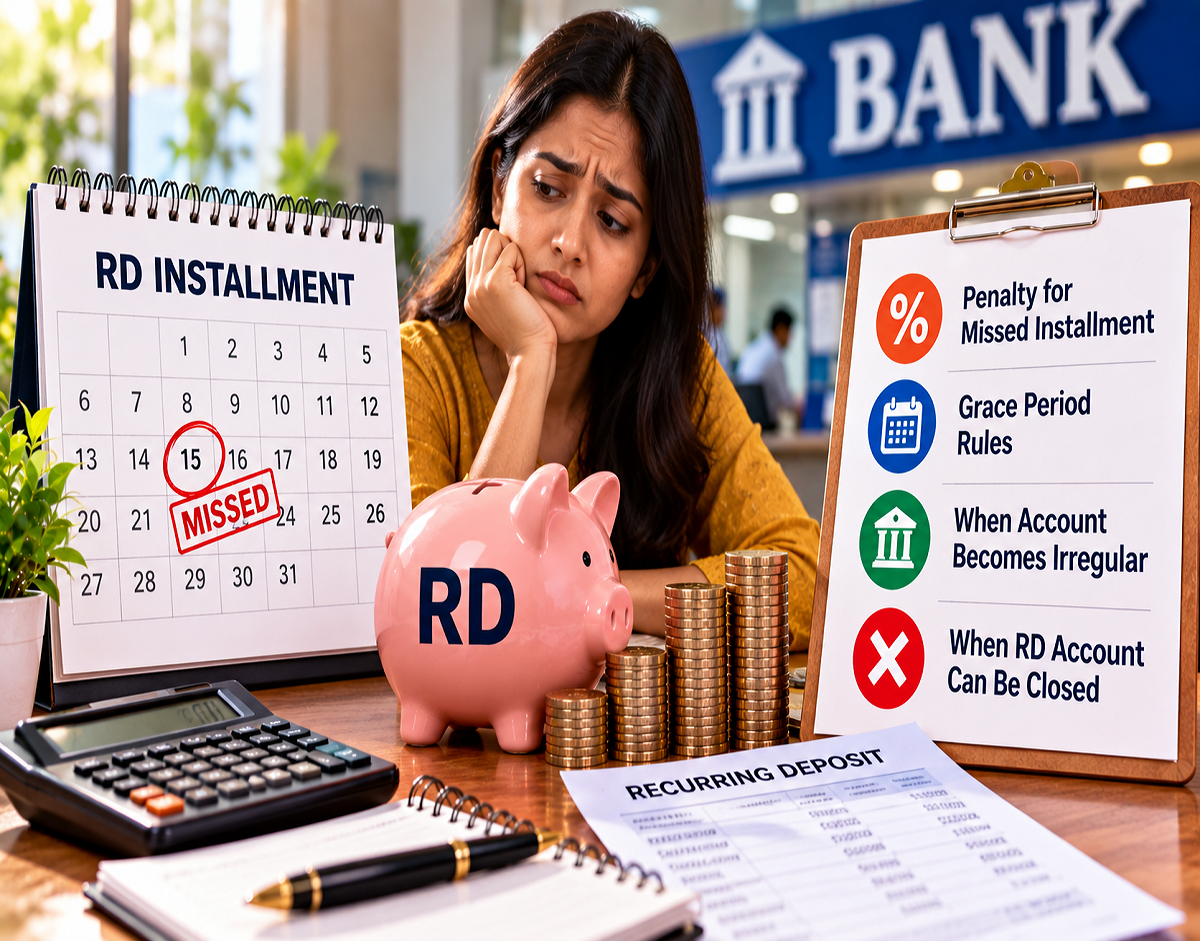
Recurring Deposits (RDs) are commonly used by people who want to build savings through fixed monthly contributions. Instead of investing a large amount at once, an RD allows you to deposit a predetermined sum every month and earn interest according to the terms offered by the bank or post office.
But what happens if you forget to pay an installment?
Missing one monthly RD payment generally does not mean that your account will immediately be closed. Banks may allow customers to clear the overdue installment, although a penalty can apply.
The situation can become more serious when several installments remain unpaid. Depending on the bank and the particular RD scheme, the account may become irregular and could eventually be prematurely closed.
Here is how missed RD installments can affect your savings.
First, Understand How an RD Works
A Recurring Deposit requires you to deposit a fixed amount at regular intervals, generally every month, for a predetermined tenure.
For example, suppose you start a two-year RD and agree to deposit ₹5,000 every month.
Over 24 months, your total contribution would be:
₹5,000 × 24 = ₹1,20,000
The bank pays interest according to the rate and compounding terms applicable to the RD. At maturity, you receive your accumulated deposits along with the applicable interest.
The arrangement works smoothly when installments are paid on schedule. Missing payments, however, can trigger penalties or other consequences.
What Happens If You Miss One RD Installment?
One missed installment usually does not result in immediate closure of the RD.
Banks generally provide customers with an opportunity to pay the overdue amount and bring the account back into regular status.
However, the customer may have to pay a penalty for the delay.
The exact penalty varies depending on the bank, deposit amount, tenure and RD scheme. Customers should therefore check the specific terms of their account rather than assuming that all banks follow the same rule.
How Much Penalty Could You Pay?
According to BankBazaar CEO Adhil Shetty, government and private banks may levy a penalty of around ₹1.50 for every ₹100 of the monthly installment in some cases.
Consider an RD with a monthly installment of ₹10,000.
Using that illustrative penalty:
₹10,000 ÷ ₹100 = 100
100 × ₹1.50 = ₹150
So, missing one ₹10,000 installment could result in an illustrative penalty of approximately ₹150.
The depositor may then have to pay the overdue ₹10,000 installment along with the applicable penalty to regularise the RD.
This ₹150 figure is only an example. Actual penalties are determined by individual banks and RD products.
Can You Pay a Missed RD Installment Later?
In many cases, yes.
If the bank's permitted period has not expired, the customer may be allowed to clear the missed installment along with the applicable late-payment charges.
For example, if one or more monthly payments were missed because of insufficient balance in the linked savings account, the depositor may be able to pay the outstanding installments and applicable penalties later.
Once the dues are cleared according to the bank's rules, the RD may return to regular status.
However, customers should not assume that overdue installments can remain unpaid indefinitely.
What If You Miss Several Installments?
Repeatedly missing payments can have more serious consequences.
According to the expert cited in the source, some banks may provide an opportunity to regularise an RD even after approximately five or six consecutive installments have been missed.
The depositor may have to clear all outstanding installments as well as the applicable penalties during the permitted period.
But the exact number of missed installments allowed before further action is taken can vary significantly between banks and schemes.
This makes it important to read the RD's terms and conditions or contact the bank directly if several installments have been missed.
Can an RD Be Closed After Six Missed Payments?
Potentially, depending on the bank's rules.
The expert cited in the source notes that if installments remain unpaid for around six months, an RD may become eligible for premature closure under some banks' policies.
Once the account is closed, the customer may no longer be able to continue making monthly deposits under the original RD.
Depending on the applicable rules, the accumulated balance could then be transferred to the linked savings account.
This should not be treated as a universal six-month rule because individual banks can have different conditions.
Can You Reactivate an Irregular RD?
An RD may potentially be regularised if the bank has not already closed it and the permitted period for clearing overdue installments remains open.
Typically, this would involve paying the pending installments together with any applicable penalties.
For example, suppose you have missed three monthly installments of ₹5,000 each.
The overdue principal contribution would be:
₹5,000 × 3 = ₹15,000
You may then have to pay ₹15,000 plus whatever penalty is applicable under your bank's RD rules.
After the required amount is paid, the bank may restore the account to regular status, subject to the scheme's conditions.
Premature Closure Can Reduce Your Returns
The financial impact of repeated missed payments can go beyond late-payment penalties.
If an RD is prematurely closed, you may not receive the same interest that you would have earned by continuing the deposit until its scheduled maturity date.
A bank may recalculate interest based on the period for which the money actually remained deposited.
A premature-closure penalty could also apply depending on the product.
This means repeated missed installments can potentially affect both the continuation of the RD and the final return on your savings.
Why Auto-Debit Can Help
Customers who frequently forget payment dates can consider setting up an automatic debit from their savings account if their bank provides the facility.
The RD installment can then be deducted automatically on the scheduled date.
However, sufficient balance needs to be maintained in the linked account. If there is not enough money available when the debit is attempted, the installment may still fail and charges could potentially apply according to the bank's rules.
Setting a reminder a few days before the installment date can provide an additional safeguard.
What Should You Do Immediately After Missing an Installment?
If you discover that an RD installment has been missed, check the account instead of waiting until the next month's payment.
Find out the amount of the overdue installment, applicable penalty, deadline for clearing it and the maximum number of defaults permitted under your particular scheme.
If multiple installments are outstanding, ask whether they can all be cleared together and whether the account is still eligible for regularisation.
Acting early can reduce the possibility of the RD becoming irregular or being prematurely closed.
One Missed RD Payment Usually Isn't the End of the Account
Missing one RD installment generally does not mean that all your savings are lost or that the account is immediately terminated.
In many cases, the problem can be resolved by paying the overdue installment and applicable penalty.
The greater risk arises when payments remain outstanding for several consecutive months. Depending on the bank's policy, the RD could eventually be prematurely closed, which may affect the interest earned and the expected maturity amount.
Therefore, anyone who has missed an installment should check the specific terms of their RD as soon as possible rather than relying on a general penalty or six-month rule.
Disclaimer: This article is for general informational purposes only. RD penalties, default rules, interest calculations, regularisation periods and premature-closure conditions vary across banks and schemes. Check the latest terms directly with your bank or post office before making any financial decision.



