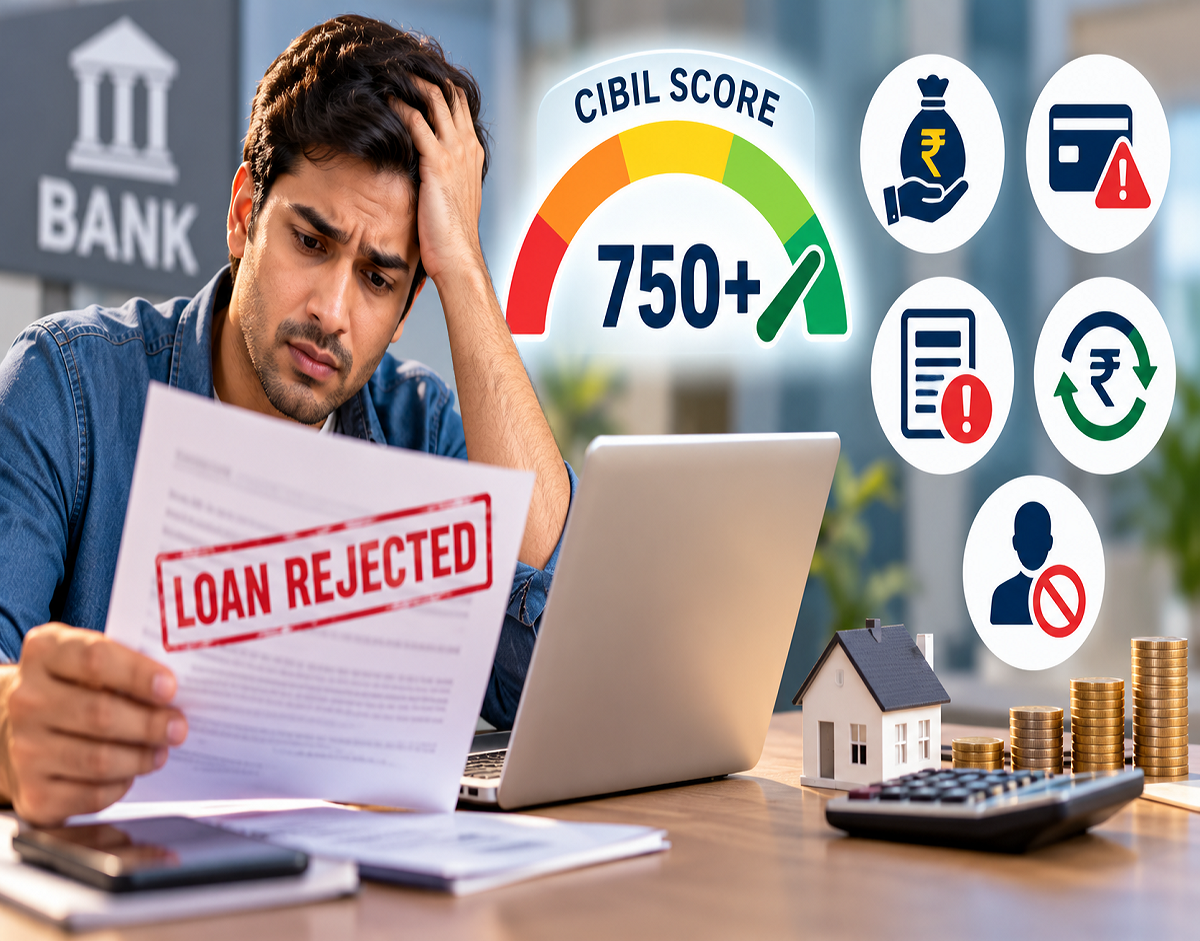
A CIBIL score above 750 is generally considered a positive sign when applying for a loan, but it does not guarantee approval. You may have repaid previous loans on time, cleared your credit card bills regularly and maintained a strong credit score, yet a bank or other lender can still turn down your application.
This is because lenders evaluate much more than the credit score displayed on your report. Your income, existing EMIs, total debt, credit card usage, recent loan applications and even errors in your credit report can influence the final decision.
Therefore, if your loan application has been rejected despite having a CIBIL score of 750 or higher, understanding the possible reasons can help you improve your chances the next time you apply.
1. Your Existing EMIs May Be Too High for Your Income
One of the first things a lender may examine is how much of your monthly income is already committed to debt repayments.
Suppose you earn ₹60,000 per month but are already paying ₹35,000 toward various EMIs. Even with a CIBIL score of 780, a lender may hesitate to approve another loan because a large portion of your income is already being used for debt servicing.
Adding another EMI could leave you with less money for household expenses and other financial commitments. From the lender's perspective, this can increase repayment risk.
Before applying for additional credit, consider reducing existing debt wherever practical. Closing a smaller outstanding loan or lowering your monthly debt obligations may improve your overall repayment profile.
2. You May Be Asking for More Than You Can Comfortably Repay
The size of the loan you request also matters.
Imagine that your monthly income is ₹70,000 and you apply for a ₹30 lakh personal loan. Even with an excellent repayment history, the lender may decide that the potential EMI is too high compared with your income.
Banks and financial institutions generally assess whether your earnings are sufficient to comfortably handle the proposed repayment obligation along with your existing expenses and debts.
Applying for an amount that is more aligned with your income and repayment capacity may strengthen your application. A lower loan amount usually means a smaller EMI, making the proposed debt easier to service.
However, every lender follows its own eligibility and underwriting criteria, so reducing the requested amount does not automatically guarantee approval.
3. Heavy Credit Card Usage Can Raise Concerns
Paying your credit card bills on time is important for maintaining a healthy credit profile, but lenders may also look at how much of your available credit you regularly use.
For example, suppose your credit card has a limit of ₹2 lakh and your outstanding spending frequently reaches around ₹1.5 lakh. Even if you pay the bill on time, consistently using a large portion of the available limit may suggest heavy dependence on credit.
This is where the credit utilisation ratio becomes relevant.
Borrowers are often advised to keep their utilisation relatively low. A commonly cited guideline is to stay below around 30% of the available credit limit where practical. However, this is a rule of thumb rather than a universal loan-approval requirement.
Reducing unnecessary card spending and avoiding repeatedly reaching close to your maximum credit limit may help present a healthier credit profile.
4. Too Many Loan Applications in a Short Period Can Hurt Your Profile
Applying to several lenders within a short period can also work against you.
If one bank rejects your application, immediately applying to several other banks may seem like the obvious solution. However, when lenders evaluate a formal credit application, they may make a hard enquiry into your credit report.
Multiple hard enquiries within a relatively short period can indicate that you are actively seeking a significant amount of new credit. Depending on the lender's assessment, this may be viewed as a sign of increased credit risk.
Instead of submitting applications everywhere, compare eligibility requirements, interest rates, loan amounts and estimated EMIs beforehand. You can then focus on lenders whose requirements more closely match your financial profile.
5. Errors in Your Credit Report Could Affect Approval
Sometimes the problem may not be your financial behaviour at all. Incorrect information in your credit report can also create difficulties.
For instance, a loan you never took could mistakenly appear on your report. An old loan that you have already repaid may continue to show an outstanding balance. Payment information or account status could also be incorrect.
Even when the overall CIBIL score remains relatively high, inaccurate account information could influence a lender's assessment.
It is therefore advisable to review your credit report before making an important loan application. Check your personal details, active credit accounts, repayment history, outstanding balances and closed loans.
If you notice an error, you can raise a dispute with the credit bureau and, where necessary, contact the concerned lender to have the information corrected.
Why a 750 CIBIL Score Alone Does Not Guarantee a Loan
A score of 750 or above can indicate a relatively strong credit history, but a credit score is only one part of the lending decision.
Banks may consider your monthly income, employment profile, existing liabilities, debt-to-income position, repayment capacity, credit utilisation and the amount and type of loan requested. Individual lenders may also have their own internal credit policies and risk-assessment models.
This explains why two people with the same CIBIL score may receive different loan decisions.
One applicant may have a stable income with very few existing liabilities, while another may already be paying several EMIs and carrying high credit card balances. Despite having similar scores, their overall financial risk profiles can be quite different.
What Should You Check Before Applying Again?
If your loan was rejected despite a good CIBIL score, avoid focusing solely on raising the score further. Review your complete financial position first.
Calculate how much of your income is already committed to EMIs, check your outstanding loans, examine your credit card utilisation and review your credit report for inaccurate information. It can also be useful to avoid making several formal loan applications within a short period.
Most importantly, apply for a loan amount and EMI that fit comfortably within your repayment capacity.
A strong CIBIL score can improve your credit profile, but it should never be treated as a guarantee of loan approval. The final decision remains with the lender and depends on its eligibility rules, underwriting standards and assessment of your overall ability to repay.
Disclaimer: This article is intended for general information and financial awareness only. Loan eligibility and approval criteria differ across lenders and borrowers. Consider reviewing the lender's official terms or seeking qualified financial advice before making borrowing or other financial decisions.