
Business
LIC Jeevan Labh: Can ₹8,000 Monthly Build a ₹25 Lakh Corpus? Check Premium, Bonus and Maturity Math
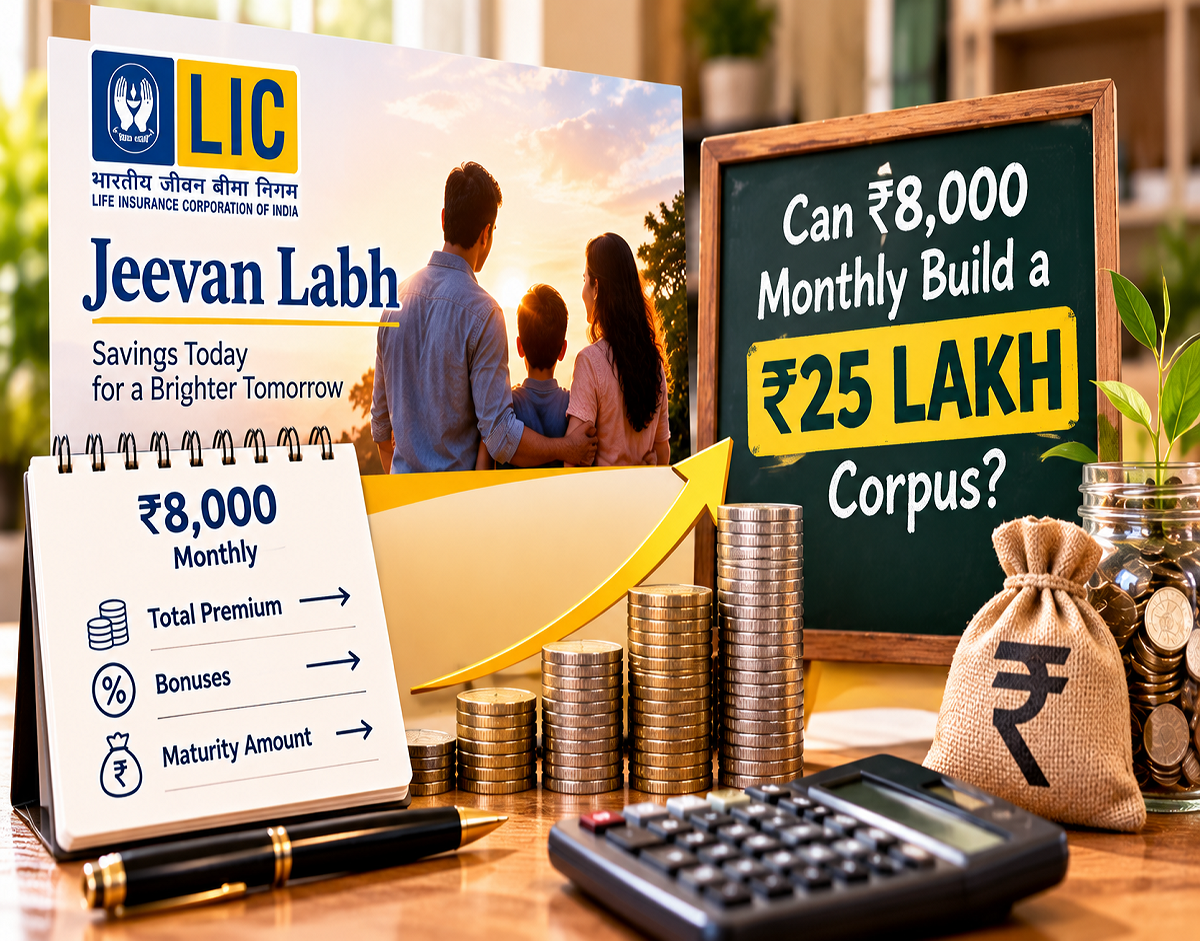
LIC Jeevan Labh Policy Calculation 2026: People looking for a combination of life insurance and long-term savings often consider traditional participating insurance plans. LIC's Jeevan Labh is one such plan, designed to provide life cover along with a maturity benefit for policyholders who complete the policy term.
An illustration cited in the supplied information suggests that a policyholder targeting a corpus of around ₹25 lakh could consider a basic sum assured of approximately ₹10 lakh, with the eventual maturity value potentially increasing through bonuses.
However, there is an important distinction: bonuses under a participating LIC policy should not automatically be treated as guaranteed. The final maturity proceeds depend on the policy terms and bonuses declared by LIC during the relevant period.
Here is how the ₹25 lakh illustration described in the source works.
What Does 'Double Bonus' Mean in an LIC Policy?
The phrase "double bonus" is commonly used to describe a situation where a participating insurance policy may receive more than one type of bonus. It does not mean LIC automatically doubles the policyholder's money.
One important component can be the Simple Reversionary Bonus (SRB).
When declared for an eligible participating policy, this bonus can accrue according to the terms of the plan. Over a long policy period, accumulated reversionary bonuses can form a significant part of the final benefit.
Another potential component is the Final Additional Bonus (FAB). This may be payable on eligible policies depending on LIC's applicable bonus declaration and the conditions attached to the policy.
Therefore, the maturity amount may consist of the applicable sum assured on maturity plus vested bonuses and any Final Additional Bonus for which the policy qualifies.
How Could the ₹25 Lakh Maturity Illustration Work?
The example provided assumes a policyholder with a ₹10 lakh basic sum assured.
Under the illustration, the final benefit is calculated as:
| Maturity Component | Illustrative Amount |
|---|---|
| Basic Sum Assured | ₹10 lakh |
| Simple Reversionary Bonus | ₹11.5 lakh |
| Final Additional Bonus | ₹3.5 lakh |
| Illustrative Total | ₹25 lakh |
Using these assumptions, the policyholder could receive around ₹25 lakh at maturity.
But the ₹11.5 lakh reversionary bonus and ₹3.5 lakh Final Additional Bonus used in this example should not be considered guaranteed future amounts unless specifically guaranteed under the policy contract.
Actual bonus rates declared over the policy term could result in a different maturity value.
How Much Premium Could Be Required?
The supplied calculation considers a person approximately 25 to 30 years old opting for a long-term policy with a premium-paying period shorter than the overall policy duration.
The illustration estimates a premium equivalent to roughly ₹250-₹260 per day, or approximately ₹7,500-₹8,000 per month.
At ₹8,000 a month, the annual outgo would be approximately:
₹8,000 × 12 = ₹96,000
If premiums were payable for 16 years at exactly ₹8,000 per month, the simple arithmetic would result in total payments of:
₹8,000 × 12 × 16 = ₹15,36,000
However, actual LIC premiums are not calculated simply by choosing a desired monthly amount. They depend on factors such as the policyholder's age, sum assured, policy term, premium-paying term, payment frequency, applicable taxes and any riders selected.
Anyone considering the policy should therefore obtain an official benefit illustration showing the actual premium and projected benefits applicable to their profile.
Life Insurance Cover Is an Important Part of the Plan
Jeevan Labh is not simply an investment account. It is fundamentally a life insurance product with a savings component.
If the insured person dies while an eligible policy remains in force, death benefits become payable to the nominee according to the policy terms.
The exact death benefit should be checked in the policy document because it may be determined by multiple conditions rather than simply being equal to the maturity amount.
Optional riders may also be available subject to eligibility and additional premium.
Are LIC Jeevan Labh Maturity Benefits Tax-Free?
The source describes the policy as offering tax benefits, but tax treatment should not be presented as automatically identical for every policyholder.
Eligible life insurance premiums may qualify for deductions under Section 80C of the Income-tax Act, subject to the prevailing tax regime, statutory conditions and overall deduction limits.
Similarly, maturity proceeds from qualifying life insurance policies may receive favourable treatment under Section 10(10D) if the policy satisfies the applicable conditions.
Tax rules have changed over time, including rules affecting the treatment of certain high-premium life insurance policies. Policyholders should therefore check the provisions applicable to the date their policy was issued and their individual circumstances.
A statement that every maturity payment is automatically and completely tax-free could be misleading without considering these conditions.
Who Can Consider LIC Jeevan Labh?
Eligibility depends on the policy version and term selected.
The source cites an entry-age range beginning from 8 years, with the maximum entry age reaching 59 years for applicable options. Exact eligibility can vary with the selected policy term and LIC's prevailing product conditions.
Prospective buyers should confirm the currently available term, entry-age requirements, sum-assured limits and premium-paying options directly from LIC before purchasing.
Documents Required to Purchase an LIC Policy
Customers generally need to complete KYC and underwriting requirements when buying a life insurance policy.
Depending on the policy and sum assured, documents may include Aadhaar or another accepted identity document, PAN, photographs, bank details, address proof and income-related documents.
Medical examinations or additional financial documentation may also be requested depending on the applicant's age, health profile, insurance amount and LIC's underwriting requirements.
Should You Choose a Policy Only for the ₹25 Lakh Maturity Figure?
A maturity illustration can help explain how a policy works, but it should not be the only factor used when purchasing life insurance.
Before buying, customers should compare the premium commitment, guaranteed benefits, non-guaranteed bonus assumptions, surrender conditions, death benefit and policy duration.
It is especially important to understand which numbers in the benefit illustration are guaranteed and which depend on future bonus declarations.
Someone whose primary objective is life protection may also want to compare the amount of life cover available for the same premium under other insurance structures. Those primarily focused on investment returns should separately assess whether the savings component fits their time horizon and financial goals.
Under the example cited here, a ₹10 lakh basic sum assured plus an illustrative ₹11.5 lakh reversionary bonus and ₹3.5 lakh Final Additional Bonus produces a ₹25 lakh maturity figure.
That calculation explains the source's ₹25 lakh claim, but it should be treated as an illustration—not a promise that every policyholder will receive exactly ₹25 lakh.
Disclaimer: Insurance benefits, premiums, bonuses and tax treatment depend on the applicable policy terms and prevailing regulations. Bonus figures used above are illustrative figures from the supplied calculation and should not be interpreted as guaranteed returns. Prospective policyholders should review LIC's official benefit illustration and policy document before purchasing.
Tighten the headline for clarityClarify the premium calculation assumptions



