Business
Kisan Vikas Patra Withdrawal Rules: Can You Take Out Your Money Before Maturity? Check KVP Rules
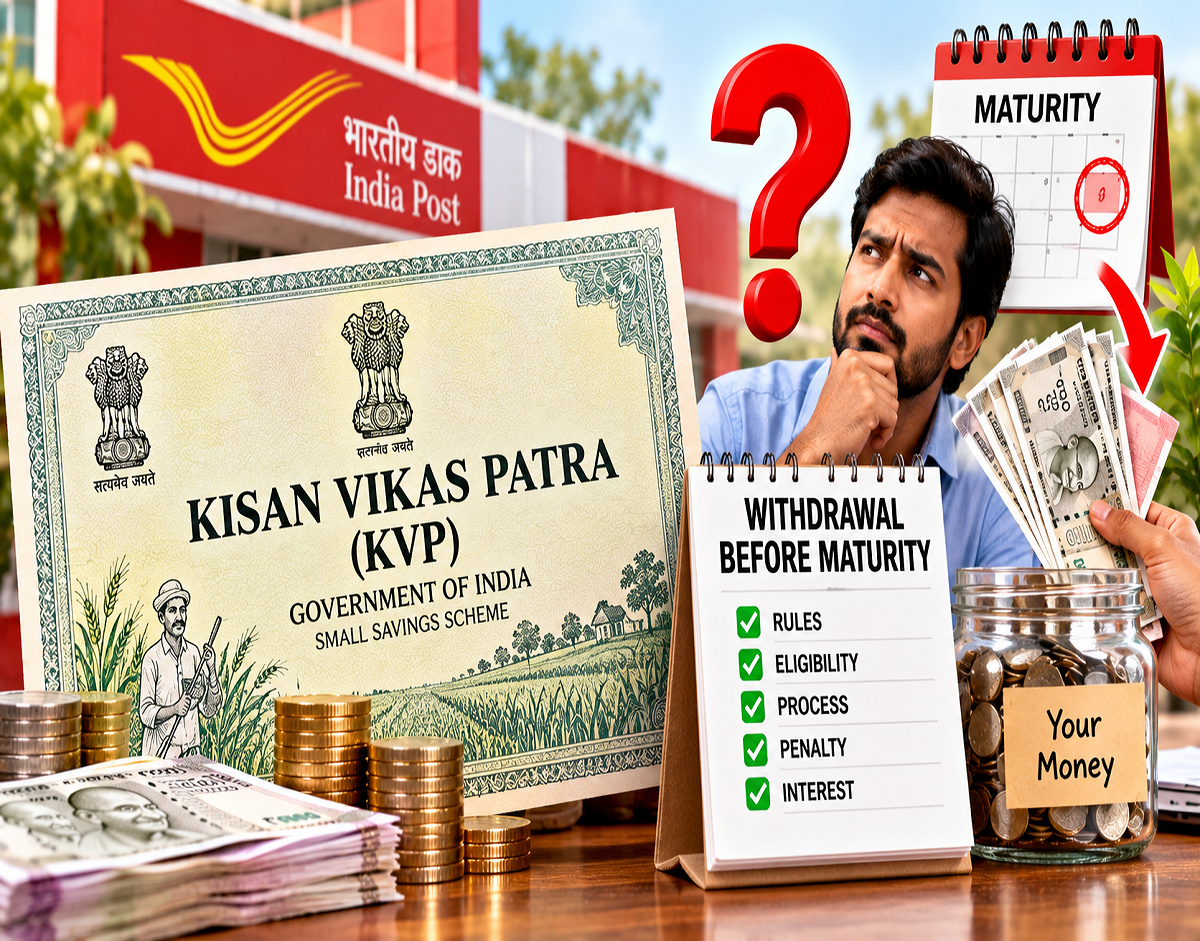
Kisan Vikas Patra (KVP) is a government-backed small savings scheme available through post offices and eligible banks. It is often considered by investors looking for a relatively straightforward long-term savings option where the invested amount grows according to a government-notified interest rate.
But what happens if an investor needs the money before KVP reaches maturity? Can the account be closed early, transferred to another person or pledged against a loan?
These questions are important because KVP comes with specific rules governing premature closure, transfer and pledging. Investors should understand these provisions before putting their savings into the scheme.
At the currently cited 7.5% annual interest rate, the KVP maturity period is 115 months, or 9 years and 7 months, during which the investment is designed to approximately double under the applicable scheme terms.
However, the interest rate and corresponding maturity period are subject to government notification, so investors should check the terms applicable when the account is opened.
How Much Can You Invest in Kisan Vikas Patra?
The minimum amount required to open a KVP account is ₹1,000.
Additional investments can be made in the prescribed multiples, and there is no specified maximum investment ceiling under the scheme.
This means an investor could potentially invest ₹10,000, ₹1 lakh, ₹5 lakh or a larger amount, subject to applicable KYC, source-of-funds and other regulatory requirements.
A KVP account can be opened individually or jointly in accordance with the scheme rules.
Can a Minor Have a KVP Account?
KVP also provides options for minors.
An adult guardian can open an account on behalf of a minor. A minor who has reached the prescribed age can also hold an account under the applicable conditions.
When the minor becomes an adult, the account records can be updated according to the required procedure.
Investors should submit the required identity and KYC documents while opening or updating the account.
Aadhaar, PAN and KYC Requirements
Identity verification is an important part of opening a government small-savings account.
Aadhaar requirements apply in accordance with the prevailing small-savings KYC rules.
PAN may also be required depending on the investment amount and applicable regulations. The supplied information states that PAN is required for investments exceeding ₹50,000.
For significantly larger investments, such as amounts above ₹10 lakh, additional documentation regarding the source of funds or income may be requested under applicable KYC and anti-money-laundering requirements.
Investors should confirm the latest documentation requirements with the post office or authorised bank at the time of investment.
Can KVP Be Withdrawn Before Maturity?
Yes, but the answer depends on when and why the investor wants to close the account.
KVP is not designed like a normal savings account where money can be withdrawn freely at any time.
There is a lock-in framework, and premature closure before the normal permissible period is generally allowed only under specified circumstances.
The scheme rules also provide for encashment after the prescribed minimum holding period, subject to the amount payable under the applicable table.
This distinction is important: special premature closure and normal encashment after the lock-in period are not exactly the same thing.
What Is the KVP Lock-In Period?
KVP generally has a 2-year-and-6-month lock-in period for ordinary premature encashment.
This means investors generally cannot simply decide to close the account during the first 30 months because they want their money back.
After completing the prescribed period, the certificate/account can generally be encashed before final maturity in accordance with the scheme's premature encashment values.
The amount payable depends on how long the investment has been held.
Therefore, investors should not assume that closing a KVP immediately after 30 months will produce the same return as holding it for the full maturity period.
When Can KVP Be Closed Before the Lock-In Ends?
Certain exceptional situations can permit premature closure even before the normal lock-in period has been completed.
These include specified circumstances such as:
- Death of a single account holder.
- Death of one or all holders in an eligible joint account.
- Forfeiture by an authorised pledgee in accordance with the applicable rules.
- Closure ordered by a court.
The exact amount payable in such cases depends on the applicable KVP rules and the period for which the account was held.
Investors or legal heirs dealing with such a situation should obtain the applicable calculation directly from the post office or authorised bank.
What Happens After 2 Years and 6 Months?
Once the investment has crossed the prescribed 2-year-and-6-month period, the account can generally be closed before final maturity under the scheme rules.
The investor receives the amount applicable for the completed holding period rather than simply receiving the full maturity value promised at the end of 115 months.
The premature encashment value is determined according to the tables and rules applicable to the certificate.
This is an important consideration for investors who may need liquidity before the full KVP tenure ends.
Can Kisan Vikas Patra Be Used to Get a Loan?
Another useful feature of KVP is that it can be pledged as security under prescribed conditions.
Instead of prematurely closing the investment when money is urgently needed, an eligible investor may be able to pledge KVP to an approved institution as collateral for a secured loan.
The process requires the prescribed documentation and acceptance by the institution receiving the KVP as security.
Who Can KVP Be Pledged To?
Subject to applicable rules, KVP can be pledged or transferred as security to specified authorities and institutions.
These can include:
- The President of India or a State Governor.
- The Reserve Bank of India.
- Scheduled banks.
- Co-operative societies and eligible co-operative banks.
- Public or private corporations and government companies where permitted.
- Local authorities.
- Eligible housing finance companies.
The investor needs to complete the prescribed process through the post office or authorised institution.
Simply possessing a KVP account does not mean a lender is automatically required to provide a loan. Loan approval remains subject to the lender's policies and eligibility assessment.
Can KVP Be Transferred to Another Person?
KVP can be transferred from one person to another, but transfers are allowed only under specified circumstances rather than as an unrestricted sale between investors.
For example, after the death of the account holder, the investment can be transferred to the nominee or legal heir in accordance with the applicable rules.
For a joint account, the investment can be transferred to the surviving holder or holders following the death of an account holder.
A transfer may also take place pursuant to a court order.
Similarly, when KVP is pledged as security, the account can be transferred to the pledgee according to the prescribed procedure.
KVP at a Glance
| Feature | KVP Rule |
|---|---|
| Minimum investment | ₹1,000 |
| Maximum investment | No specified upper limit |
| Current cited interest rate | 7.5% per annum |
| Current cited maturity period | 115 months |
| Equivalent tenure | 9 years and 7 months |
| Normal premature encashment | Generally after 2 years and 6 months |
| Earlier closure | Allowed only under specified circumstances |
| Can KVP be pledged? | Yes, subject to rules |
| Can it be transferred? | Yes, in specified circumstances |
The interest rate and maturity period should always be checked against the government notification applicable when the investment is made.
How Long Does It Take for KVP Money to Double?
At the currently cited interest rate of 7.5%, KVP has a maturity period of 115 months.
For illustration, an investment of ₹1 lakh would mature at approximately ₹2 lakh at the end of the applicable doubling period under the scheme.
Similarly, ₹5 lakh would become approximately ₹10 lakh and ₹10 lakh would become approximately ₹20 lakh on completion of the applicable maturity period.
These examples assume the terms applicable at the time of investment and full holding until maturity.
Is KVP Interest Tax-Free?
Investors should not confuse KVP with tax-exempt schemes such as PPF in terms of tax treatment.
Interest earned on KVP is generally taxable according to the investor's applicable income-tax rules.
KVP also does not generally provide the same Section 80C investment deduction that applies to certain other eligible small-savings products.
Tax rules can change, so investors should check the provisions applicable to the relevant financial year.
What Investors Should Know Before Putting Money in KVP
Kisan Vikas Patra can suit investors looking for a government-backed savings option with a predetermined maturity framework, but liquidity should be considered carefully.
The scheme's normal maturity period is currently cited as 115 months, while ordinary premature encashment is generally available only after completing the prescribed 2 years and 6 months.
Special circumstances such as the death of an account holder, a court order or forfeiture by an eligible pledgee can permit earlier closure under the scheme rules.
KVP can also be pledged as security and transferred in specified circumstances, giving investors options other than simply waiting for maturity.
Anyone considering KVP should therefore look beyond the headline promise of the investment doubling. The lock-in period, premature withdrawal value, taxation, transfer provisions and liquidity requirements should all be considered before investing.