
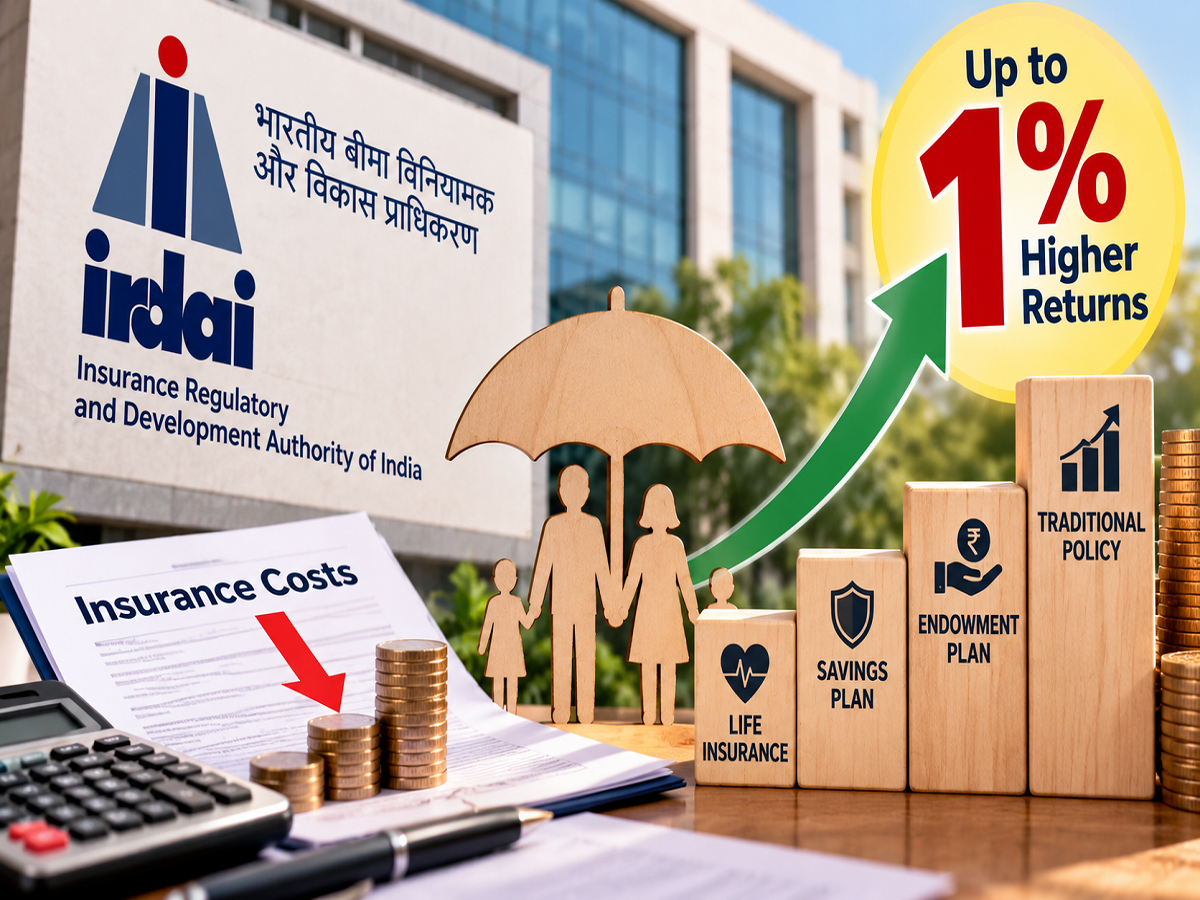
Life insurance customers could potentially see better returns from traditional savings policies if proposed distribution reforms by the Insurance Regulatory and Development Authority of India (IRDAI) are implemented. The regulator has suggested tighter limits on management expenses, distribution costs and agent commissions, which could eventually allow a larger portion of policy premiums to contribute towards customer benefits.
According to estimates cited by industry experts, the proposed changes could improve the Internal Rate of Return (IRR) of some traditional savings insurance products by around 0.50% to 1%, or 50 to 100 basis points.
However, policyholders should note an important distinction: these changes are currently part of a draft consultation proposal. They are not final rules yet, and the eventual limits could change after IRDAI reviews feedback from insurers and other industry participants.
Why IRDAI Wants to Reduce Insurance Costs
A portion of the premium collected by life insurers goes towards operating and distribution expenses. These may include management costs and commissions paid to agents and other distribution entities.
IRDAI's latest proposal seeks to gradually reduce these expenses.
If insurers are able to lower their distribution and management costs, more value could potentially flow to customers through improved maturity benefits and better effective returns on certain savings-oriented life insurance products.
The impact, however, would depend on how insurers redesign or price their products after the final regulations are issued.
Management Expense Limit Could Fall to 15% by FY29
Under the roadmap outlined in the consultation paper, IRDAI has proposed a phased reduction in the Expense of Management (EoM) ceiling for life insurance companies.
The proposed limit would be reduced to 15% by FY29. It could subsequently be tightened further to 12.5% by FY32.
This would represent another significant change in the way insurance company expenses are regulated.
In 2023, IRDAI moved towards an overall EoM ceiling rather than imposing separate caps on individual products. That framework provided insurers greater flexibility in allocating their expenses.
The latest proposal seeks to tighten the overall expense framework further.
Could Traditional Insurance Returns Rise by Up to 1%?
Traditional savings-oriented life insurance policies currently generate an IRR of around 5% to 6% annually on average, according to the estimates cited in the source material.
Industry calculations suggest that lower expenses could improve effective returns, although the benefit would differ according to the policy term, premium payment term, product design and insurer.
For certain shorter premium-payment structures, the projected improvement could reach around 80 to 100 basis points, equivalent to 0.8% to 1%.
Longer-term policies could see a smaller but still meaningful improvement of around 50 to 60 basis points, or 0.5% to 0.6%, based on the cited estimates.
These figures are projections rather than guaranteed returns.
Example 1: ₹1 Lakh Annual Premium for Five Years
Consider a 35-year-old purchasing a policy with a five-year Premium Payment Term (PPT) and a total policy duration of 10 years.
Suppose the policyholder pays an annual premium of ₹1 lakh for five years, with death cover equal to 10 times the annual premium as assumed in the illustration.
Under the existing offering cited in the example, the maturity amount would be around ₹6.5 lakh at the end of the 10th year.
If the proposed cost reductions translate into the estimated improvement in returns, the maturity amount could rise to approximately ₹7.1 lakh.
That would represent an additional maturity benefit of roughly ₹60,000.
The projected improvement in IRR for this example is approximately 0.8% to 1%.
Example 2: ₹1 Lakh Premium for 10 Years
The potential impact can also be illustrated with a longer-duration policy.
Suppose a 35-year-old pays ₹1 lakh annually for 10 years under a life insurance policy with a total term of 20 years.
Under the existing structure used in the illustration, the policy could provide a maturity value of approximately ₹22.25 lakh after 20 years.
Following the proposed reforms, the estimated maturity amount could increase to approximately ₹24.5 lakh.
That translates into a potential additional maturity benefit of about ₹2.25 lakh.
For this policy structure, the estimated IRR improvement is lower at around 50 to 60 basis points, equivalent to approximately 0.5% to 0.6%.
Again, these calculations are illustrative projections and should not be interpreted as guaranteed future policy benefits.
New Agent Commission Limits Proposed
Another important element of the consultation paper concerns first-year commissions paid to agents and other distribution entities.
IRDAI has proposed different maximum limits depending on the policy's Premium Payment Term (PPT). The suggested limits cover both linked and non-linked policies.
Under the draft framework, shorter premium-payment policies would have lower first-year commission ceilings, while policies requiring premiums for longer periods could have higher limits.
Here are the proposed caps mentioned in the draft:
| Premium Payment Term | Distribution Entity Cap | Agent Commission Cap |
|---|---|---|
| Less than 5 years | 5% | 6.25% |
| 5 years | 10% | 12.5% |
| 6–8 years | 14% | 17.5% |
| 9 years | 18% | 22.5% |
| 10 years or more | 20% | 25% |
These limits are proposed ceilings under the draft framework, not necessarily the final commission rates that will ultimately apply.
Why Lower Commission Could Benefit Policyholders
Distribution costs can form an important component of the overall expense structure of a life insurance product, particularly during the initial years.
If the amount spent on commissions and other acquisition expenses falls, insurers may have greater scope to improve policyholder benefits or product economics.
That does not mean every reduction in agent commission will automatically be passed on to customers as an identical increase in returns. The actual outcome would depend on final regulations, insurer pricing, product design and other expenses.
The estimates of a 0.5% to 1% improvement in IRR therefore represent potential outcomes calculated under certain assumptions rather than a regulator-guaranteed increase.
What Could Change for Insurance Agents?
The proposals could also affect the economics of insurance distribution.
Agents and distribution businesses have traditionally played an important role in acquiring customers, explaining products and supporting policy servicing.
Lower commission ceilings could reduce upfront earnings on some products. Insurers and distributors may therefore need to reconsider their sales structures and operating costs if the proposals become final.
The precise impact will depend on the final commission framework adopted by IRDAI.
Existing Policyholders Should Not Assume Their Returns Will Rise Immediately
Policyholders should also avoid interpreting the consultation paper as an immediate increase in the maturity value of every existing insurance policy.
Traditional insurance products can have different structures, including guaranteed and non-guaranteed benefits. Returns depend on the specific terms of the policy.
The projected improvements discussed in the consultation context relate to the possible impact of lower expenses on product economics.
Existing policyholders should continue to rely on the benefits, guarantees and conditions stated in their individual policy documents unless their insurer officially communicates a change permitted under applicable regulations.
Draft Rules Are Still Under Review
The most important point is that IRDAI's proposals have not yet reached their final form.
The consultation process allows insurance companies and other stakeholders to submit feedback. IRDAI can review those representations before issuing final regulations.
As a result, expense limits, commission ceilings, timelines or other provisions could be modified before implementation.
If the proposed framework is ultimately adopted broadly in its present form, lower distribution and management expenses could potentially improve the economics of traditional savings-oriented life insurance policies.
For customers, the key figures to watch are the proposed EoM reduction to 15% by FY29 and 12.5% by FY32, along with the new commission ceilings. The frequently cited 0.50% to 1% improvement in returns remains an industry estimate, not a guaranteed benefit announced by IRDAI.
Disclaimer: This article is for general information only. The proposed changes discussed above are based on a draft consultation framework and may be revised before final implementation. Illustrative maturity amounts and IRR improvements are estimates and do not guarantee future returns. Consumers should review official policy documents and seek qualified professional advice before making insurance or investment decisions.



