
Business
EPFO PF Withdrawal Rules 2026: How Many Times Can You Withdraw Money for Medical, Marriage, Education and Housing?
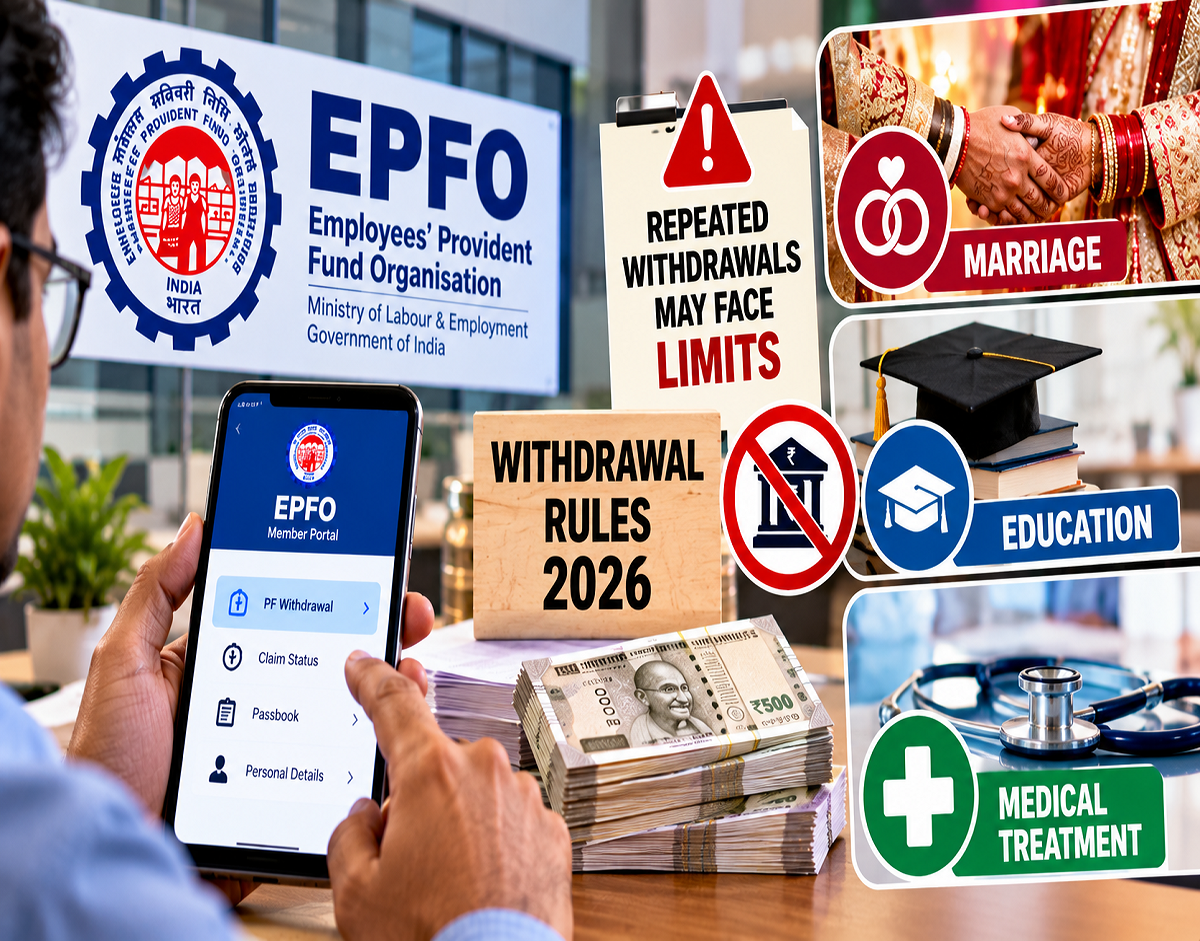
EPFO New PF Withdrawal Rules 2026: The Employees' Provident Fund Organisation (EPFO) has reportedly introduced a revised framework for partial provident fund withdrawals, clarifying how frequently members can access their retirement savings for different financial needs. According to an October 14, 2026 report, eligible employees can withdraw PF money up to 10 times for education, five times for marriage and five times for housing-related expenses during their membership period.
The report also states that medical advances do not have a fixed numerical frequency limit, while withdrawals for specified special circumstances may be permitted twice in a financial year.
Another important feature highlighted in the report is the facility to withdraw up to 75% of the eligible EPF balance after completing 12 months of membership, subject to applicable conditions.
EPFO Announces Category-Wise PF Withdrawal Limits
Provident fund savings are primarily intended to provide financial security after retirement. However, employees may face situations where they need money before reaching retirement age.
Medical emergencies, children's education, marriage expenses and housing requirements are among the reasons for which eligible EPFO members can seek partial withdrawals.
The revised framework described in the October 14 report establishes different frequency limits depending on the purpose of the withdrawal.
This means employees cannot assume that the same withdrawal rules apply to every financial requirement.
While some categories allow multiple withdrawals during the membership period, others are subject to annual limits.
Members must also satisfy the eligibility requirements applicable to their chosen withdrawal category.
EPFO PF Withdrawal Limits 2026: Complete Category-Wise Table
| Withdrawal Purpose | Reported Maximum Frequency |
|---|---|
| Medical Treatment | No Fixed Numerical Limit |
| Education Expenses | Up to 10 Times During Membership |
| Marriage Expenses | Up to 5 Times During Membership |
| House Purchase, Construction or Related Housing Needs | Up to 5 Times During Membership |
| Notified Special Circumstances | Up to 2 Times Per Financial Year |
These figures are based on the October 14, 2026 report. The applicable EPFO notification should be consulted to confirm the detailed conditions and implementation status.
Medical Emergency: How Many Times Can You Withdraw PF?
Medical emergencies can arise unexpectedly and may require immediate financial assistance.
Under the reported withdrawal framework, there is no fixed numerical limit on the number of medical advances an eligible EPFO member can request.
This means members may be able to apply more than once for qualifying medical expenses.
The facility may be useful when employees or eligible family members require hospitalization, surgery or other necessary treatment.
However, the absence of a fixed frequency limit does not mean that unlimited money can be withdrawn.
Each application must meet the relevant eligibility conditions, and the amount available will depend on the member's balance and applicable rules.
Employees should also check whether their particular medical requirement qualifies under the prescribed provisions.
Education Expenses: PF Withdrawal Allowed Up to 10 Times
Education is another major expense for many working families.
According to the reported revised framework, eligible members can withdraw money from their EPF accounts up to 10 times during their membership period for qualifying educational purposes.
This facility may help employees manage expenses associated with eligible educational requirements.
However, members should not interpret the 10-withdrawal limit as permission to withdraw any amount whenever they choose.
Each withdrawal remains subject to the applicable conditions and available balance.
The report does not provide a complete list of eligible courses, institutions or documentation requirements.
Employees should verify these details through EPFO before submitting an education-related claim.
Marriage Expenses: Maximum Five PF Withdrawals
Marriage expenses can create substantial financial commitments for families.
The reported rules allow eligible EPFO members to withdraw PF money for qualifying marriage-related expenses up to five times during their membership period.
This may include the member's own marriage or other eligible family-related marriage expenses, depending on the applicable provisions.
However, the withdrawal must satisfy the relevant conditions.
The five-withdrawal allowance is a frequency limit, not a guarantee that every application will be approved.
Members should confirm the permissible amount, required documents and eligibility requirements before applying.
It is also important to consider the effect of using retirement savings for large personal expenses.
Housing Needs: PF Withdrawal Permitted Up to Five Times
Buying or constructing a house is one of the largest financial commitments many employees make.
The revised withdrawal framework described in the report allows eligible members to access PF savings for housing-related purposes up to five times during their membership.
Qualifying purposes may include purchasing a residential property, constructing a house, repaying an eligible home loan and carrying out permitted repairs or renovations.
However, these activities may be subject to different conditions.
For example, the eligibility requirements for buying a house may not be identical to those for renovating an existing property.
The maximum amount that can be withdrawn will also depend on the applicable provision.
Employees should therefore select the correct housing category when submitting their claim.
Special Circumstances: Two Withdrawals Per Financial Year
The report also describes a separate provision for special circumstances notified under the revised EPFO framework.
Under this category, eligible members may be permitted to apply for a PF advance up to twice in a financial year.
The facility is intended to address qualifying situations covered by the applicable notification.
However, the report does not provide an exhaustive list of circumstances that qualify.
Employees should not assume that every unexpected household expense automatically falls within this category.
The relevant conditions must be checked before applying.
Can You Withdraw 75% of Your PF Balance?
One of the most significant points mentioned in the report concerns the amount members may be eligible to withdraw.
According to the reported framework, eligible members who have completed at least 12 months of membership may be able to withdraw up to 75% of their EPF balance.
The report states that the eligible balance includes employee contributions, employer contributions and accumulated interest.
However, the maximum amount available for an individual claim may still depend on the purpose of withdrawal and the applicable conditions.
A 75% ceiling should not be interpreted as an automatic right to withdraw three-fourths of the account balance for every purpose.
Members should confirm how the limit applies to their specific withdrawal category.
Example: How Much PF Money Could Be Withdrawn?
Consider an employee with an accumulated EPF balance of ₹4 lakh.
If the member qualifies for a withdrawal of up to 75% of that balance, the maximum amount under this illustrative calculation would be:
\[ ₹4,00,000 \times 75\% = ₹3,00,000 \]
The calculation can be understood through the following examples:
| Eligible EPF Balance | 75% of Balance |
|---|---|
| ₹1,00,000 | ₹75,000 |
| ₹2,00,000 | ₹1,50,000 |
| ₹3,00,000 | ₹2,25,000 |
| ₹4,00,000 | ₹3,00,000 |
| ₹5,00,000 | ₹3,75,000 |
| ₹10,00,000 | ₹7,50,000 |
These figures are mathematical examples only. The actual approved withdrawal may be lower depending on eligibility, available funds and the rules governing the claim.
Is 12 Months of EPFO Membership Enough for Every Withdrawal?
The October 14 report states that the revised framework includes a 12-month membership requirement for the reported withdrawal facility.
However, employees should not assume that completing one year of membership automatically qualifies them for every type of advance.
Different withdrawal purposes may involve additional conditions.
The applicable notification may also specify how membership duration is calculated.
Employees should check whether their previous employment service and transferred PF balances are considered when determining eligibility.
How to Apply for PF Withdrawal Online
Eligible members can generally submit PF advance applications through the EPFO Unified Member Portal.
The process involves logging in with the Universal Account Number (UAN) and password.
After accessing the account, members can navigate to the online claim section and select the appropriate withdrawal option.
They must then provide the required details, choose the relevant withdrawal purpose and complete the applicable verification process.
The portal may request additional information depending on the claim category.
Once the application is submitted, EPFO processes it according to the applicable rules.
Approval depends on eligibility and successful verification.
Important Requirements Before Applying
Employees should ensure that their UAN is active and their account details are correct.
Aadhaar information, bank account details and other required KYC records should be updated.
The bank account linked to the EPFO record should be active and capable of receiving the payment.
Members should also verify that the selected withdrawal category matches the actual purpose of the claim.
Incorrect information or incomplete records can lead to delays or rejection.
Will Frequent PF Withdrawals Reduce Retirement Savings?
Yes. Although partial withdrawals can help employees manage financial emergencies, they reduce the money available for retirement.
The withdrawn amount also stops earning future EPF interest.
For example, an employee who withdraws ₹2 lakh today will no longer earn EPF interest on that ₹2 lakh within the provident fund account.
Over a long period, the impact can be substantial because the amount would otherwise have continued accumulating interest.
Employees should therefore consider whether a withdrawal is necessary and whether other suitable financial options are available.
The availability of multiple permitted withdrawals does not mean that using all of them is financially advisable.
Are PF Withdrawals Tax-Free?
The tax treatment of provident fund withdrawals depends on the nature of the claim and the applicable income tax provisions.
Eligible partial advances may be treated differently from final PF settlements.
For final withdrawals, the period of continuous service and other conditions can be important.
Employees should not assume that every type of withdrawal is automatically exempt from tax.
They should check the applicable tax provisions before making a significant withdrawal.
What Is the Difference Between Partial PF Withdrawal and Final Settlement?
A partial PF withdrawal allows an eligible member to access part of the accumulated balance for a permitted purpose while retaining the remaining funds in the account.
A final settlement, on the other hand, involves withdrawal of the eligible accumulated balance under the applicable exit, retirement or other qualifying provisions.
The conditions for these two types of claims are different.
The frequency limits discussed in the October 14 report concern specified advance withdrawal categories.
They should not be confused with the rules governing final PF settlement.
EPFO PF Withdrawal Rules 2026: What Employees Should Remember
The revised framework described in the report introduces different withdrawal frequencies for different purposes.
Medical advances reportedly have no fixed numerical frequency limit, while education-related withdrawals may be allowed up to 10 times.
Marriage and housing-related withdrawals are reportedly limited to five times each during membership.
Special circumstances may permit up to two advances per financial year.
The report also highlights a facility involving withdrawals of up to 75% of the eligible EPF balance after 12 months of membership.
However, members must satisfy the applicable conditions for each claim.
Conclusion
The reported EPFO withdrawal framework for 2026 provides greater clarity about how often employees may access provident fund savings for important financial needs.
The category-wise limits are particularly relevant for members planning withdrawals for medical treatment, education, marriage or housing.
According to the October 14 report, the key limits are 10 withdrawals for education, five for marriage, five for housing, no fixed frequency limit for medical needs and two withdrawals per financial year for notified special circumstances.
Employees should verify the official EPFO notification before submitting a claim, especially regarding the 12-month membership condition and the reported 75% withdrawal facility.
Disclaimer: This article is based on the supplied October 14, 2026 report. The complete revised EPFO notification has not been independently verified. Actual eligibility, withdrawal amounts and frequency limits will be governed by the official rules in force.



