Withdrawing money from an Employees' Provident Fund (EPF) account has become easier with online claim facilities, but a small error in KYC, bank details or personal information can still cause a claim to be delayed or rejected.
Employees planning to submit an EPF withdrawal request should therefore check their UAN, KYC details, bank account information and employment records before filing the claim.
According to the supplied information, EPFO has also introduced several changes aimed at simplifying claim processing. These include removing the requirement to upload a cancelled cheque or attested bank passbook image in specified online claim processes and expanding auto-settlement for eligible advance claims.
Despite these improvements, incorrect information can still create problems.
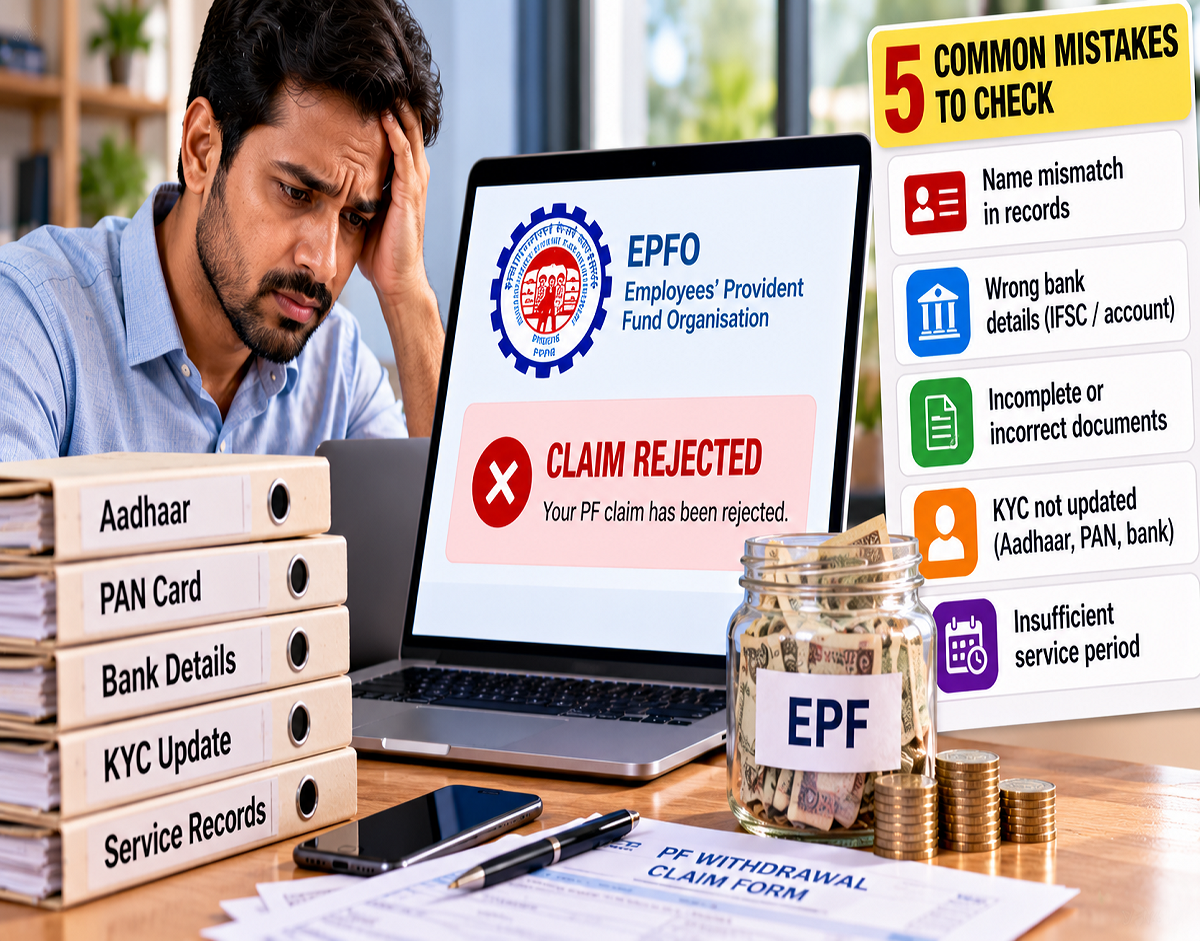
Here are five common reasons why an EPF claim may face rejection and what members can do before submitting a withdrawal request.
EPFO Has Simplified Online Claims
EPFO has made several changes to reduce paperwork associated with online claims.
According to the supplied report, from April 2025, members were no longer required to upload an image of a cancelled cheque or attested bank passbook while submitting applicable online claims.
This does not mean that bank information has become unimportant.
The bank account linked with the UAN still needs to meet the applicable verification requirements because approved EPF payments are ultimately credited to the beneficiary's bank account.
Therefore, members should verify their account number and other banking information even when a physical cheque image is not required.
EPF Advance Auto-Settlement Limit Increased
Another major change mentioned in the report came in June 2025, when EPFO increased the auto-settlement limit for eligible advance claims from ₹1 lakh to ₹5 lakh.
Eligible advance claims processed through the automated system are generally targeted for processing within around three days, according to the supplied information.
However, the ₹5 lakh limit should not be interpreted as meaning that every member can automatically withdraw ₹5 lakh.
The actual amount available depends on the reason for withdrawal, account balance, eligibility and applicable EPF rules.
More EPF Claims Are Being Processed Automatically
The supplied report cites an EPFO update from August 2026 stating that approximately 84% of Form 31 advance claims and 50% of Form 19 final PF settlement claims were being handled through auto-settlement at the national level.
Automation can make processing faster, but clean and consistent member records remain important.
Accurate KYC, properly linked identification details and correct banking information can reduce the possibility of verification problems.
Members should therefore review their information before starting a claim rather than waiting for a rejection to identify an error.
1. Incomplete or Incorrect KYC
One of the most common reasons for EPF claim problems is incomplete or inconsistent KYC.
Important information associated with the UAN, including Aadhaar and bank details, should be properly recorded and verified according to the applicable EPFO process.
If a member's name or another key detail differs across records, verification can become difficult.
For example, a spelling difference between Aadhaar and EPFO records can potentially create a mismatch.
Before submitting a claim, members should review the KYC section of their EPFO account and check whether the required information is correctly recorded.
2. Incorrect Bank Account Details
An EPF claim can also face problems when the bank account information is incorrect.
The account number and IFSC details should be carefully checked because approved claim proceeds are transferred to the bank account recorded for the member.
A single incorrect digit in an account number can create a payment problem.
Similarly, outdated bank information can become an issue if the account is closed or no longer usable.
Members should therefore make sure the account linked to their UAN is active and belongs to them as required under the applicable process.
Employer Approval Rule for Bank Linking Was Simplified
The supplied report also highlights a change introduced in April 2025.
According to the report, EPFO removed the requirement for employer approval after a bank account is linked with the UAN under the simplified process.
The bank information can proceed through the prescribed bank and NPCI verification process.
This can reduce dependence on an employer for certain bank-account verification steps.
However, it does not remove the member's responsibility to provide accurate banking information.
3. Name or Personal Details Don't Match
A mismatch in personal details can be another reason for claim difficulties.
Members should compare the information recorded in Aadhaar, PAN where applicable, and EPFO records.
The name, date of birth and other important details should be consistent wherever required.
Even relatively small differences can create verification issues in some cases.
According to the supplied information, members with an Aadhaar-verified UAN can make several eligible profile corrections themselves through available EPFO facilities.
Members should correct discrepancies before submitting a withdrawal request whenever possible.
Check Your Details Before Filing a Claim
Do not wait until the claim is rejected to compare your documents.
Before applying, check the spelling and format of your name across relevant records.
Also verify other key personal information.
If a correction is required, use the authorised EPFO process rather than submitting a claim with information that you already know is inconsistent.
Resolving the mismatch first can make the subsequent claim process smoother.
4. Employment and PF Records Don't Match
EPF claims can also be affected by inconsistencies in employment records.
Information maintained by the establishment and the details associated with the member's EPFO account need to match where required for claim processing.
According to the supplied report, EPFO's frequently asked questions identify mismatches between member details and establishment records as one possible reason for online claim rejection.
This can be particularly relevant for employees who have changed jobs multiple times.
Members should review their employment and PF records before submitting a final settlement request.
Check Date of Exit and Previous Employment Details
When an employee leaves a job, employment-related information in the EPFO system can affect certain claims.
Members should check whether their previous employment details have been recorded correctly and whether the applicable exit information is available.
If multiple PF member IDs are associated with the same UAN, the employee should also understand whether transfer or consolidation of the relevant records is required for the intended transaction.
The correct action depends on the member's employment history and the type of claim being submitted.
5. Submitting the Wrong or Incomplete Claim Information
A claim can also fail simply because incorrect or incomplete information was entered while filing it.
Members should choose the correct claim type and provide the information required for that particular request.
EPF withdrawal rules differ according to whether the member is applying for an advance, final settlement or another eligible benefit.
A person should not select an incorrect withdrawal reason merely because it appears to allow a larger amount.
The information submitted should accurately reflect the member's circumstances.
Check These Details Before Submitting Your EPF Claim
Before pressing the final submit button, review the key information in your account:
- UAN and member details
- Aadhaar/KYC status
- Bank account number
- IFSC and bank information
- Name and other personal details
- Employment and PF records
- Applicable claim type and withdrawal reason
A few minutes spent reviewing these details can help identify errors before the claim enters the processing system.
UAN Activation Through Face Authentication
EPFO has also introduced newer digital options for UAN-related services.
According to the supplied report, the upgraded system provides Aadhaar-based face authentication through the UMANG app for services such as UAN activation and generation of a new UAN.
This is intended to make identity verification more convenient and reduce dependence on manual processes.
Members should use only official EPFO and UMANG services for these tasks.
Avoid unknown applications or websites claiming that they can activate a UAN instantly in exchange for payment.
What Should You Do If Your EPF Claim Is Rejected?
A rejection does not necessarily mean that the member has permanently lost the right to claim eligible EPF money.
The first step is to check the claim status and identify the reason shown for rejection.
Once the reason is known, the member can determine what needs to be corrected.
For example, if the problem involves bank details, the banking information should be reviewed and corrected through the applicable procedure.
If there is a KYC or personal-data mismatch, the relevant information should be corrected before submitting a fresh claim.
Members should avoid repeatedly filing the same claim without fixing the underlying issue.
Can You Submit the Claim Again?
In many cases, a member can file a fresh claim after correcting the problem that caused the earlier rejection, subject to eligibility and the applicable EPFO process.
However, the solution depends on the actual rejection reason.
This is why reading the rejection message carefully is important.
If the reason is unclear or the member cannot correct the problem through the available online services, assistance may be required from EPFO.
EPFO Helpline for Claim Problems
According to the supplied report, members can contact the EPFO helpline at 14470 for assistance.
Keep relevant information available when seeking support, such as the UAN and claim-related details.
Do not share sensitive passwords or OTPs with an unknown person claiming to be an EPFO representative.
Official support should never require you to disclose your UPI PIN, ATM PIN or internet-banking password.
Beware of Fake PF Withdrawal Services
Cybercriminals may target EPFO members with messages claiming that their PF claim has been rejected or that their UAN will be blocked.
These messages may contain links to fake websites designed to collect Aadhaar, PAN, banking or login information.
Members should avoid opening suspicious links received through SMS, WhatsApp or email.
Never install an unknown APK file claiming to be an EPFO or UMANG update.
Use authorised EPFO digital channels for claims and account-related services.
Check Your EPF Details Before Withdrawing Money
EPFO's digital claim process has become more streamlined, and the expansion of auto-settlement can help eligible claims move faster.
According to the supplied report, the auto-settlement limit for eligible EPF advance claims was increased from ₹1 lakh to ₹5 lakh in June 2025, while August 2026 data cited in the report showed significant use of automated processing for Form 31 and Form 19 claims.
But automation does not eliminate the need for accurate records.
The five areas members should review are KYC, bank details, personal information, employment/PF records and the information entered in the claim itself.
If a claim is rejected, check the stated reason first, correct the underlying issue and then use the appropriate process to submit a fresh request where permitted.
Note: EPF withdrawal eligibility, documentation, auto-settlement limits and claim procedures can change. Members should check the latest applicable EPFO rules before submitting a withdrawal or settlement request.