Business
Death Certificate Rules From October 1: New Approval Process for Delayed Registration Explained
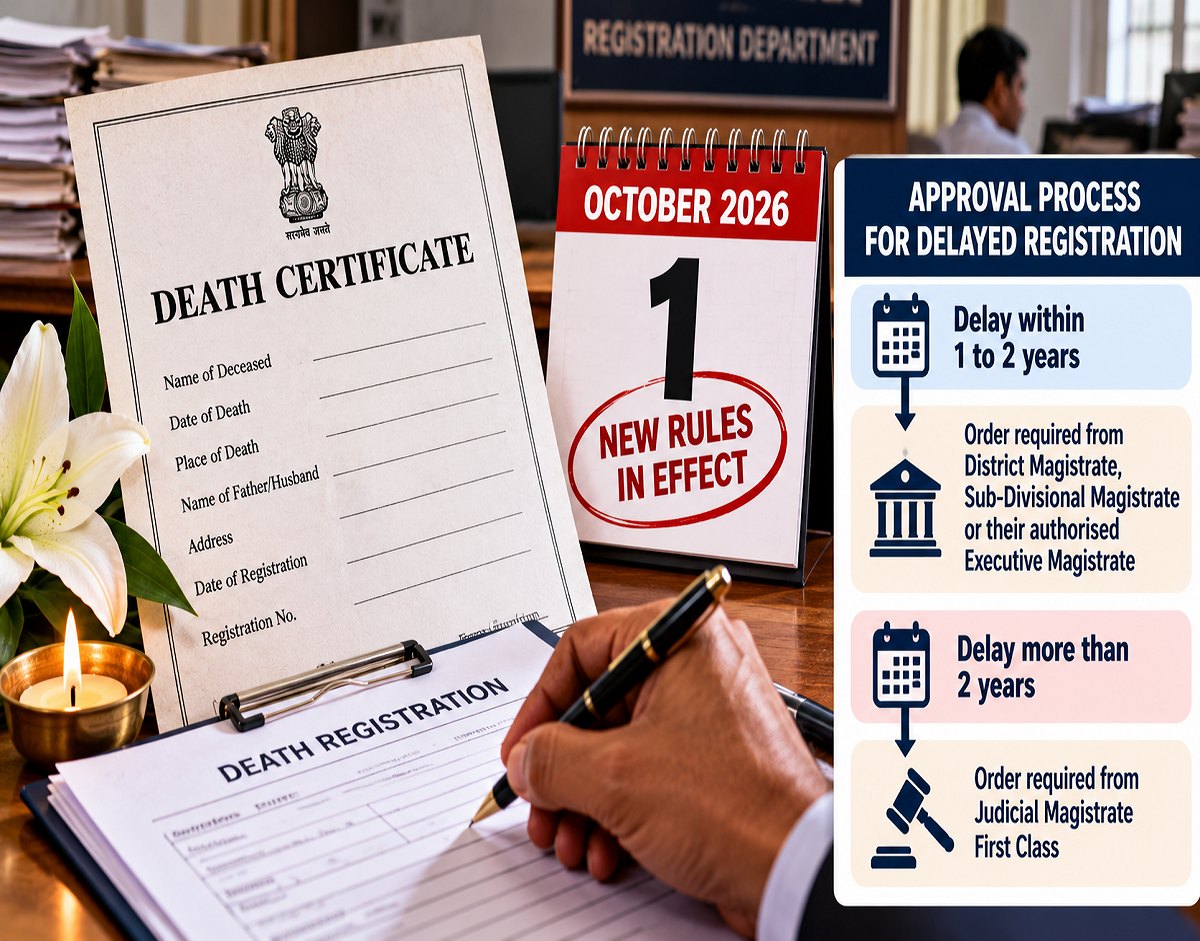
Death Certificate New Rules 2026: The process for registering a death after a long delay is becoming stricter under changes to India's birth and death registration framework. The new provisions focus particularly on cases where a birth or death has remained unregistered for more than one year.
Under the revised framework, a delay of more than one year but up to two years will require approval from the competent Executive Magistrate. If registration is sought after more than two years, approval from a Judicial Magistrate of the First Class will be required.
The change is intended to strengthen verification in very late registrations and reduce the possibility of inaccurate or fraudulent entries.
For families applying for a death certificate, it is important to understand that the new provisions primarily concern delayed registration. They should not be interpreted to mean that every death-certificate application will now require a magistrate's approval.
What Is Changing in Death Registration?
The Registration of Births and Deaths (Amendment) Bill, 2026 amended the framework governing delayed registration.
The government has said the purpose is to make delayed registration more stringent while establishing a streamlined verification mechanism.
The biggest change concerns events that were not registered within the prescribed period.
The level of approval required will now depend on how much time has passed since the death.
Delay of More Than One Year but Up to Two Years
If a death has remained unregistered for more than one year but not more than two years, registration will require the approval of the competent Executive Magistrate.
Depending on the applicable administrative arrangement, this may involve the District Magistrate, Sub-Divisional Magistrate or an Executive Magistrate authorised by the District Magistrate.
The registration authority may require supporting records to establish that the information provided about the death is genuine.
This means applicants dealing with an old unregistered death should be prepared for additional verification rather than expecting the same procedure as an ordinary timely registration.
What If the Death Was Not Registered for More Than Two Years?
The scrutiny becomes stronger when the delay exceeds two years.
Under the new framework, a birth or death remaining unregistered for more than two years can be registered only with the approval of a Judicial Magistrate of the First Class.
The authorities can examine the circumstances and supporting evidence before the delayed event is entered into the official registration system.
This is one of the most significant changes because it introduces a separate level of judicial scrutiny for particularly old cases.
Delayed Registration Rules at a Glance
| Delay in Registration | Approval Required Under the New Framework |
|---|---|
| More than 1 year and up to 2 years | Competent Executive Magistrate |
| More than 2 years | Judicial Magistrate of the First Class |
The exact procedure, supporting evidence, prescribed fees and local application process can vary according to the applicable rules and registration authority.
Does Everyone Need a Magistrate's Order?
No.
This is an important distinction for families reading about the new rules.
The stricter magistrate-approval requirements relate to significantly delayed registration.
A family reporting a recent death through the normal registration process should not assume that it needs to approach a Judicial Magistrate simply to obtain a regular death certificate.
The process applicable to an individual case depends on when the death occurred, when it is reported and the rules followed by the concerned registration authority.
Where Is a Death Registered?
A death is generally registered with the registration authority responsible for the area where the death occurred.
Depending on the location, the relevant authority can operate through a municipal corporation, municipality, local body, panchayat or another designated registration office.
The registration system can therefore look different in a large city compared with a village or smaller town.
Several states and Union Territories also provide online facilities for birth and death registration and certificate-related services.
However, an online application does not necessarily remove the need for physical verification when authorities require supporting documents.
What Happens When a Person Dies in a Hospital?
When a death occurs in a hospital or another medical institution, the institution has an important role in reporting and documenting the event.
Medical records relating to the death and its cause can form part of the documentation required during the registration process.
The broader registration framework also provides for medical certification of the cause of death in applicable cases.
Families should preserve all documents supplied by the hospital rather than discarding them after completing funeral-related formalities.
These records may be required later for registration, insurance, pension, bank accounts and inheritance-related procedures.
Which Documents May Be Required for a Death Certificate?
The exact document list can differ according to the state, local authority and circumstances of the death.
Commonly requested information or records may include documents relating to the death issued by the hospital or medical professional, details identifying the deceased, information about the place and date of death, details of the person reporting the death and the prescribed application form.
For delayed registration, additional supporting evidence or an order from the competent authority may be necessary.
Applicants should therefore check the document list issued by their local registration authority rather than relying on a generic online checklist.
Basic Information About the Deceased May Be Needed
The application generally requires accurate personal information about the deceased.
This can include the person's full name, date or year of birth where applicable, place of birth, address, date and place of death and other identifying particulars requested by the authority.
The informant or applicant may also need to provide their own details and relationship with the deceased.
Accuracy is important because mistakes in a registered death record can later create problems when the certificate is used for financial or legal purposes.
Why Is a Death Certificate Important?
A death certificate is not merely a record of the event.
Families may need it for several important administrative and financial procedures after a person's death.
These can include closing or transferring bank accounts, settling insurance claims, processing pension or family-pension benefits, transferring property, handling investments, completing inheritance formalities and updating government records.
It can also be required when dealing with EPF, gratuity and other employment-related benefits.
Delaying registration can therefore create complications across several unrelated processes.
Why Are Very Late Registrations Being Scrutinised More Closely?
An event reported soon after it occurs is generally easier to verify through contemporary records.
The situation can become more complicated when someone tries to register a death several years later.
Documents may be unavailable, witnesses may be difficult to locate and conflicting records can emerge.
Old registrations can also have implications for inheritance, property ownership, pension, insurance and other legal rights.
The revised approval mechanism provides additional scrutiny for these cases before an entry is officially added to the register.
Digital Registration Is Expanding
India's Civil Registration System has been moving toward greater digitisation.
The Ministry of Home Affairs has previously highlighted facilities such as online fee payment, electronic delivery of certificates, SMS or email notifications, e-sign functionality and integration capabilities with DigiLocker in participating states and Union Territories.
However, the availability of a particular digital service can differ by location.
Applicants should therefore check what facilities are actually offered by the registration authority in the area where the death occurred.
Don't Confuse the 2026 Rules With the 2023 Changes
There have been multiple changes to India's birth and death registration framework in recent years, which can create confusion.
Earlier amendments that came into force in October 2023 expanded digital registration, electronic delivery of certificates and other features. They also changed procedures for certain delayed registrations.
The 2026 change goes further for very late cases, creating separate approval stages for registration after one year and after two years.
Therefore, articles discussing the October 2026 provisions should not mix them up with the earlier October 2023 changes.
What Families Should Do
The simplest way to avoid the additional delayed-registration process is to ensure that a death is reported and registered within the prescribed timeline.
Where a hospital or institution is involved, families should collect and preserve all relevant medical and death-related records.
If the death occurred a long time ago and was never registered, applicants should first contact the competent local Registrar of Births and Deaths to determine which procedure applies.
For a delay exceeding one year, applicants should be prepared for additional verification and approval requirements.
Be Careful With Agents Promising Instant Certificates
Stricter rules can also create opportunities for fraud.
Families should be cautious if an agent claims that an old death can be registered instantly without supporting records or official verification.
Do not pay money to unknown individuals claiming they can bypass magistrate approval or manipulate government records.
Applications should be made through the competent registration authority and other officially recognised channels.
Key Change From October 2026
The important takeaway is that the new framework does not make obtaining every death certificate more complicated.
The stricter requirements specifically target delayed registration.
For a death that remains unregistered for more than one year but up to two years, approval from the competent Executive Magistrate will be required. For a delay exceeding two years, approval from a Judicial Magistrate of the First Class will be necessary.
Families dealing with an old unregistered death should therefore expect stronger verification and should keep supporting records ready.
Disclaimer: This article provides general information about changes to delayed birth and death registration. Procedures, documents, fees and local requirements may vary by state, Union Territory and registration authority. Applicants should verify the current procedure with the competent Registrar of Births and Deaths or other authorised government authority.