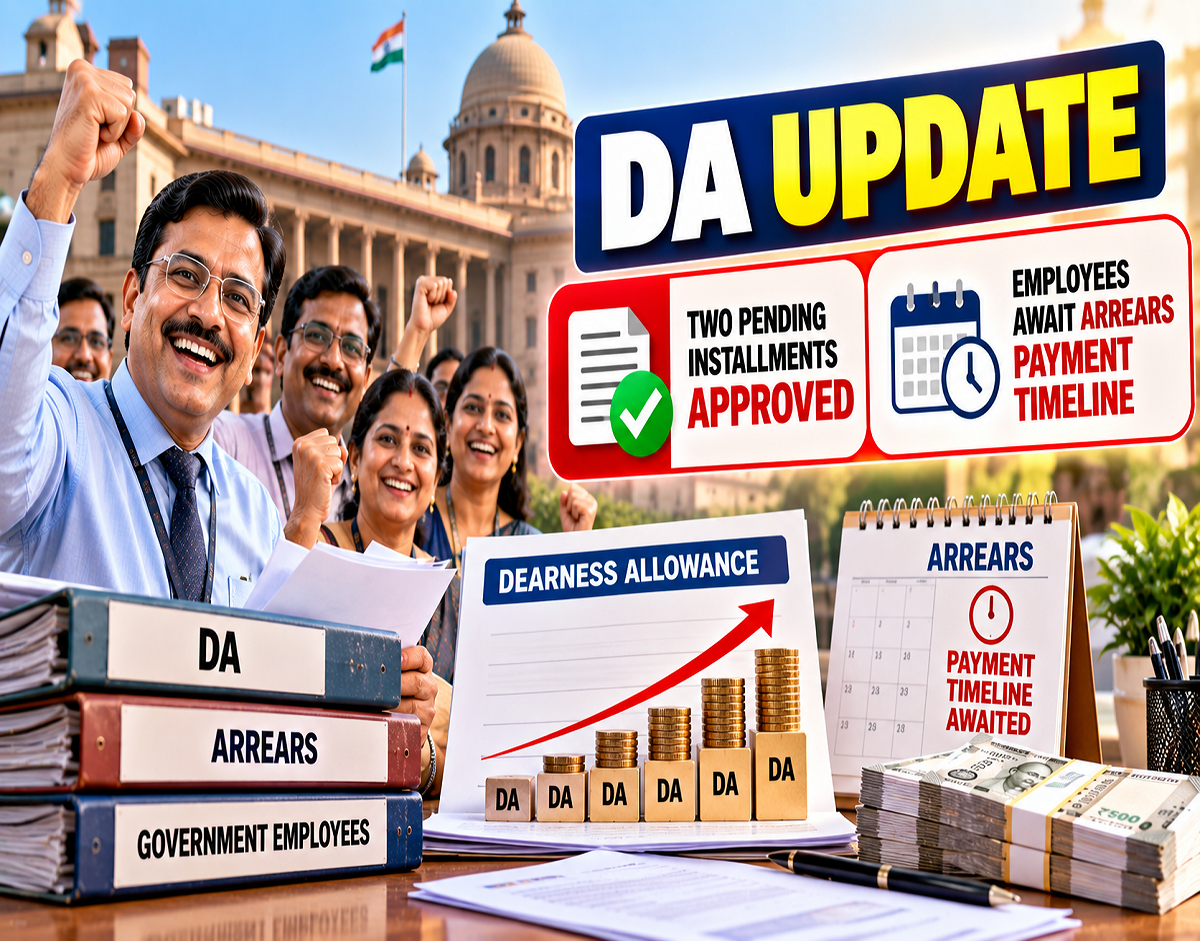
Government employees and pensioners in Telangana have received an important update regarding their pending Dearness Allowance (DA) and Dearness Relief (DR). The state government has reportedly approved the release of two pending installments, addressing a long-standing demand from employee organisations.
According to the supplied report, the decision was taken by the Telangana government led by Chief Minister Revanth Reddy and was discussed following a Cabinet meeting at the Secretariat.
The move is expected to create an additional financial burden of approximately ₹2,500 crore annually for the state government, according to figures cited in the report.
While approval for the two pending installments is significant, questions remain about when all outstanding arrears will actually reach employees and pensioners.
The report indicates that pending DA-related amounts and certain arrears from 2024 are expected to be addressed, but a complete payment schedule for all outstanding dues has not yet been specified.
Telangana Approves Two Pending DA and DR Installments
The latest decision concerns Telangana state government employees and pensioners.
According to the report, the government has cleared the release of two pending DA/DR installments.
The decision follows discussions with state employee organisations, which have been seeking settlement of pending dearness allowance dues.
DA is paid to eligible serving employees, while the corresponding inflation-related benefit provided to pensioners is generally referred to as Dearness Relief or DR.
The latest move therefore has implications for both groups, subject to the terms of the formal government orders.
What About the Pending Arrears?
Approval of a DA installment and actual payment of all accumulated arrears are not necessarily the same thing.
According to the supplied information, the state government has indicated that two pending installments and certain arrears relating to 2024 will be released.
However, the report does not provide a complete date-wise schedule for clearing every remaining outstanding amount.
Employees should therefore avoid assuming that all accumulated arrears will necessarily be credited in a single payment immediately.
The exact payment method—whether through salary, pension, installments or another mechanism—will become clearer through official government orders and departmental instructions.
Government Could Face ₹2,500 Crore Annual Financial Impact
The decision is expected to have a substantial impact on the state government's finances.
According to the report, releasing the two pending DA installments could result in an additional expenditure of approximately ₹2,500 crore annually.
This figure highlights the financial scale of DA revisions when applied across a large workforce and pensioner base.
Even a relatively small percentage-point increase in DA can translate into significant additional expenditure for a state government because it applies to eligible basic pay or pension across thousands of beneficiaries.
How Does a DA Increase Affect Salary?
DA is calculated as a percentage of the applicable basic pay.
For example, suppose an employee has basic pay of ₹40,000 and the applicable DA rate increases by 2 percentage points.
The additional monthly DA would be:
₹40,000 × 2% = ₹800
If the increase were 3 percentage points:
₹40,000 × 3% = ₹1,200
For an employee with ₹50,000 basic pay, a 2-percentage-point increase would mean an additional ₹1,000 per month, while a 3-point increase would mean ₹1,500.
These are only illustrations. The actual Telangana benefit will depend on the officially notified rates, effective dates, applicable basic pay and government order.
Why Arrears Can Become a Major Issue
When a DA revision is made effective from an earlier date but the revised amount is paid later, the difference accumulated for the intervening period can become arrears.
For example, if an employee becomes entitled to an additional ₹1,000 per month from an earlier effective date but the revised amount starts being paid six months later, the accumulated difference could amount to ₹6,000 before considering other applicable factors.
With thousands of employees and pensioners involved, clearing arrears can create a substantial one-time financial requirement for the government.
This is one reason governments may separately specify the effective date, cash-payment date and arrears-payment schedule.
Telangana Employees Should Wait for Detailed Orders
The Cabinet-level approval is an important development, but employees should look for the detailed government order before calculating their final benefit.
The order is expected to clarify important questions such as:
- Which DA/DR installments have been approved.
- The applicable revised rate.
- The date from which each installment becomes effective.
- When revised DA will appear in salary or pension.
- How outstanding arrears will be handled.
- Whether arrears will be paid together or through a phased mechanism.
Until those details are officially specified, calculations circulating on social media should be treated cautiously.
Central Government DA Is a Separate Matter
The report also discusses Dearness Allowance for central government employees, but this is completely separate from Telangana's state-government decision.
Central government DA is generally revised twice a year, with revisions linked to the January and July cycles.
According to the supplied information, the January-cycle revision had taken the central government DA rate to 60% after a 2-percentage-point increase.
Attention has consequently shifted to the next revision associated with the July cycle.
However, Telangana's decision to release pending installments has no direct bearing on the rate that the Central Government may announce.
Will Central Government DA Rise by 3% or 4%?
Reports and employee discussions cited in the source suggest that the next central DA increase could be around 3 to 4 percentage points.
This should currently be treated as an estimate or expectation, not an officially announced rate.
Until the Union Government approves and formally announces the revision, employees should not calculate their salary on the assumption that a 3% or 4% hike is guaranteed.
The final percentage, effective date and payment details will depend on the official decision.
DA Announcement Expected Around Festive Period
The supplied report suggests that employees expect an announcement around the Dussehra-Diwali period.
Again, an expected festive-season announcement should not be confused with a confirmed notification date.
Government DA decisions can be announced after the effective date because the revision is often applied retrospectively from the relevant January or July cycle.
Employees should therefore rely on the final Cabinet decision and official Finance Ministry notification for the actual rate and payment schedule.
Employee Unions Also Raise Bonus Demand
Apart from DA, employee organisations have also raised the issue of festive bonus payments.
According to the report, unions representing postal employees have urged the Central Government to announce a bonus before Durga Puja.
They have also reportedly sought an increase in the bonus calculation ceiling from ₹7,000 to ₹21,000.
This is currently a demand from employee organisations and should not be interpreted as an approved increase in the bonus ceiling.
The report states that no final Central Government announcement on this particular demand had been made at the time of publication.
DA Hike and Bonus Are Different Benefits
Employees should also distinguish between Dearness Allowance and a festival or productivity-linked bonus.
DA is an inflation-linked component calculated using the applicable basic pay and notified rate.
A bonus is governed by a separate set of eligibility conditions, calculation rules and government orders.
Therefore, an employee receiving a DA increase does not automatically become entitled to the bonus amount being demanded by unions.
Likewise, a union demand to raise the bonus ceiling to ₹21,000 does not change the existing ceiling unless the government formally approves and notifies such a revision.
Telangana DA Update: Key Details
| Particular | Current Update |
|---|---|
| State | Telangana |
| Beneficiaries | Eligible state employees and pensioners |
| Decision | Two pending DA/DR installments reportedly approved |
| Estimated annual financial impact | Around ₹2,500 crore |
| 2024 arrears | Reported to be taken up for payment |
| Complete arrears schedule | Not specified in supplied report |
| Central government DA | Separate from Telangana decision |
| Expected central DA increase | 3-4 percentage points being discussed, not officially confirmed |
| Postal bonus ceiling of ₹21,000 | Union demand, not an approved change in supplied information |
What Telangana Employees Should Check Next
For Telangana employees and pensioners, the next important development will be the detailed implementation order.
That document should provide the information needed to calculate the actual financial benefit.
Employees should particularly check the revised DA percentage, effective date, arrears period and payment schedule.
Until those details are available, estimates of the exact amount that will be credited to individual employees remain provisional.
Key Takeaway
The significant development is that the Telangana government has reportedly approved two pending installments of DA and DR, potentially providing relief to state employees and pensioners who have been waiting for their dues.
The move is estimated to add around ₹2,500 crore to the state's annual financial burden.
However, the exact timeline for clearing all remaining arrears has not been fully specified in the supplied information.
Separately, central government employees are awaiting the next DA decision. While a 3-4 percentage-point increase is being discussed, it remains an expectation until the Union Government makes an official announcement.
Similarly, the demand to increase the postal employees' bonus ceiling from ₹7,000 to ₹21,000 remains a union proposal unless formally accepted and notified by the government.