Business
DA Hike Update: 3% Increase Expected for Central Employees, Check How Much Salary Could Rise
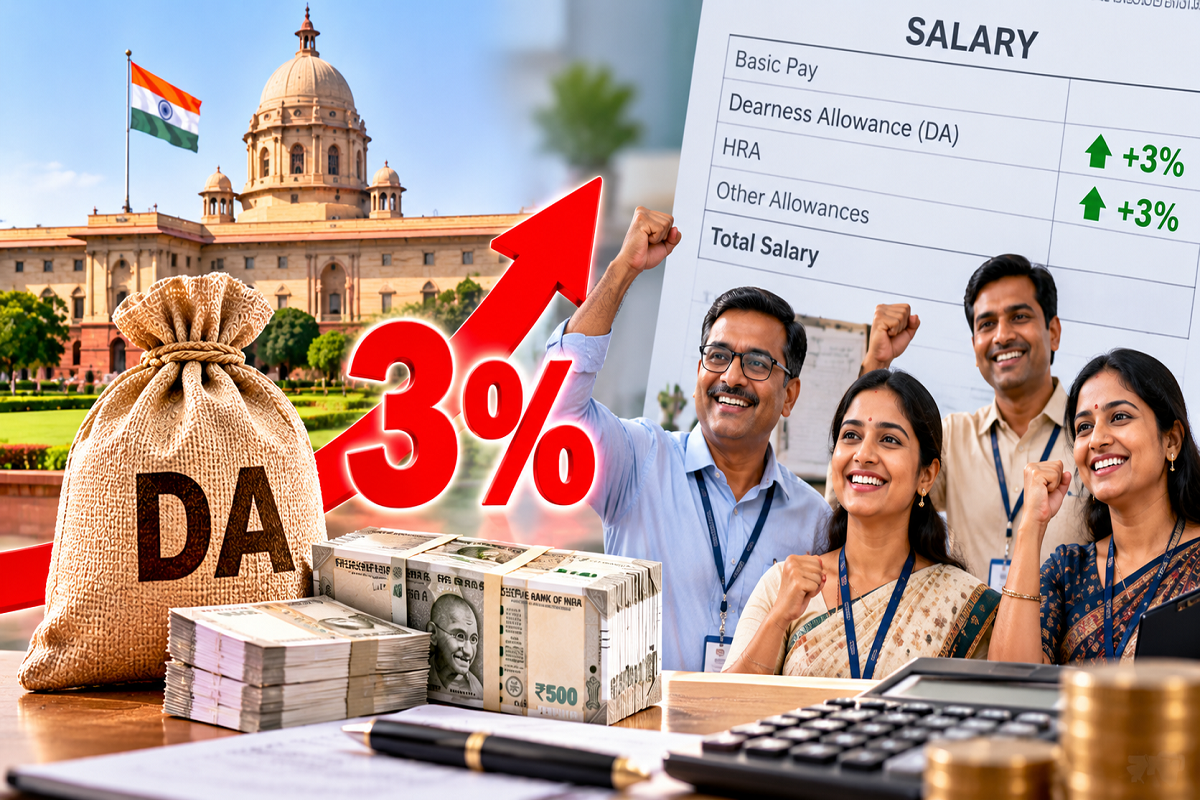
Central government employees and pensioners are awaiting an official decision on the next revision in Dearness Allowance (DA) and Dearness Relief (DR). Expectations are centred on a possible 3 percentage point increase for the July 2026 cycle, which would take the DA rate from the existing 60% to 63% of basic pay.
Attention is now on the Union Cabinet meeting scheduled for October 6. However, according to the information available in the report, it has not been officially confirmed that the DA hike proposal will be taken up or approved at this meeting.
Therefore, employees should treat the 63% figure as an expected rate based on the inflation-index calculation until the government issues a formal notification.
If approved as anticipated, the revised DA would take effect retrospectively from July 1, 2026, potentially resulting in arrears for the months between the effective date and actual payment.
Why Is a 3% DA Increase Expected?
Dearness Allowance for central government employees under the 7th Pay Commission framework is linked to inflation data represented by the All-India Consumer Price Index for Industrial Workers (CPI-IW).
The CPI-IW readings covering the relevant calculation period indicate that the July 2026 revision could take DA to approximately 63%.
According to the calculation cited in the report, the index reached 151.9 in June 2026, completing the data period required for determining the July revision.
The calculated DA reportedly comes to approximately 63.75%. Based on the applicable method cited in the report, the payable rate is expected to be 63%.
Employees are currently receiving DA at 60% of basic pay following the January 2026 revision. If the government approves 63%, the effective increase would therefore be 3 percentage points.
How Much Could Your Salary Increase With a 3% DA Hike?
DA is calculated on an employee's basic pay, rather than the entire take-home salary.
This makes the calculation relatively straightforward.
For example, an employee earning a basic salary of ₹50,000 currently receives DA at 60%, equivalent to ₹30,000.
If DA rises to 63%, the amount would become ₹31,500.
That translates into an increase of ₹1,500 per month in the DA component.
Here are a few illustrative calculations:
| Basic Pay | DA at 60% | DA at 63% | Monthly Increase |
|---|---|---|---|
| ₹18,000 | ₹10,800 | ₹11,340 | ₹540 |
| ₹25,000 | ₹15,000 | ₹15,750 | ₹750 |
| ₹30,000 | ₹18,000 | ₹18,900 | ₹900 |
| ₹40,000 | ₹24,000 | ₹25,200 | ₹1,200 |
| ₹50,000 | ₹30,000 | ₹31,500 | ₹1,500 |
| ₹60,000 | ₹36,000 | ₹37,800 | ₹1,800 |
| ₹75,000 | ₹45,000 | ₹47,250 | ₹2,250 |
| ₹1,00,000 | ₹60,000 | ₹63,000 | ₹3,000 |
These figures show the increase in the DA component only. The actual change in take-home salary may differ because of applicable deductions, taxes and other salary components.
Simple Formula to Calculate Your Expected DA Increase
Employees can estimate the additional monthly amount using a simple calculation:
Basic Pay × 3% = Expected Monthly DA Increase
For someone with basic pay of ₹30,000:
₹30,000 × 3% = ₹900
For basic pay of ₹50,000:
₹50,000 × 3% = ₹1,500
And for someone drawing ₹1 lakh as basic pay:
₹1,00,000 × 3% = ₹3,000
The same principle applies to the relevant pension component when calculating Dearness Relief, subject to applicable government rules.
Will Employees Receive Arrears From July 2026?
If the government approves the expected revision with effect from July 1, 2026, the increased DA would become payable from that effective date.
This means that if the revised amount begins to be paid later, eligible employees could receive the difference for the intervening months as arrears.
For example, if three months of arrears became payable, an employee whose DA rises by ₹1,500 per month would have an illustrative arrear difference of:
₹1,500 × 3 = ₹4,500
Similarly, someone receiving an additional ₹3,000 per month could have a three-month difference of ₹9,000.
The actual arrear amount and payment timing will depend on the government's final approval and implementation instructions.
Pensioners Could Also Benefit Through Higher DR
The revision is also important for central government pensioners because Dearness Relief is generally revised in line with the applicable DA cycle.
Therefore, if a 3 percentage point revision is formally approved, eligible pensioners could also see a corresponding increase in DR, subject to the government's notification and applicable pension rules.
As with employees, the final benefit should not be treated as confirmed until the official order is issued.
January 2027 DA Revision Already Coming Into Focus
While employees await the July 2026 revision, fresh CPI-IW readings are already contributing to the calculation cycle for the next revision.
According to the figures cited in the report, CPI-IW stood at 153.2 in July 2026 and increased further to 154.4 in August 2026.
These readings do not change the calculation for the July 2026 DA cycle. Instead, they will form part of the data used for determining the next DA revision from January 2027.
More CPI-IW readings will be required before the next revision can be calculated with greater clarity.
Official Government Announcement Remains Crucial
The expected increase from 60% to 63% would provide a noticeable boost to the DA component of central government employees' salaries and the DR component for eligible pensioners.
For a ₹50,000 basic salary, the illustrative monthly increase would be ₹1,500, while an employee with ₹1 lakh basic pay would see a ₹3,000 increase in DA if the expected 3% revision is approved.
However, the key distinction remains important: the 3% DA hike and the 63% rate have not yet been formally approved in the information provided as of October 6, 2026.
Employees and pensioners should therefore wait for the Union Cabinet's decision and the subsequent official government notification before treating the revised rate, arrears or payment date as final.