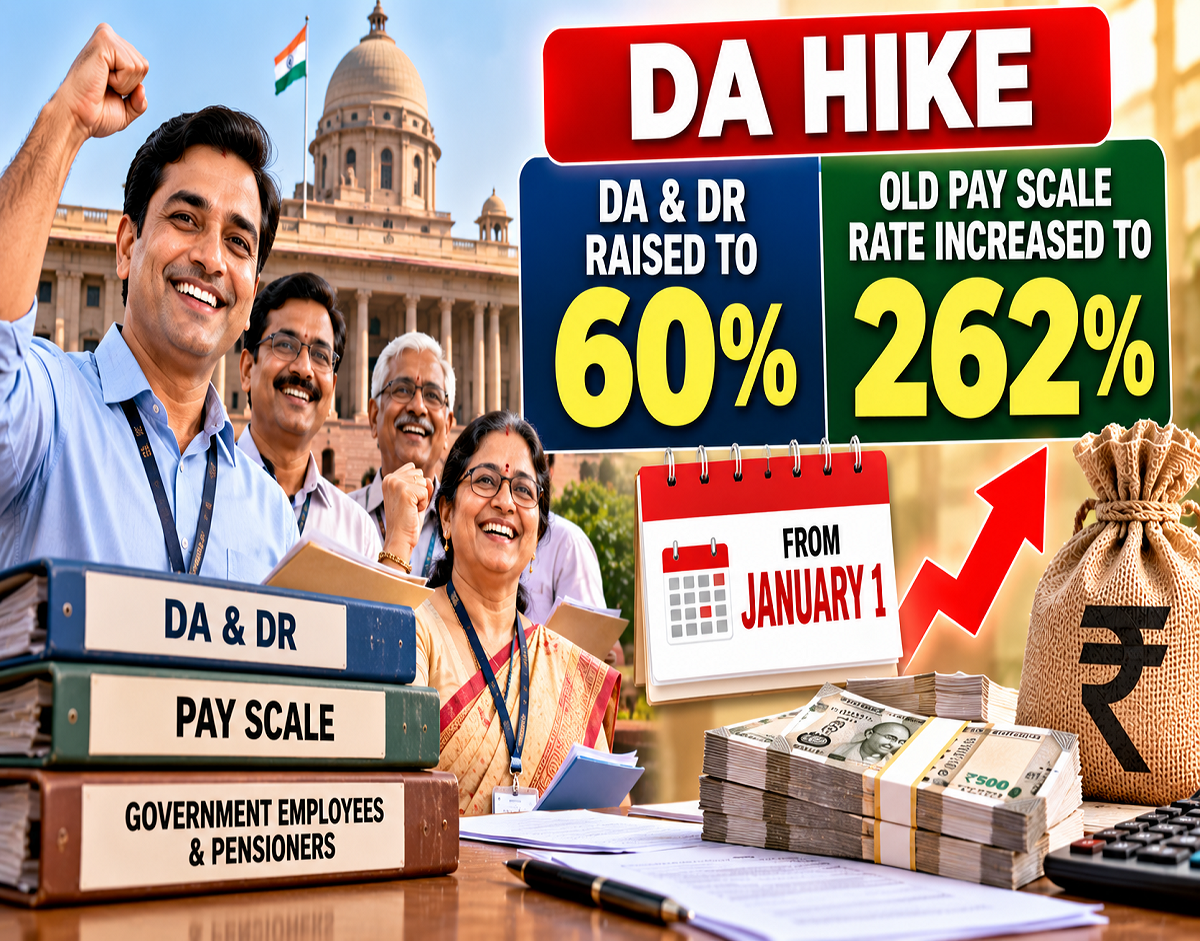
Government employees and pensioners in Sikkim have received an important Dearness Allowance (DA) and Dearness Relief (DR) update. The Sikkim government has revised the applicable rates for employees and pensioners covered under different pay structures, with the changes taking effect from January 1.
According to the Finance Department circular cited in the report, employees and pensioners drawing salary or pension under the revised basic-pay structure will see their DA/DR rate rise from 58% to 60%.
At the same time, those covered under the applicable pre-revised pay structure will see the rate move from 257% to 262%.
This means the increase is not uniformly 5% for every employee. The old or pre-revised structure receives a 5-percentage-point increase, while the revised structure receives a 2-percentage-point increase.
Around 50,000 employees are expected to benefit from the state government's decision, according to the supplied information.
Sikkim DA Hike: What Has Changed?
The government has announced separate rates because employees and pensioners can be covered by different pay structures.
For those receiving salary or pension based on the revised basic-pay framework, DA and DR have increased by 2 percentage points.
The rate has moved:
58% → 60%
For eligible employees and pensioners receiving pay under the pre-revised structure, the increase is larger in percentage-point terms:
257% → 262%
This represents a rise of 5 percentage points.
Both revisions are stated to be effective from January 1.
DA Hike at a Glance
| Category | Previous Rate | New Rate | Increase |
|---|---|---|---|
| Revised basic pay structure | 58% | 60% | 2 percentage points |
| Pre-revised basic pay structure | 257% | 262% | 5 percentage points |
| Eligible AIS officers under revised structure | 58% | 60% | 2 percentage points |
| Eligible AIS officers under old structure | 257% | 262% | 5 percentage points |
Employees should identify the pay structure applicable to them before calculating their expected benefit.
Don't Confuse a 5-Percentage-Point DA Hike With a 5% Salary Increase
This distinction is important.
An increase in DA from 257% to 262% does not mean an employee's total salary increases by 5%.
It means that the DA rate calculated on the applicable basic pay has risen by five percentage points.
Similarly, an increase from 58% to 60% means the DA component rises by two percentage points of the applicable basic pay.
The actual increase in rupees will therefore depend on an employee's basic pay and the pay structure under which the person is covered.
How Much More Will Employees Under the 60% Rate Receive?
Suppose an employee has an applicable basic pay of ₹40,000.
At the earlier DA rate of 58%:
₹40,000 × 58% = ₹23,200
At the revised rate of 60%:
₹40,000 × 60% = ₹24,000
The additional DA would therefore be:
₹24,000 - ₹23,200 = ₹800 per month
For a basic pay of ₹50,000, the difference would be ₹1,000 per month.
Here are some illustrative calculations:
| Basic Pay | DA at 58% | DA at 60% | Increase Per Month |
|---|---|---|---|
| ₹20,000 | ₹11,600 | ₹12,000 | ₹400 |
| ₹30,000 | ₹17,400 | ₹18,000 | ₹600 |
| ₹40,000 | ₹23,200 | ₹24,000 | ₹800 |
| ₹50,000 | ₹29,000 | ₹30,000 | ₹1,000 |
| ₹60,000 | ₹34,800 | ₹36,000 | ₹1,200 |
These figures are illustrations based purely on the percentage difference. Actual payments will depend on the applicable government rules and the employee's eligible basic pay.
How Does the 257% to 262% Increase Work?
Employees covered by the pre-revised basic-pay structure have a much higher DA percentage because the underlying basic-pay framework is different.
Suppose, purely for illustration, an eligible employee's applicable pre-revised basic pay is ₹20,000.
At 257%, DA would be:
₹20,000 × 257% = ₹51,400
At 262%, it would become:
₹20,000 × 262% = ₹52,400
The difference would be ₹1,000 per month.
Again, this does not mean employees under the old pay scale are automatically receiving a larger overall benefit than employees under the revised structure. The basic-pay systems are different, so headline DA percentages should not be compared without considering the underlying pay base.
Pensioners Will Receive Higher DR
The revision also applies to eligible pensioners through Dearness Relief.
DA is generally associated with serving employees, while DR provides corresponding inflation-related relief to eligible pensioners.
A pensioner's actual increase will depend on the eligible basic pension used for calculating DR.
For instance, where a pensioner is covered by a 58%-to-60% revision and has an eligible basic pension of ₹30,000, the illustrative increase would be:
₹30,000 × 2% = ₹600 per month
The final amount remains subject to the applicable pension rules.
Contractual and Work-Charged Employees Also Covered
The decision is not restricted only to regular government employees.
According to the supplied information, eligible contractual employees and work-charged establishment employees receiving revised salaries under pay scales applicable to regular state-government employees will also receive the benefit under the applicable provisions.
However, eligibility depends on the employee's service and pay conditions.
Contract workers should therefore check whether their appointment and salary structure fall within the categories specified in the government circular.
All India Services Officers Get Revised DA
The revised rates also cover eligible All India Services officers serving in Sikkim, according to the report.
For those covered under the relevant old pay structure, the cited DA rate rises from 257% to 262%.
For those covered under the applicable revised pay structure, the rate increases from 58% to 60%.
The applicable rate will depend on the officer's pay framework.
Government Explains Rounding-Off Rule
The circular also specifies how fractions arising during DA or DR calculations will be treated.
According to the supplied information, where the calculated amount contains a fraction of 50 paise or more, it will be rounded up to the next whole rupee.
A fraction below 50 paise will be ignored or rounded down according to the prescribed rule.
For example, if the calculated amount is ₹1,250.60, it would be rounded to ₹1,251. If the amount is ₹1,250.40, it would be treated as ₹1,250.
This prevents small fractions from complicating monthly salary and pension calculations.
Around 50,000 Employees Expected to Benefit
The report estimates that approximately 50,000 employees could benefit from the government's DA decision.
Pensioners covered by the corresponding DR revision will also receive the applicable increase.
Because the rates take effect from January 1, the effective date is particularly important when determining the amount payable under the government order.
Employees should check their salary statements and official departmental communication for details of revised payments and any applicable arrears.
Why Governments Revise DA and DR
Dearness Allowance and Dearness Relief are intended to help compensate employees and pensioners for the impact of inflation.
As prices of everyday goods and services rise, purchasing power can decline.
Periodic DA and DR revisions provide inflation-linked relief to eligible government employees and pensioners under the applicable pay framework.
The rate is calculated as a percentage of the relevant basic pay or pension rather than as a percentage increase in the employee's entire salary package.
What Sikkim Employees and Pensioners Should Check
Employees should first determine whether they fall under the revised or pre-revised pay structure.
That distinction determines which rate applies.
Those covered by the revised structure move from 58% to 60%, representing a 2-percentage-point increase.
Those covered by the relevant pre-revised structure move from 257% to 262%, representing a 5-percentage-point increase.
Eligible pensioners receive corresponding DR revisions, while covered contractual, work-charged and All India Services personnel may also benefit according to the applicable provisions.
The key takeaway is that the headline “5% DA hike” applies specifically to the cited old-pay structure. It should not be interpreted as a 5% DA increase for every Sikkim government employee or pensioner.