Business
Central Government Staff Car Rules 2026: EV Price Limit Raised to ₹20 Lakh, Petrol-Diesel Cars Capped at ₹10 Lakh
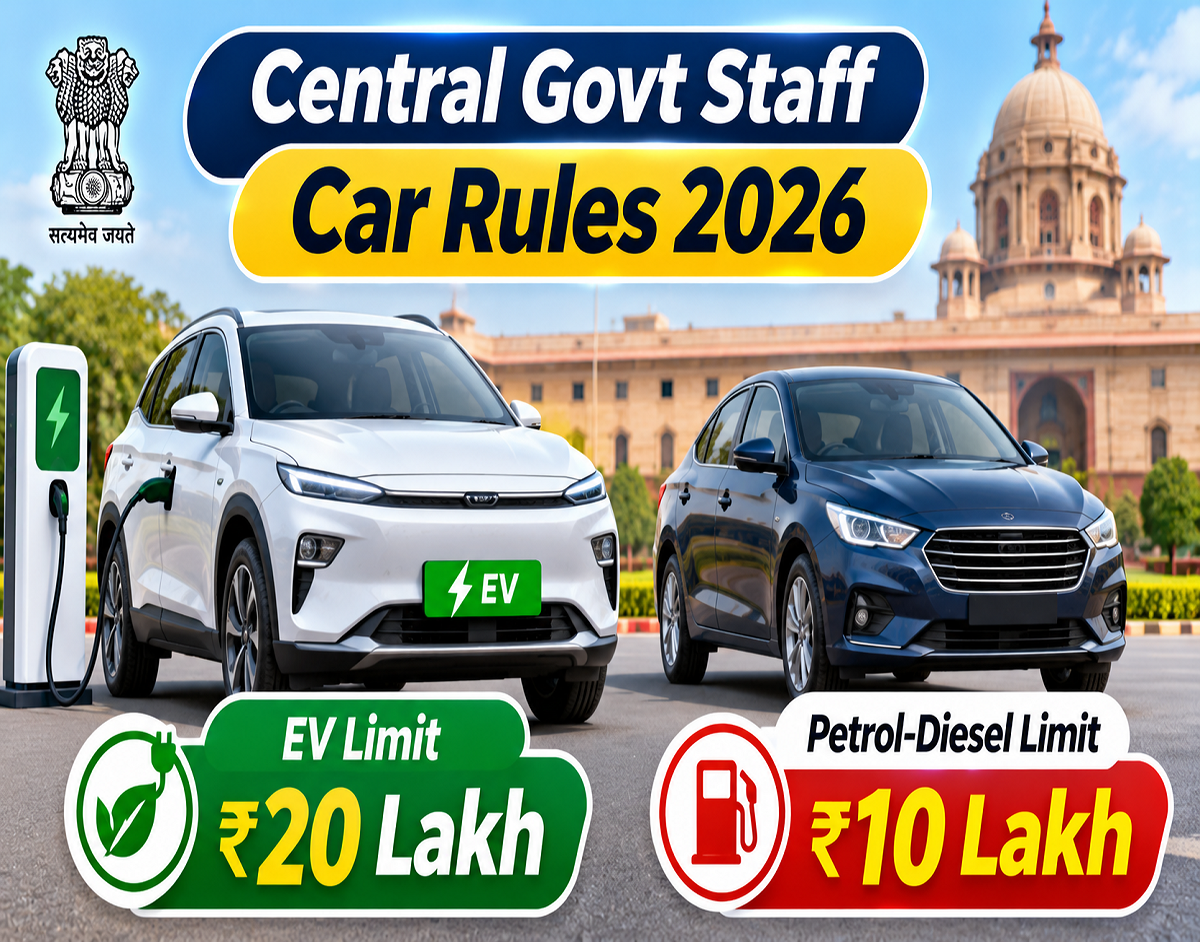
Central Government Staff Car Rules 2026: The Union Finance Ministry has introduced revised guidelines for purchasing and hiring official staff cars across Central Government ministries and departments. Under the new rules, electric vehicles (EVs) will receive preference over petrol, diesel and hybrid vehicles, with a higher procurement price ceiling of ₹20 lakh.
The Department of Expenditure issued an Office Memorandum on November 10, 2026, revising the existing vehicle procurement framework.
According to the memorandum, the Net Dealer Price (NDP) ceiling for electric staff cars is ₹20 lakh, while petrol, diesel and hybrid vehicles have a separate ceiling of ₹10 lakh.
The revised instructions came into effect immediately and are intended to encourage electric mobility, reduce dependence on fossil fuels and account for vehicle costs over their operating lives. <Cite refs={["turn420181search15","turn420181news6"]}/>
Central Government Staff Car Rules 2026: Key Highlights
| Particulars | Revised Rules |
|---|---|
| Issuing Ministry | Ministry of Finance |
| Department | Department of Expenditure |
| Notification Date | November 10, 2026 |
| Electric Vehicle Price Ceiling | ₹20 Lakh |
| Petrol Car Price Ceiling | ₹10 Lakh |
| Diesel Car Price Ceiling | ₹10 Lakh |
| Hybrid Car Price Ceiling | ₹10 Lakh |
| Preferred Vehicle Category | Electric Vehicles |
| Conventional Vehicle Purchase | Permitted With Special Approval |
| Effective Date | November 10, 2026 |
| Applicable Offices | Central Government Ministries and Departments |
The new limits apply to the specified Net Dealer Price used for government procurement. They should not be confused with a universal on-road price limit for private buyers.
Electric Vehicles Become the Preferred Choice
One of the most significant changes is the government's decision to prioritize electric vehicles when replacing existing staff cars.
Under the revised instructions, ministries and departments should ordinarily procure EVs when their existing petrol, diesel or other conventional staff cars are condemned or due for replacement.
This means departments planning to replace an ageing official vehicle are expected to consider an electric model as the normal procurement option.
The policy does not require every existing petrol or diesel staff car to be replaced immediately.
Instead, it establishes a preference for EVs during future procurement and replacement decisions.
The change is intended to gradually increase the share of electric vehicles in the Central Government's official fleet.
Why Has the EV Price Ceiling Been Increased to ₹20 Lakh?
The Finance Ministry has revised the procurement limits after considering prevailing vehicle prices and lifecycle costs.
Electric vehicles can have different upfront purchase costs compared with conventional vehicles.
Their operating expenses also depend on factors such as electricity tariffs, charging arrangements, maintenance requirements and vehicle usage.
By increasing the EV procurement ceiling, the government has provided departments with a broader price range when selecting eligible electric staff cars.
The revised ceiling is twice the ₹10 lakh limit applicable to conventional vehicles.
However, the higher limit does not mean that every department must purchase an EV costing ₹20 lakh.
Vehicle procurement must still follow applicable financial rules, approvals and purchasing procedures.
Petrol, Diesel and Hybrid Cars: What Has Changed?
The new rules retain a separate procurement category for internal combustion engine vehicles.
This category includes petrol, diesel and hybrid vehicles.
Their Net Dealer Price ceiling has been fixed at ₹10 lakh.
However, the most important change is not simply the price limit.
Government departments must now provide a specific justification if they consider an electric vehicle impractical and want to purchase a conventional model instead.
Such proposals require additional administrative and financial scrutiny.
Therefore, conventional vehicles remain permissible in exceptional circumstances rather than being the default option.
Can Government Departments Still Buy Petrol or Diesel Cars?
Yes. The revised policy does not impose an absolute prohibition on petrol, diesel or hybrid staff cars.
A ministry or department may seek permission to purchase a conventional vehicle if an EV is considered unsuitable for its operational requirements.
However, the department must submit a properly justified proposal to the Department of Expenditure.
The proposal must have the approval of the Secretary of the concerned administrative ministry or department and the concurrence of its Financial Adviser.
The Department of Expenditure will consider relaxation requests individually.
This arrangement allows departments to explain operational difficulties while maintaining the government's overall preference for electric mobility. <Cite refs={["turn420181search12","turn420181news3"]}/>
What About Government Departments Hiring Cars?
The Finance Ministry has also addressed the hiring of official vehicles.
The existing instructions issued on September 1, 2022, requiring ministries and departments to hire electric vehicles will continue to apply.
Departments seeking to hire conventional vehicles must follow a similar approval process.
They must provide justification and obtain the necessary administrative and financial clearances before requesting relaxation from the Department of Expenditure.
This means the EV preference applies not only to vehicle purchases but also to the hiring arrangements covered by the guidelines.
What Is the Net Dealer Price?
Net Dealer Price, or NDP, is the price measure specified in the government's vehicle procurement rules.
The Finance Ministry's new memorandum uses NDP to establish the maximum permitted price for each vehicle category.
It is important to distinguish this from the final on-road cost displayed to individual car buyers.
On-road prices can include additional components such as registration, insurance and other applicable charges.
The new memorandum specifies the NDP ceilings but does not independently redefine every component of vehicle procurement expenditure.
Government offices must follow the applicable procurement rules when calculating and approving vehicle purchases.
Will Central Government Employees Receive New Cars?
The revised guidelines do not announce a new personal vehicle benefit for all Central Government employees.
They concern the procurement and hiring of official staff cars by ministries and departments.
The rules do not automatically entitle every employee to an official car.
Existing provisions governing staff car entitlement remain unchanged.
Similarly, the announcement does not provide a personal car purchase allowance or subsidy to government employees.
It primarily changes the type of vehicle departments should prefer and the applicable procurement price limits.
What Happens to Existing Government Petrol and Diesel Cars?
The new guidelines focus on future procurement and the replacement of existing vehicles.
They do not direct departments to immediately remove every conventional vehicle from service.
Existing staff cars may continue to be used according to the applicable rules governing their operation and replacement.
When a vehicle becomes due for replacement, the department should ordinarily select an EV.
The pace of transition will therefore depend on procurement requirements, vehicle replacement schedules and operational considerations.
Why Is the Government Promoting Electric Vehicles?
The Finance Ministry has identified several objectives behind the revised instructions.
Reducing Fossil Fuel Dependence
Electric vehicles do not require petrol or diesel for propulsion.
Greater EV adoption can help reduce direct dependence on conventional transport fuels.
Encouraging Electric Mobility
Government procurement can contribute to demand for electric vehicles and associated services.
Considering Long-Term Operating Costs
Vehicle costs extend beyond the initial purchase price.
Electricity consumption, maintenance, usage patterns and other expenses can influence the total cost of operating a vehicle.
Supporting Cleaner Transportation
Electric vehicles produce no tailpipe emissions during operation.
Their overall environmental impact also depends on electricity generation, manufacturing and vehicle lifecycle factors.
The revised procurement policy is one part of the government's broader efforts to promote electric mobility.
Will the New Rules Benefit India's EV Industry?
The policy could create additional opportunities for electric vehicle manufacturers and fleet service providers supplying government departments.
A higher procurement ceiling may allow departments to consider a wider range of eligible electric cars.
However, the actual impact will depend on the number of vehicles purchased, departmental budgets, procurement decisions and available models.
The memorandum does not specify a nationwide target for the number of electric staff cars to be purchased.
Therefore, any claim about guaranteed vehicle sales or a fixed increase in EV demand would be premature.
What Are the Challenges in Switching to EVs?
Although electric vehicles offer certain operational advantages, departments may need to consider practical requirements.
Charging infrastructure is an important factor, particularly for offices with frequent vehicle usage.
Driving range, availability of charging points, maintenance support and the nature of official travel may also affect vehicle selection.
These requirements can differ between metropolitan offices and departments operating in remote locations.
The revised guidelines recognize that an EV may not be practical in every situation.
That is why a case-by-case relaxation mechanism has been retained for conventional vehicles.
Are Other Government Staff Car Rules Changing?
The November 10 memorandum partially modifies the earlier instructions issued on September 1, 2022.
It does not replace the entire framework governing official staff cars.
Other provisions concerning entitlement, procurement and hiring remain unchanged.
The Finance Ministry has also clarified that procurement will continue to be governed by the General Financial Rules, 2017, as amended from time to time. <Cite refs={["turn420181search9","turn420181search11"]}/>
Central Government Staff Car Rules 2026: Latest Update
The Finance Ministry's revised staff car guidelines establish electric vehicles as the preferred option for Central Government ministries and departments.
The new Net Dealer Price ceiling is ₹20 lakh for EVs and ₹10 lakh for petrol, diesel and hybrid vehicles.
Departments replacing conventional staff cars should ordinarily purchase electric models.
Conventional vehicles can still be procured or hired where justified, but the department must obtain the prescribed approvals.
The instructions took effect on November 10, 2026, and mark a change in the government's official vehicle procurement policy.
Source Credit: Government of India, Ministry of Finance, Department of Expenditure, Office Memorandum F. No. 16(17)/E.Coord/2025, dated November 10, 2026.
Official Reference: Department of Expenditure
Memorandum Copy: Staff Car Procurement and Hiring Guidelines, November 10, 2026
Disclaimer: This article explains the revised Central Government staff car procurement guidelines. The stated price ceilings refer to official vehicle procurement and do not constitute personal vehicle purchase benefits for government employees. Departments must comply with the applicable financial and administrative rules.