Technology
Bank Fraud Alert 2026: Money Missing From Your Account at Midnight? Report It Immediately Using These Steps
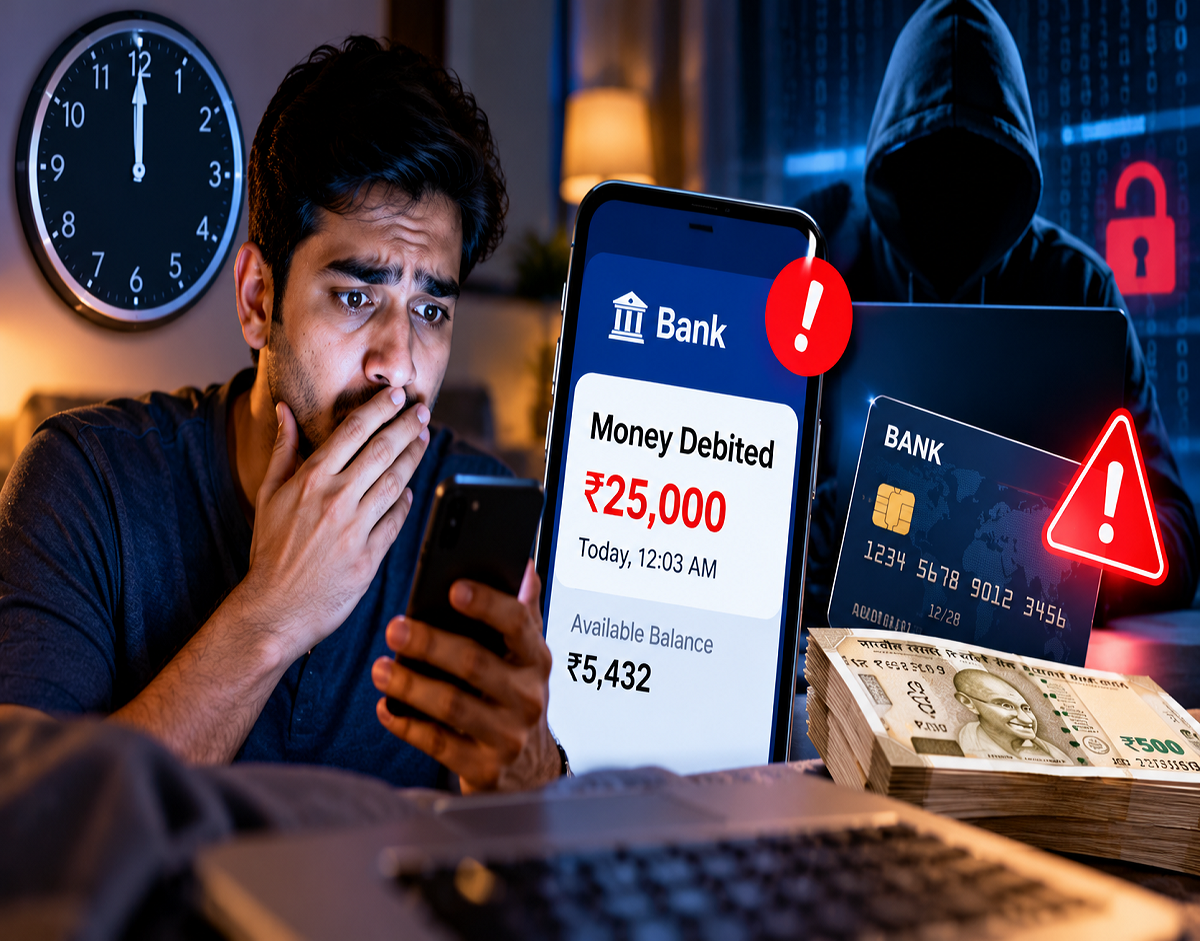
Bank Fraud Complaint 2026: Imagine receiving a message at 1 AM informing you that ₹40,000 has been transferred from your bank account. You have not authorised any payment, yet when you open your banking application, the money is already missing.
Your bank branch is closed, and you are unsure whether customer support will answer at such a late hour. Should you wait until the next morning to report the transaction?
The answer is no.
If money disappears from your bank account without your permission, reporting the incident immediately can help protect your remaining funds and improve the chances of recovering the stolen amount.
Under the Reserve Bank of India's (RBI) customer protection framework, banks must provide customers with round-the-clock channels to report unauthorised electronic banking transactions.
Customers can also report suspected financial cybercrime through India's national cybercrime helpline, 1930, without waiting for their bank branch to open.
Here is what you should do if money is stolen from your bank account during the night, on a Sunday or during a bank holiday.
Money Debited Without Permission? Take These Steps Immediately
If you notice an unfamiliar transaction, acting quickly is more important than waiting for regular banking hours.
Emergency Bank Fraud Action Checklist
Contact your bank using its official 24-hour fraud reporting channel.
Ask the bank to block the affected card, UPI access or payment facility as necessary.
Call the national cybercrime helpline at 1930.
Report the incident at cybercrime.gov.in.
Save the transaction ID, complaint number, alerts and screenshots.
0 of 5 steps completedReset
These actions can be taken even when your local bank branch is closed.
Step 1: Contact Your Bank's Official Customer Support Immediately
The first step is to notify your bank about the unauthorised transaction.
Most banks provide dedicated channels for reporting suspicious payments, card misuse and account-related fraud.
You can find the bank's official contact information through its website, mobile application or other verified banking documents.
When speaking to customer support, explain that money has been transferred or withdrawn without your authorisation.
Provide the transaction amount, approximate time and available transaction details.
Ask the bank to register your complaint and issue a reference or acknowledgement number.
Keep this number safe because it may be required for follow-up communication, investigation and any subsequent dispute.
Avoid calling telephone numbers received through suspicious SMS messages, social media advertisements or unknown websites.
Fraudsters sometimes publish fake customer support numbers to steal additional banking information.
Step 2: Block the Affected Banking Facility to Prevent Further Losses
Reporting the transaction is important, but protecting the remaining balance is equally necessary.
If someone has gained unauthorised access to your account or payment credentials, they may attempt additional transactions.
Ask your bank whether the affected card, payment channel or account access should be temporarily blocked.
Depending on your bank's available features, you may be able to take certain actions directly through its mobile application.
For example, many banking applications allow customers to temporarily disable debit cards or restrict specific transaction types.
If your UPI credentials may have been compromised, inform the bank and ask about the appropriate protective measures.
You should not wait for the fraud investigation to finish before taking reasonable steps to secure your account.
Step 3: Call 1930 to Report Financial Cybercrime
National Cybercrime Helpline
1930
Copy number
Report suspected financial cybercrime as soon as possible, particularly when money has been transferred to another account.
In addition to informing your bank, customers in India can report financial cybercrime through the national helpline number 1930.
This reporting mechanism is intended to support a coordinated response to online financial fraud.
Early reporting may help authorities and participating financial institutions identify and restrict suspected fraudulent fund movements.
However, reporting a case quickly does not guarantee that the entire amount will be recovered.
The outcome depends on factors such as how the fraud occurred, how quickly the transaction was reported and whether the funds can still be traced or restricted.
Step 4: File a Complaint on the National Cybercrime Reporting Portal
Customers can also report suspected financial cybercrime through the government's National Cyber Crime Reporting Portal.
The official website is cybercrime.gov.in.
The portal provides a channel for submitting complaints about online financial fraud and other cybercrime incidents.
When filing a complaint, keep the relevant information ready.
| Information Required | Why It Matters |
|---|---|
| Transaction ID | Helps identify the disputed payment |
| Transaction Amount | Records the amount involved |
| Date and Time | Establishes when the transaction occurred |
| Bank Name | Identifies the affected financial institution |
| SMS or Email Alerts | Provides supporting transaction evidence |
| Bank Complaint Number | Helps connect the bank report with the cybercrime complaint |
| Relevant Screenshots | May support investigation and verification |
Customers should submit accurate information and retain the complaint acknowledgement for future reference.
What If Money Was Stolen Through UPI?
UPI fraud can occur through several methods, including phishing, impersonation, fraudulent payment requests and unauthorised access to payment credentials.
If you notice an unfamiliar UPI transaction, report it immediately to your bank and through the appropriate cybercrime reporting channel.
You may also be able to raise a dispute through the UPI application used for the transaction.
However, the payment application's complaint process should not replace notifying your bank when an unauthorised transaction has occurred.
It is also important to understand that entering a UPI PIN generally authorises a payment from your account.
You do not need to enter your UPI PIN merely to receive money.
Be cautious of anyone claiming that a PIN, OTP or screen-sharing application is required to process a refund.
RBI Rules: Will the Bank Refund Money Lost to Fraud?
The RBI's customer protection framework provides different levels of liability depending on the circumstances of an unauthorised electronic banking transaction.
One important factor is whether the loss occurred because of the bank, a third party or the customer's own actions.
The time taken to report the incident also matters.
When Can Customer Liability Be Zero?
Under the RBI framework, a customer generally has zero liability when an unauthorised transaction occurs because of contributory fraud, negligence or deficiency on the bank's part.
Zero liability can also apply to certain third-party breaches where neither the bank nor the customer is responsible, provided the customer reports the unauthorised transaction within three working days of receiving the bank's communication.
The three-working-day condition is especially important in cases involving third-party breaches.
What Happens If the Customer Reports Late?
For eligible third-party breaches, reporting within four to seven working days can result in limited customer liability under the RBI framework.
Reporting after seven working days is subject to the bank's board-approved policy.
The applicable liability can depend on the account category and the circumstances of the transaction.
Therefore, customers should report suspicious transactions immediately rather than relying on the maximum reporting window.
What If the Customer Shared an OTP or UPI PIN?
Cases involving customer negligence are treated differently.
For example, if a person is tricked into sharing an OTP, password or UPI PIN, the bank may examine whether the loss resulted from the customer's actions.
Under the RBI framework, where the loss is due to customer negligence, the customer may bear the loss until the unauthorised transaction is reported to the bank.
Any further unauthorised loss occurring after the bank has been notified is generally borne by the bank under the applicable framework.
However, liability is determined according to the facts and governing rules, and not every fraud dispute has the same outcome.
This is another reason why reporting the incident immediately is essential.
What If the Bank's Helpline Does Not Answer at Night?
If you cannot reach your bank through one reporting channel, try another official option.
Some banks provide fraud-reporting features through their mobile banking applications or internet banking platforms.
Others may offer designated SMS or card-blocking services.
If available, use the bank's self-service options to secure the affected payment facility.
Keep screenshots of any complaint submission, failed contact attempts or acknowledgement messages.
You should also report the incident through 1930 and the cybercrime portal rather than waiting for the branch to open.
Continue attempting to contact the bank through verified channels and maintain a record of the actions you take.
What Should You Do the Next Morning?
After submitting an initial complaint, check whether your bank has acknowledged it.
Ask whether additional documentation is required and whether you need to visit a branch.
Keep all transaction alerts, complaint numbers and relevant correspondence together.
If the bank asks for supporting documents, submit them through an official channel.
You should also monitor your account for further suspicious activity.
If necessary, change compromised credentials using the bank's legitimate security procedures.
Do not trust anyone promising immediate recovery of stolen money in exchange for an advance payment.
Such offers can be another form of financial fraud.
Can You Escalate the Complaint If the Bank Does Not Resolve It?
If the bank does not resolve the complaint satisfactorily, customers may be able to escalate the matter through the RBI's Integrated Ombudsman Scheme.
Generally, customers must first complain to the regulated entity.
If the bank rejects the complaint, provides an unsatisfactory response or fails to respond within 30 days, the customer may be eligible to approach the RBI Ombudsman, subject to the scheme's conditions.
The RBI's official complaint management portal is cms.rbi.org.in.
Customers should retain their original bank complaint reference and supporting documents before escalating the matter.
Bank Fraud Alert 2026: Why Immediate Reporting Matters
A fraudulent transaction can happen at any time, including late at night, during a weekend or on a public holiday.
Although physical bank branches operate during fixed business hours, customers have access to reporting channels outside those hours.
If money disappears from your account without authorisation, do not wait until morning. Contact your bank immediately, secure the affected payment facility and report suspected cybercrime through 1930 or the official government portal.
Prompt action can reduce the risk of further losses and may improve the chances of recovering funds.
It can also be important when determining customer liability under RBI rules.
Disclaimer: This article provides general information about reporting unauthorised banking transactions in India. Refund eligibility, customer liability and complaint resolution depend on the circumstances of each case and the applicable RBI directions and bank policies. Reporting fraud does not guarantee recovery of funds.